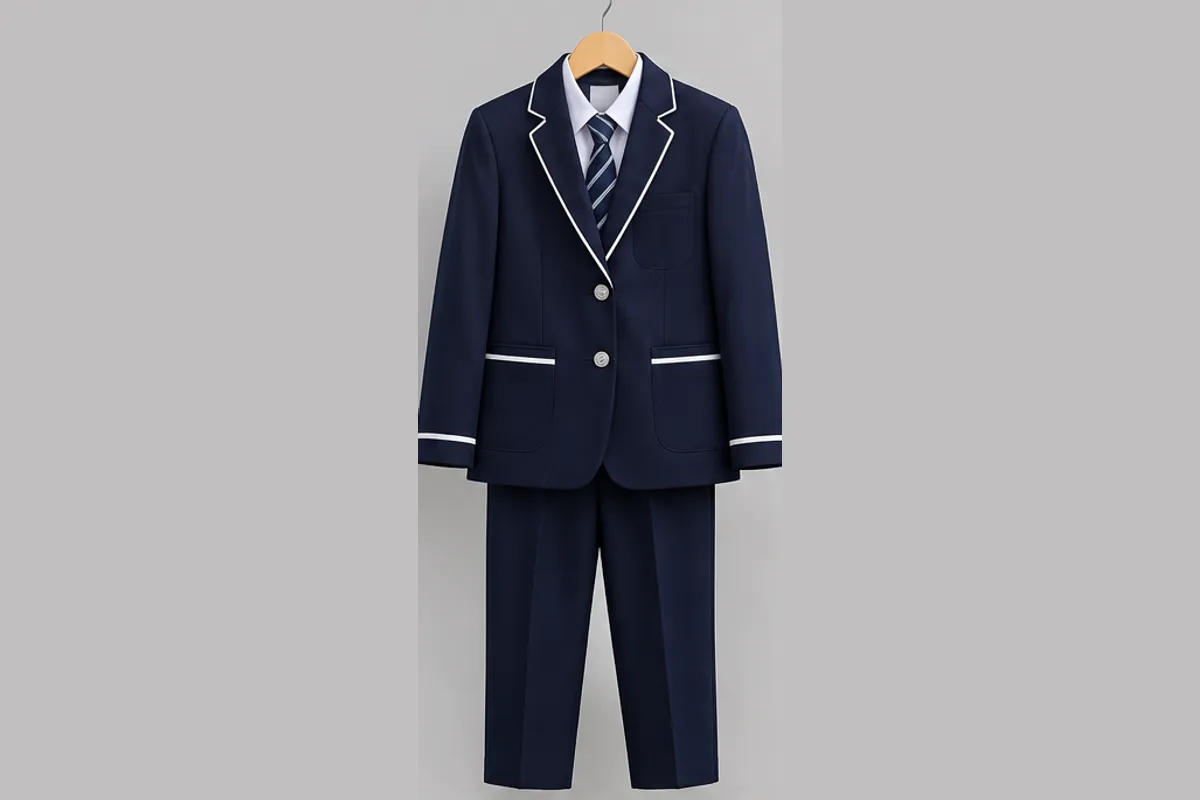
A blazer back vent is a vertical opening at the lower back of the blazer that lets the hem spread when the wearer sits, bends or puts hands in pockets. School blazers use a single centre vent, double side vents, or no vent at all. A single vent is the most common on school blazers; double vents give a more tailored hang; no vent keeps a clean back and is simplest to make and alter.
The vent is easy to forget on a specification, yet it changes how the blazer behaves through a school day of sitting at desks, running for buses and carrying rucksacks.
The three vent options defined
Single vent. One opening up the centre back seam. It is the traditional school and sports-jacket style.
Double vent. Two openings, one at each side of the back. Each panel moves independently, so the blazer drapes smoothly when the wearer sits or reaches into a pocket.
No vent (ventless). A closed back. The blazer has a clean line but can ride up and crease across the seat when the wearer sits.
How do they compare on a school blazer?
| Point | Single vent | Double vent | No vent |
|---|---|---|---|
| Ease when sitting | Good | Very good | Hem bunches |
| Look from behind | Traditional | Tailored | Clean, simple |
| Behaviour with a rucksack | Can gape open | Panels may flip up | Stays closed |
| Wear points | Top of the vent | Top of each vent | Lower back creasing |
| Alteration of length | Moderate | More work | Easiest |
| Suits | Most school blazers | Senior or formal styles | Junior blazers, girls’ cuts |
A single vent suits most uniforms, especially boys’ cuts that cover the seat. Shorter girls’ blazers, which sit at the hip, often do not need a vent, because the hem clears the seat when sitting.
Construction details that make a vent last
Vents fail in a predictable place: the top, where the two edges of the opening meet the closed seam. Daily stress from sitting can tear the stitching there. Look for these points on the sample:
- the top of the vent reinforced with a bar tack or stay stitching
- an overlap deep enough that the vent stays closed when standing
- the vent hanging straight, not twisting outwards
- the lining finished neatly round the vent, if the blazer is lined
- the hem level across the vent when the blazer is on a hanger
On a half-lined blazer, the inside of the vent is visible, so the edge finish should be tidy. Blazers can be lined or half-lined, as specified, and the vent finish is shown on the sample in either case.
Does cloth choice affect the vent?
It does, slightly. A softer poly-viscose cloth drapes and lets a vent close neatly. A firmer polyester holds its shape and can make a vent stand open if the overlap is short. The vent depth and overlap are adjusted to suit the cloth when the pattern is set. Our fabrics and colour matching page describes how the two cloths compare in drape and handle.
Which vent for which age?
For younger students, simplicity often wins. A single vent or no vent is easy to wear and easy to alter as children grow. For senior students, many schools choose a single vent, with double vents kept for a formal or senior style. Whatever you choose, keep it consistent within a cut, so blazers on the same rail look alike.
Pressing guidance shops can pass on is simple: press the vent closed from the inside, with the overlap lying flat, and avoid pressing a sharp crease along the vent edge, which can leave a shine.
When you send your blazer specification, include the vent choice for each cut. We quote school blazers by fabric, quantity and branding, and the vent is made and reinforced as agreed on the sample.
Questions buyers ask
Why does our single vent keep flapping open?
The overlap may be too narrow, or the cloth too firm for the vent depth. Students sitting on the vent tails can also stretch them. Send an example, and the overlap can be deepened in the pattern for the next order.
Can a vent be closed up on existing blazers?
A tailor can stitch a vent closed, but the blazer may then feel tight across the seat when sitting. It is better to change the vent in the pattern at the next order and keep existing stock as it is.
Do double vents suit young children?
They are rarely chosen for young children. Two vents on a short blazer can flip up and look untidy, and they make altering the length harder. Double vents are more often used on senior or formal blazers.