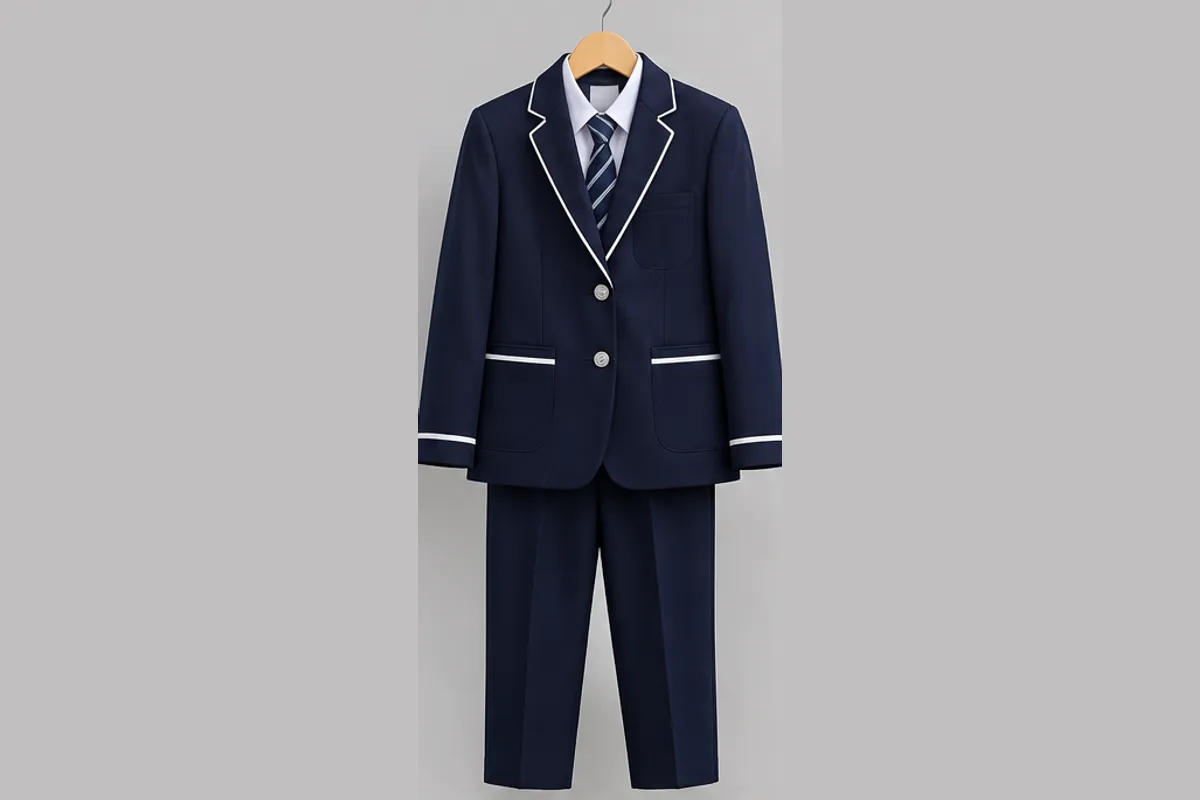
Blazer collar construction joins two layers: a top collar cut from the blazer cloth and an undercollar, often cut on the bias or from a firmer material, with interfacing between them to hold the shape. The collar folds along a roll line, which lets it stand at the back of the neck and lie flat over the shoulders. When the layers are balanced, the collar hugs the neck; when they are not, it curls at the points or lifts away from the shirt.
The collar is one of the hardest parts of a blazer to get right, and also one of the first to show poor making. A collar that stands away from the neck makes a new blazer look second-hand.
The parts of a blazer collar
Top collar. The visible outer layer, cut from the same cloth as the blazer.
Undercollar. The layer beneath, facing the neck. It is cut slightly smaller than the top collar so the seam rolls underneath and does not show.
Collar stand. The part that rises up the back of the neck before the collar folds over.
Roll line. The fold where the stand turns into the fall of the collar, continuing down into the lapel.
Gorge. The seam where the collar joins the lapel, forming the notch.
Why do school blazer collars curl or lift?
| Fault | Likely cause | What to look for on the sample |
|---|---|---|
| Points curl upwards | Undercollar too large, or interfacing too soft | Collar points lie flat when the blazer is on a hanger |
| Collar stands away from the neck | Collar too short, or stand too high | No gap between collar and shirt at the back |
| Seam shows at the edge | Top and undercollar the same size | Edge seam rolls slightly under |
| Collar bubbles after washing | Interfacing and cloth shrink differently | Ask how the sample behaves after care testing |
| Braid ripples along the collar | Braid eased on too tightly or too loosely | Braid lies smooth along the whole edge |
Most of these are pattern and construction issues that are corrected at sample stage. That is why it pays to put the sample on a real student, or a mannequin of the right size, rather than only looking at it flat.
How is the collar kept in shape?
Interfacing in the collar gives body without stiffness. The undercollar can be cut from the blazer cloth or from a firm felt-like material that holds its shape well. Felt undercollars are traditional in tailoring and resist curling, but must suit the care instructions of the blazer. Some makers stitch along the roll line to set the fold. All of these are construction choices agreed for the pattern and confirmed on the sample.
The collar should also suit the cloth. Polyester and poly-viscose behave slightly differently under pressing, so the interfacing chosen for one may not suit the other. Our fabrics and colour matching page covers how cloth choices are made.
Checks for the buyer
Use this list when a sample blazer arrives:
- collar lies close to the shirt at the back of the neck
- collar points flat, not curling or lifting
- undercollar seam hidden beneath the edge
- roll line runs smoothly into the lapel
- braid or piping along the collar flat and even
- a hanging loop, if wanted, sewn securely under the collar
Hang the blazer up overnight and look again in the morning. A collar that springs back into shape is well made; one that stays creased or twisted needs attention.
Collar care advice to pass on
Collars suffer most from being stuffed into bags and hung on pegs by the collar itself. Shops can pass on simple advice: hang the blazer by its loop or on a shaped hanger, press the collar from the underside with a pressing cloth, and never press a hard crease into the roll line. These habits keep the collar sitting properly for longer.
If your current blazers have collars that curl, mention it when you enquire, and send an example. We look at the collar construction on our school blazers sample and quote by fabric, quantity and branding.
Questions buyers ask
Should the undercollar be a different colour?
It is normally a close match to the cloth, so it does not show when the collar is turned up. A contrast undercollar is a tailoring detail rarely seen on school blazers and usually not worth the extra matching.
Can a curled collar be fixed by pressing?
Light curling can often be pressed out from the underside with steam and a pressing cloth. A collar that curls again straight away has a construction imbalance, which should be corrected in the pattern before the next order.
Does braid on the collar make it stiffer?
Slightly, because braid adds a firm edge. That can help the collar hold its shape. The braid must be sewn on with the right tension, though, or it pulls the collar and makes the points lift.