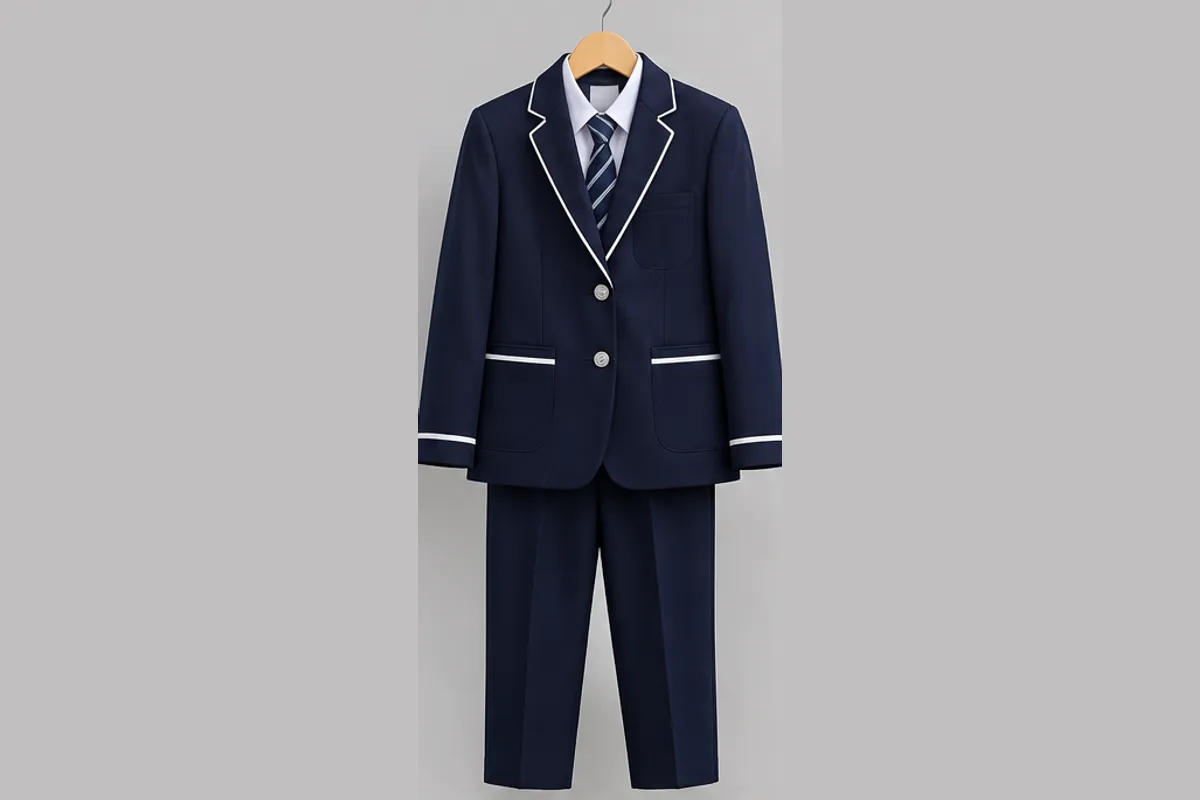
For a first blazer order, size younger students by age band and senior students by chest size, then weight the quantities towards the year groups that buy new blazers most often. A blazer is fitted across the chest and shoulders, so a size that is slightly wrong is far more obvious than on a sweatshirt, and getting the mix right on the first order saves rushed top-ups later.
This guide is for uniform shops, suppliers and schools placing a first order. It covers where to switch from age to chest sizing, how to build a starting size mix, and how to plan top-up orders.
Age bands first, chest sizes for seniors
Our blazer styles run from age 5–6 up to age 15–16, then continue in chest sizes for senior students. That pattern matches how blazers are bought. Younger children are fitted by age because parents know their child’s age, not their chest measurement. Older students vary so much in build that an age label stops being useful; two fifteen-year-olds can be several sizes apart.
Decide where your size list switches over. Some buyers run age bands to 13–14 and then switch to chest sizes; others carry both labels for the overlap years. Whatever you choose, keep it the same on every order, so a parent who bought a 12–13 last year can find the next size up.
Chest sizes are usually stepped evenly, for example every two inches or every five centimetres, as set out on your chart. The exact measurements, sleeve lengths and body lengths are agreed with the size chart for each order. Our size charts page explains how a chart is agreed and what measurements it covers.
Points to settle on the chart:
- the chest measurement for each size, measured on the garment, not the body
- sleeve length, since tall students often need a longer sleeve before a wider chest
- back length, which affects how the blazer sits over a skirt or trousers
- whether you want a separate long-fitting option for the largest senior sizes
A starting size mix
A blazer is often bought once on entry to a school and then replaced when the child outgrows it, so sales cluster at the entry year and at growth points. Your own sales history or roll numbers are the right guide. If you have none, the table below is a starting example to adjust against your own data. It is not a forecast.
| Size | Typical wearer (planning example) | Share of a first order (starting example) |
|---|---|---|
| Age 5–6 to 7–8 | Infants entering a blazer school | Lower, unless your school starts blazers at this age |
| Age 8–9 to 10–11 | Junior years | Moderate, spread evenly |
| Age 11–12 | Secondary entry year | Highest single size |
| Age 12–13 to 13–14 | Early secondary, growth replacements | High |
| Age 14–15 to 15–16 | Upper secondary | Moderate |
| Chest sizes, smaller | Slim senior students | Moderate |
| Chest sizes, larger | Senior students and tall students | Low to moderate; keep some of each |
Two adjustments are worth making. First, if the school has a large intake year, weight the entry size up. Second, never leave the largest sizes at zero. Only a few students need them, but those students have nothing to wear if the size is missing, and a single blazer cannot be made to order quickly.
If you order both boys’ and girls’ blazers, plan the mix separately. They are separate styles, each with a minimum of 50 pieces, and girls’ and boys’ growth points fall at different ages.
Top-up orders and reorders
A common plan is a main order before the start of the school year and a smaller top-up once you see which sizes are selling. Sizes can be mixed within a style, so a top-up can cover just the sizes that ran short, as long as the style reaches the minimum.
Plan the top-up date backwards from the point when your stock would run out. Lead time is confirmed in the quotation, and it includes cutting, sewing, badging and quality check, so a top-up placed in the same week the shelf empties will arrive too late. A simple rule is to review stock at the end of the first busy selling period, then order straight away.
Every repeat order is made to the approved sample and the agreed chart, so the new blazers match the ones already sold. If you want to change a measurement, for example lengthen the sleeves on the senior sizes, tell us at reorder and we confirm it on the quotation.
A sizing checklist for your first order
- Age bands and chest sizes listed in one size list
- Switch-over point from age to chest size decided
- Sleeve and back lengths agreed on the chart
- Entry-year size weighted up
- Largest sizes included, even in small numbers
- Boys’ and girls’ styles planned separately
- Top-up review date set against your term start
You can see the blazer styles and colours we make on our school blazers page.
Send us your size list, your rough quantities and your term start date, and we will prepare a quotation quoted per style, by fabric, quantity and branding.
Questions buyers ask
How do I measure a student’s chest for a blazer?
Measure round the fullest part of the chest over a shirt, with the tape under the arms and level at the back. Then compare with the garment chest on your chart, which should be larger to allow for a jumper underneath.
Where should a blazer sleeve end?
With arms relaxed, the sleeve should reach about the wrist bone, leaving a little shirt cuff showing. A sleeve that covers the hand suggests the blazer is too big, even if the chest seems to fit.
Should families buy a blazer with room to grow?
A little room is sensible, but a blazer must still fit at the shoulders. If the shoulder seam drops well past the shoulder, the size is too large. Extra room is better taken in sleeve length than across the back.