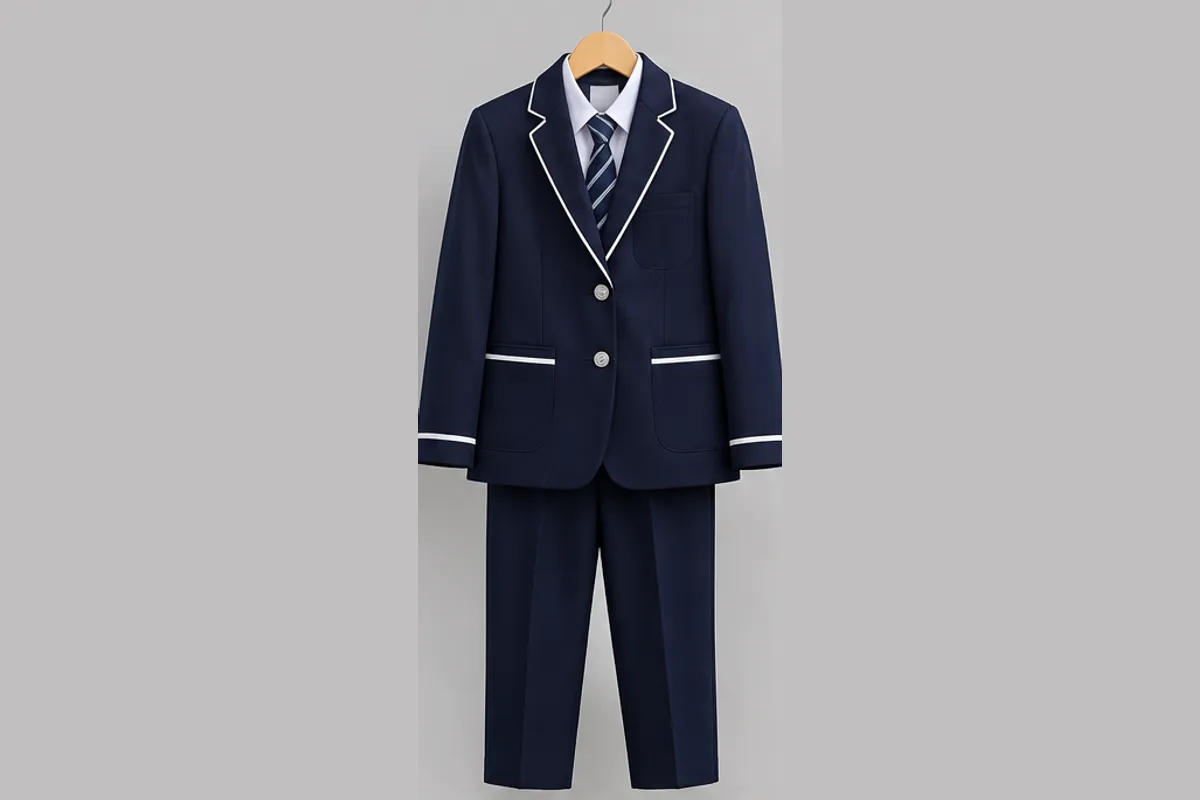
The right school blazer sleeve length ends at the wrist bone with the arm relaxed, leaving about a centimetre of shirt cuff visible. On a size chart, sleeve length is measured on the garment from the shoulder point to the cuff edge, and it should rise by an even step with each size. Sleeves are usually the first thing to look wrong as students grow, so they deserve their own attention when a chart is agreed.
This post looks at sleeve length from the buyer’s side: how it is graded, why it causes more returns than chest size, and the options for students whose arms outgrow their blazer before their chest does.
Why sleeve length causes so many complaints
A blazer that is slightly loose in the body still looks tidy. A sleeve that stops short of the wrist looks wrong straight away, and a sleeve that covers the knuckles looks like a hand-me-down. Parents notice both, and both come back to the shop counter.
Arms also grow in spurts that do not follow chest growth. Between roughly 11 and 15, many students lengthen in the arm well before they broaden in the chest. They end up in a blazer that fits round the body but shows too much wrist. For a shop, that means exchange requests in sizes that should have been correct.
How is sleeve length graded across sizes?
Grading is the increase from one size to the next. For sleeve length the step is usually small in the junior sizes and larger in the senior sizes, because arms lengthen faster in adolescence. The pattern below shows how a buyer might think about it. The figures are a planning illustration only; your own chart sets the real ones.
| Size group | Sleeve step between sizes | What to watch |
|---|---|---|
| Age 5–6 to 8–9 | Small, even steps | Sleeve should not cover the hand; young children push sleeves up |
| Age 9–10 to 12–13 | Moderate steps | First spurts; check sleeve on the sample in two sizes |
| Age 13–14 to 15–16 | Larger steps | Arms often outgrow chest here |
| Senior chest sizes | Steady steps, plus a long-sleeve option if needed | Tall students in average chest sizes |
When you review a draft chart, read the sleeve column on its own. If the step suddenly shrinks or jumps, ask why. A smooth progression means fewer students fall between two sizes.
Options for longer arms
There are three practical ways to deal with students whose arms are longer than their size allows.
- Longer sleeves on senior sizes. Add a few centimetres to the sleeve on the largest age bands and the chest sizes, and agree it on the chart. This suits schools where many senior students are tall.
- A long-fitting variant. Make a version of selected chest sizes with longer body and sleeve. It counts as its own set of sizes within the style, so it can be part of the same order.
- A turn-back allowance. Some buyers ask for extra cloth folded inside the cuff so a tailor can let the sleeve down. Discuss this at sample stage, because it depends on how the cuff is finished and where any braid sits.
Braid on the cuff affects the last option. If the cuff carries braid, letting the sleeve down moves the braid up the arm or leaves a mark, so a longer sleeve from the start is usually the cleaner choice.
Checking sleeve length on the sample
The sample is where sleeve length is confirmed. When you receive it, put it on a student of the right size, arms relaxed at the sides. Look from the side. The sleeve should meet the wrist bone, and the shirt cuff should just show. Then ask the student to reach forward; the sleeve will ride up a little, which is normal, but it should not expose the forearm.
Measure the sample sleeve against the chart as well as trying it on. If you want a change, it goes onto the chart before production starts, and every later reorder follows the updated figure. Our size charts page sets out how chart changes are recorded.
You can see our blazer styles, including braided-cuff options, on the school blazers page. If you would like longer sleeves on your senior sizes, tell us when you ask for a quotation and we will draft the chart accordingly.
Questions buyers ask
Can a blazer sleeve be shortened after delivery?
A tailor can shorten most blazer sleeves, but it costs the family time and money, and braided cuffs complicate it. It is simpler to get the sleeve right on the chart so that most students can wear their size without alteration.
Do girls’ blazers need a different sleeve length from boys’?
Usually yes. The girls’ blazer has its own pattern and size chart, and its sleeve length is set for that pattern. Do not copy sleeve figures from the boys’ chart; review each chart’s sleeve column separately at sample stage.
How much shirt cuff should show below a blazer sleeve?
Around one centimetre is the traditional look, with the arm relaxed. Less than that is acceptable for younger children, who are hard on cuffs. More than two or three centimetres usually means the student needs the next size or a longer sleeve.