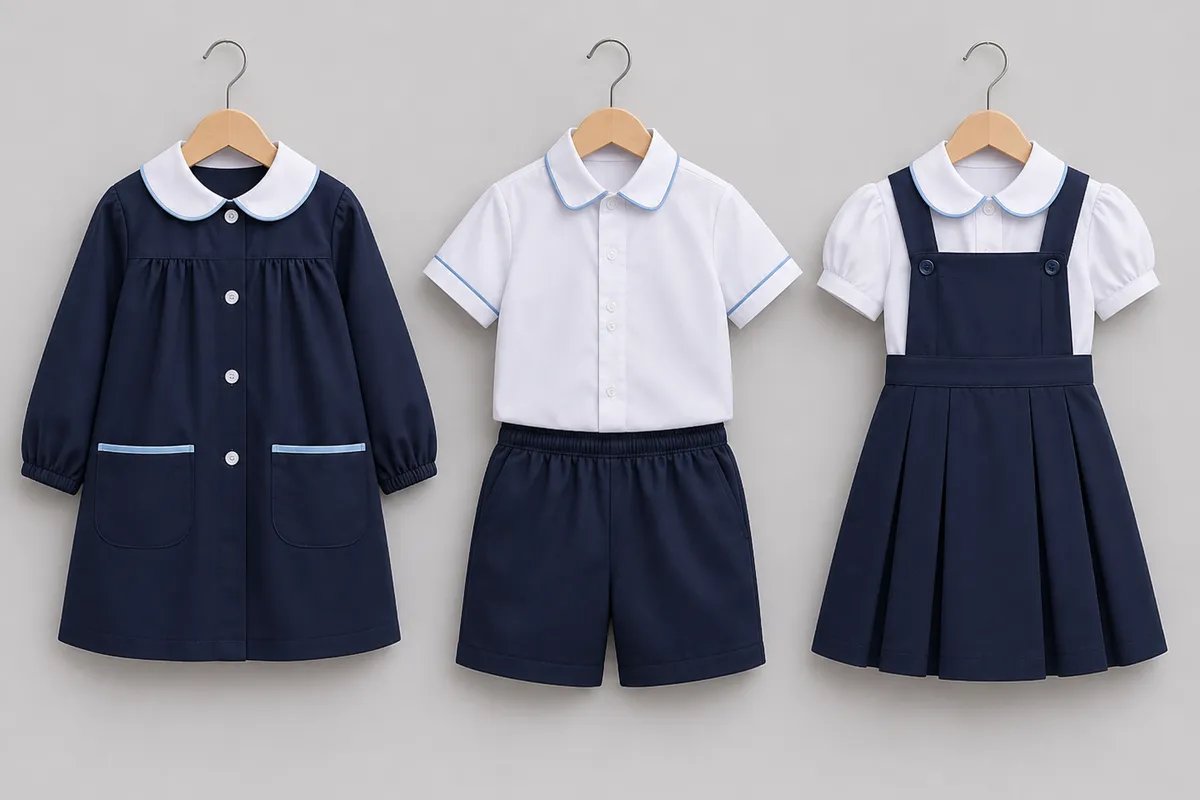
If you are asking what is a uniform for class 1, it is the set of garments a school asks its first-year primary students, usually aged around six, to wear every day: typically a shirt or polo, shorts or trousers for boys, a pinafore, tunic or skirt for girls, a warm layer for cooler months and a separate PT or PE kit. Class 1 uniforms are designed for children who are still learning to dress themselves, so easy fastenings and hard-wearing fabric matter more than at any later stage.
This post sets out what each garment usually is, how class 1 differs from the nursery and kindergarten years before it, and what a school or shop should settle before ordering.
What does a class 1 uniform usually contain?
| Item | Boys | Girls | Notes for class 1 |
|---|---|---|---|
| Top | Short-sleeve shirt or polo | Short-sleeve shirt, blouse or polo | Polos avoid ironing; shirts look more formal |
| Bottom | Tailored shorts, sometimes trousers | Pinafore, tunic or skirt | Elastic-back waist helps small children |
| Warm layer | Sweatshirt, knitted jumper or cardigan | Same, or a cardigan | Only where the climate needs it |
| PT or PE kit | T-shirt and shorts, often in a house colour | Same | Changed into at school, so must be quick to put on |
| Summer option | Shorts and polo | Summer dress in gingham or stripe | Depends on climate and term dates |
| Items sourced separately | Tie, belt, socks, shoes | Tie, socks, shoes, hair accessories | Not part of a garment order with us |
A school in a warm climate may skip the warm layer entirely. A school with a formal uniform may add a tie and a long-sleeve shirt for assemblies.
How is class 1 different from kindergarten?
Kindergarten and nursery uniforms often use smocks, shirt-and-shorts sets, or pinafore sets made for children aged two to six. Class 1 is the first year that looks like the full school uniform, with separate garments in the school’s main colours. For many families it is the first time they buy the “real” uniform, and for shops it is the start of a run of sizes that will continue for ten years or more.
The practical differences are:
- Fastenings. Kindergarten garments use press studs and elastic. Class 1 may move to buttons and zips, but many schools keep elastic-back waists and zip-front pinafores for one or two more years.
- Fabric. Class 1 garments are usually in the same poly-viscose, polyester twill or poplin as the older classes, so the colour matches across the school.
- Logo. A class 1 uniform normally carries the full school logo, where nursery garments may have a smaller version or none.
Points a school should decide for class 1
Many schools write one uniform list for all primary classes. It helps to add a short note for class 1 covering the choices that make dressing easier:
- Choose easy waists. Elastic-back shorts and trousers, or adjustable skirts.
- Prefer front fastenings. A zip-front pinafore can be put on without help.
- Keep the PT kit simple. A T-shirt and shorts that go on quickly, with no laces or buttons.
- Allow short sleeves. Small children push long sleeves up and wear out the cuffs.
- Pick a forgiving colour. Mid-grey or navy hides marks from play.
What a uniform shop needs to know
For a shop, class 1 is a size-heavy year. Children at this age vary widely in size, so the order spreads across age bands from 5–6 down to 4–5 and up to 7–8. A first order can lean on the middle band and be topped up once the term starts. Check whether the school expects shorts, trousers or both, because the answer changes the split.
We manufacture in India and make every garment in the table above except the items sourced separately. Shirts and polos, shorts and trousers, pinafores, tunics and skirts, summer dresses, knitwear, sweatshirts and PE kit are all made in bulk, in the school’s colours. See the boys’ and girls’ bottoms on our school trousers and shorts page, and read how we work with shops on our page for uniform shops and retailers.
Send us the class 1 list your school uses, with colours and an estimate of student numbers, and we will quote each garment as its own style.
Questions buyers ask
What colour is a class 1 school uniform?
It follows the school’s main colours, which are the same for every class. Many schools use a white or pale shirt with a navy, grey, maroon or green bottom. Class 1 rarely has its own colour, so it matches the rest of the school.
Is a PT uniform part of the class 1 uniform?
Usually yes. Most schools ask class 1 students to own a PT or PE kit, normally a T-shirt and shorts. Some schools give each house a T-shirt colour. The kit is worn on sports days or swapped into for physical education lessons.
Do class 1 uniforms need a tie?
Not always. Many schools leave ties off for younger children or use a polo shirt instead. Where a tie is required, it is sourced separately from the garments, and an elastic or clip-on style is often chosen for this age.