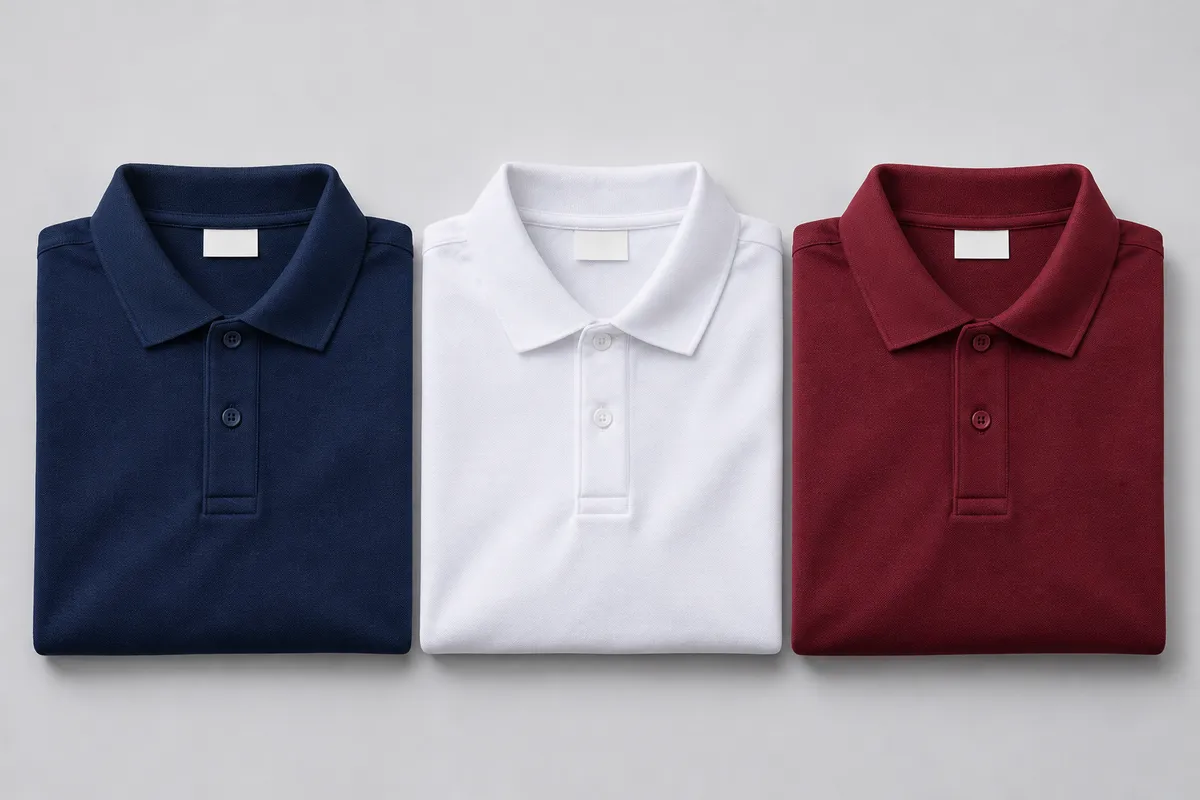
A unisex school polo shirt is a single cut worn by every student, rather than separate boys’ and girls’ shapes. For most schools it is the simpler option: one style to specify, one set of sizes to stock and one look across the year group. A separate fitted cut is worth considering mainly for older students, where some prefer a shaped polo.
This post sets out the choices so a school, shop or supplier can decide before asking for a quotation.
What makes a polo unisex?
A unisex polo has a straight body with no waist shaping, a sleeve that suits most arms, and the same collar and placket for everyone. The differences between a unisex and a fitted cut are small but visible.
| Feature | Unisex cut | Fitted (girls’) cut |
|---|---|---|
| Body | Straight from chest to hem | Slight shaping at the waist |
| Sleeve | Standard length and width | Often slightly shorter or narrower |
| Placket buttons | One agreed side for all | Traditionally the opposite side |
| Collar | Same for all | Sometimes slightly smaller |
| Sizing | One size run | Separate size run |
| Look | Uniform across the class | More tailored on older students |
For younger children, body shapes differ little, so a unisex polo works for almost every class. The question usually comes up for secondary and senior years.
Which button side should a unisex polo use?
Traditionally, men’s garments button right over left and women’s left over right. A unisex polo picks one side for everyone. Most unisex polos follow the traditional men’s side, but the choice is yours. State it in the specification, because it decides which placket strip carries the buttonholes.
For many students, the button side on a polo goes unnoticed, as the placket is short and often left partly open.
What are the trade-offs for stock?
The cut a school chooses affects every shop and supplier that sells its uniform.
- One cut means fewer styles, simpler stock and no risk of running out of girls’ sizes while boys’ sizes sit on the shelf.
- Two cuts double the size runs. Each cut is a separate style for the 100-piece minimum, with sizes mixed within each.
- A mixed approach offers the unisex polo as standard and a fitted polo as an option for older students. This keeps the main stock simple while giving a choice.
Shops selling to several schools often prefer schools to choose unisex, because one style across schools is easier to manage. Our notes for uniform shops and retailers cover ordering for more than one school.
How to decide for your school
A short set of questions helps:
- What ages wear the polo? Younger years rarely need two cuts.
- Do families ask for a fitted polo, or would a unisex one go unremarked?
- Will the polo be worn untucked, where shape shows more?
- Does the school want students to look identical, or allow a choice?
- Can the shop or supplier handle two size runs?
If the answers are mixed, ask for samples of both cuts in two sizes and let a few students try them. Fit is easier to judge on a person than on paper.
We make short-sleeve, long-sleeve and contrast-collar polos, all of which can be specified in a unisex cut. See the styles and fabrics on our school polo shirts page. Tell us your choice of cut and button side, and we will include it in your quotation.
Questions buyers ask
Does a unisex polo fit girls well?
For younger children, a unisex polo fits girls and boys alike. For older students, some girls prefer a shaped polo. A unisex polo in the right size usually fits comfortably, and trying a sample is the simplest way to confirm it.
Can the logo and colours differ between cuts?
They can, but most schools keep the logo, collar and colours identical so both cuts look like one uniform. The difference should be in shape only. Approving both on the sample keeps them consistent.
Is a unisex polo the same as a PE polo?
Not necessarily. A unisex polo is about cut, not purpose. A school can have a unisex everyday polo in poly-cotton piqué and a separate sports polo in polyester piqué, each specified as its own style.