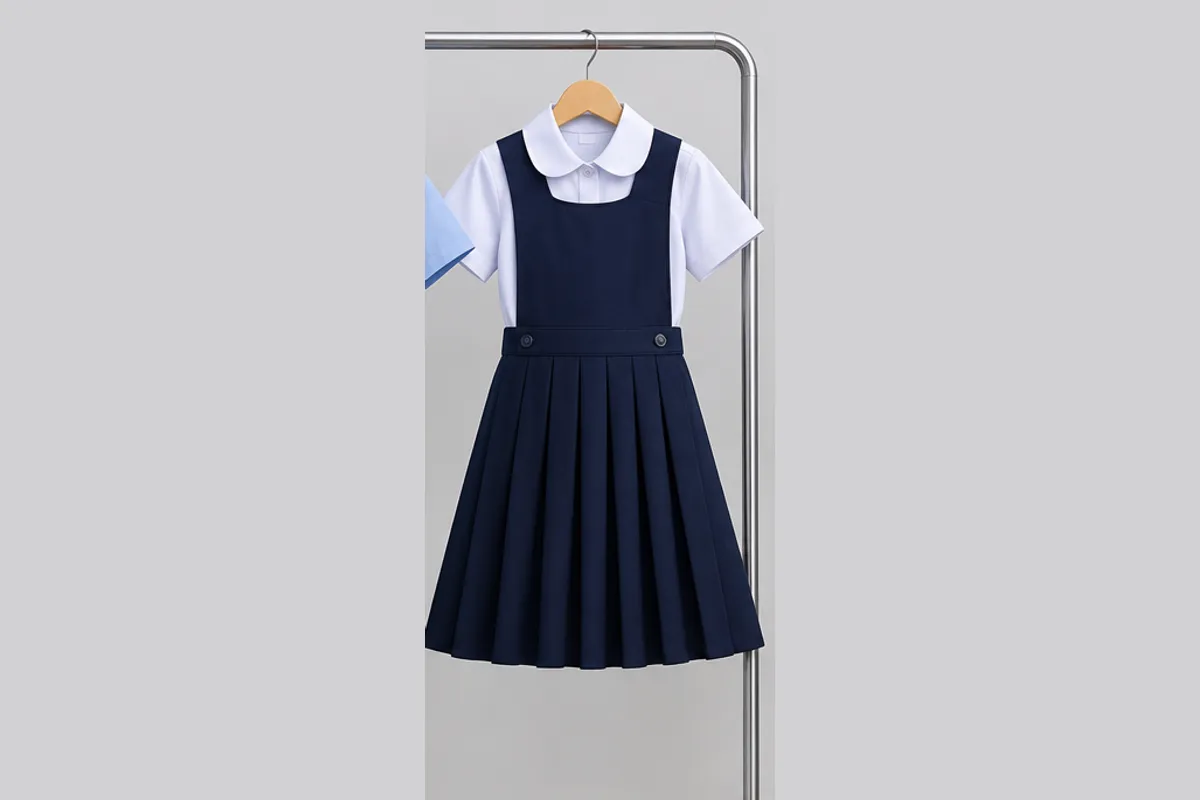
A special school uniform is usually built around three practical aims: garments students can put on and take off with as little help as possible, fabrics that stand up to frequent washing, and enough spare sets held in school for changes during the day. The look can match any other school, with the school’s colours and badge. The difference is in the garment choices behind it.
This guide is written for special schools and for mainstream schools with specialist units. It covers garments and specification only. Decisions about each student’s needs are made by the school and families.
Which garments make dressing easier?
Fastenings are the main barrier for many students. Buttons, hooks, zips and ties all take fine finger control. Garments that pull on and off avoid most of them.
| Instead of | Consider | Why it helps |
|---|---|---|
| Shirt with buttons | Polo shirt with a short placket | Goes over the head, few buttons |
| Trousers with zip and hook | Elastic-back or full elastic waist trousers | Pulls up and down |
| Skirt with side zip | Skort or elastic-waist skirt | No fastening to manage |
| Knitted cardigan | Crew-neck sweatshirt | No buttons; buttons or press studs on a sweatshirt cardigan, as specified, if a cardigan is preferred |
| Blazer | Fleece jacket with full zip | Easier to put on, and warm |
| Pinafore with buttons at the shoulder | Zip-front pinafore | Opens fully at the front |
A school polo shirt and elastic-waist bottoms are the backbone of many special school uniforms, because they suit students across a wide age range.
Fabrics for frequent washing
Uniform in a special school may be changed and washed more often than in a mainstream school. Choose fabrics that cope with that:
- Poly-cotton piqué polo shirts hold colour and shape through repeated washing.
- Poly-viscose or polyester twill trousers dry quickly and resist creasing.
- Poly-cotton fleece sweatshirts are machine washable and soft on the inside.
- Cotton jersey is a softer option for PE T-shirts where students prefer it.
Darker colours on the lower half, such as navy, grey or black, show marks less than pale colours. A white polo shirt is common, but some schools choose a mid colour for the top too.
Spare sets in every classroom
Most special schools keep spare uniform in each class or base, so a student can change without waiting for clothes from home. Planning those spares is a separate order line.
- List the garments kept as spares: usually a polo shirt, trousers or skirt, and a sweatshirt.
- Decide how many spare sets each class holds, and in which sizes.
- Label spares clearly as school property, with a different label or a mark, so they come back.
- Keep a record of which spares go home and need returning.
- Reorder spares each year at the same time as the main uniform.
Spares can be in the same style as the main uniform, so they combine with the main order and help each style reach its minimum (50 for woven, 100 for knitted).
Sizes across a wide age range
A special school may teach students from early years to young adults in one building. The size range for a single style can run from small children’s sizes to adult chest sizes. Check the size list against your roll and include the larger sizes from the first order. Our page for schools and school groups explains how we work from your size list and approve samples.
Labels and comfort
Label position and type are agreed with the sample. A printed label, or one moved to a side seam, suits students who notice labels at the neck. Flat seams inside the garment are worth checking on every sample.
If you are planning a uniform for a special school or unit, send us your garment list, the age range and any spare-set needs, and we will quote each style.
Questions buyers ask
Should a special school have a uniform at all?
That is the school’s decision. Many special schools use a uniform because it gives students a sense of belonging and makes mornings predictable. Others prefer a simple dress code. If you choose a uniform, easy-dressing garments keep it practical.
Can adaptive fastenings be added to uniform?
We make garments to the specification agreed with the sample. Pull-on styles, elastic waists, zip-front pinafores and fleece jackets with a full zip already avoid most fiddly fastenings. Specialist adaptive features beyond these are worth discussing at enquiry.
How should spare uniform be labelled?
Use a label or mark that shows the garment belongs to the school, such as a printed label reading “spare” or the class name. It stops spares being mixed with a student’s own uniform when they go home.