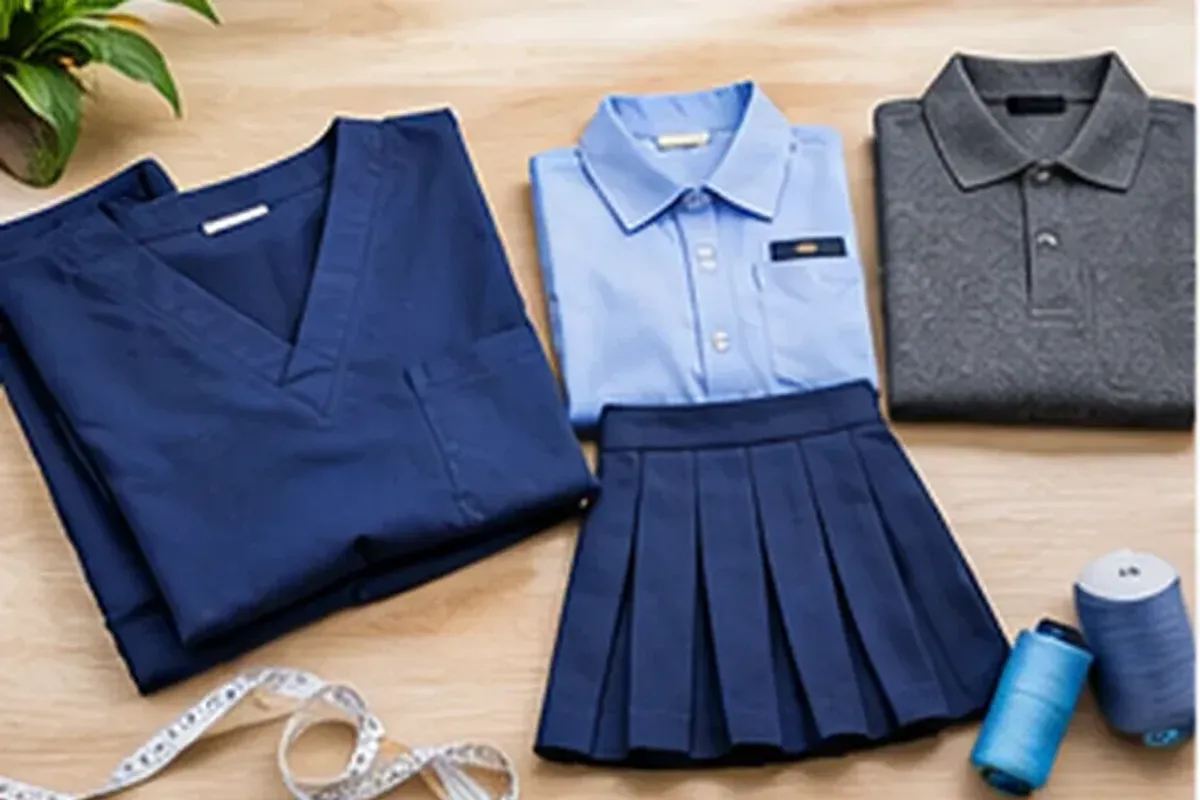
Uniform pleats are folds of fabric pressed and stitched into a garment to give it fullness and movement, and three types cover almost every school garment: knife pleats (all folds facing one way), box pleats (pairs of folds turned away from each other) and inverted pleats (pairs of folds turned towards each other). They appear on skirts, pinafores, tunics and skorts, and occasionally on the back of a shirt or blouse. The pleat type changes how much fabric a garment uses, how it hangs and how easily it keeps its shape after washing.
How each pleat is formed
Knife pleat. The fabric is folded so each pleat lies flat and faces the same direction, like a row of knife blades. All round the skirt, the folds point one way. This is the most common pleat on school skirts and gives a crisp, traditional look.
Box pleat. Two folds face away from each other, creating a flat panel on the outside with the folds meeting behind. Box pleats look bolder and give more volume at the hem. They are common on tunics and some pinafores.
Inverted pleat. The reverse of a box pleat: two folds face towards each other and meet on the outside, with the panel behind. A single inverted pleat at the centre front or back is common on A-line skirts and the back of a blazer or shirt, to give movement without a full pleated look.
Where each pleat appears on a uniform
| Garment | Knife pleats | Box pleats | Inverted pleats |
|---|---|---|---|
| Pleated skirt | All round, or front panel only | Sometimes, for a fuller look | Rarely all round |
| A-line skirt | No | No | One or two, centre front or back |
| Pleated pinafore | Skirt part, all round | Common alternative | Sometimes |
| Tunic | Sometimes | Common, from the yoke | Sometimes |
| Skort | On the skirt panel | On the skirt panel | Single front pleat |
| Shirt or blouse | No | Box pleat at the back yoke on some shirts | Back pleat on some shirts |
Pleat count, depth and fabric use
Each pleat folds fabric back on itself. A skirt with many deep pleats can need far more fabric than its finished width, and fabric is a large part of what a garment costs to make. Three choices drive this:
- Count. How many pleats run round the garment.
- Depth. How much fabric folds under each pleat.
- Coverage. All round, front only, or front and back panels with flat sides.
Fewer, shallower pleats use less fabric and are lighter to wear. More, deeper pleats hang more fully and look more formal. Neither is right in itself; the choice depends on the look the school wants and the price it can accept.
Keeping pleats in after washing
Pleats hold most firmly in fabrics with a high polyester content, because heat-setting fixes the fold. Poly-viscose and polyester twill, the fabrics we offer for skirts, pinafores and tunics, both take a heat-set pleat well. Two construction steps help further:
- Stitching down. The top part of each pleat is stitched from the waistband or yoke to the hip, so the pleat stays flat where it is most visible.
- Edge stitching. A fine line of stitching along the inside fold of each pleat keeps it sharp. It is an option on skirts where crispness matters.
Matching pleats across garments
When a uniform has a skirt, a pinafore and a skort in the same colour, using the same pleat type on all three makes them look like one family. If you already sell one of these garments, send it to us and we can follow its pleat type, count and depth on the others.
Before asking for a quotation, settle:
- Pleat type for each garment
- Number of pleats and whether all round or front only
- Stitch-down length from the waistband or yoke
- Edge stitching, if wanted
- Fabric: poly-viscose or polyester twill
Our pleated skirt and skort styles are on our school skirts and skorts page. For how pleated fabrics are chosen and matched to your colour, see fabrics and colour matching.
Send us the pleat style you want, or a garment to copy, and we will quote it in your chosen fabric.
Questions buyers ask
Which pleat type is easiest for families to look after?
Knife pleats in a polyester-rich fabric are usually the simplest, because they fall back into place after washing and need only light pressing. Deep box pleats hold well but can take longer to press neatly when they lose their shape.
Do more pleats make a skirt warmer?
Slightly, because more pleats mean more layers of fabric. In practice the difference is small, and warmth comes more from tights and a knitted layer. Pleat count is better chosen for appearance, movement and fabric use than for warmth.
Can pleats be added to a check skirt?
Yes, but the check must be matched across each pleat so the pattern lines up when the skirt hangs. This takes more care in cutting and may use more fabric. The pleat placement is agreed on the sample before bulk production.