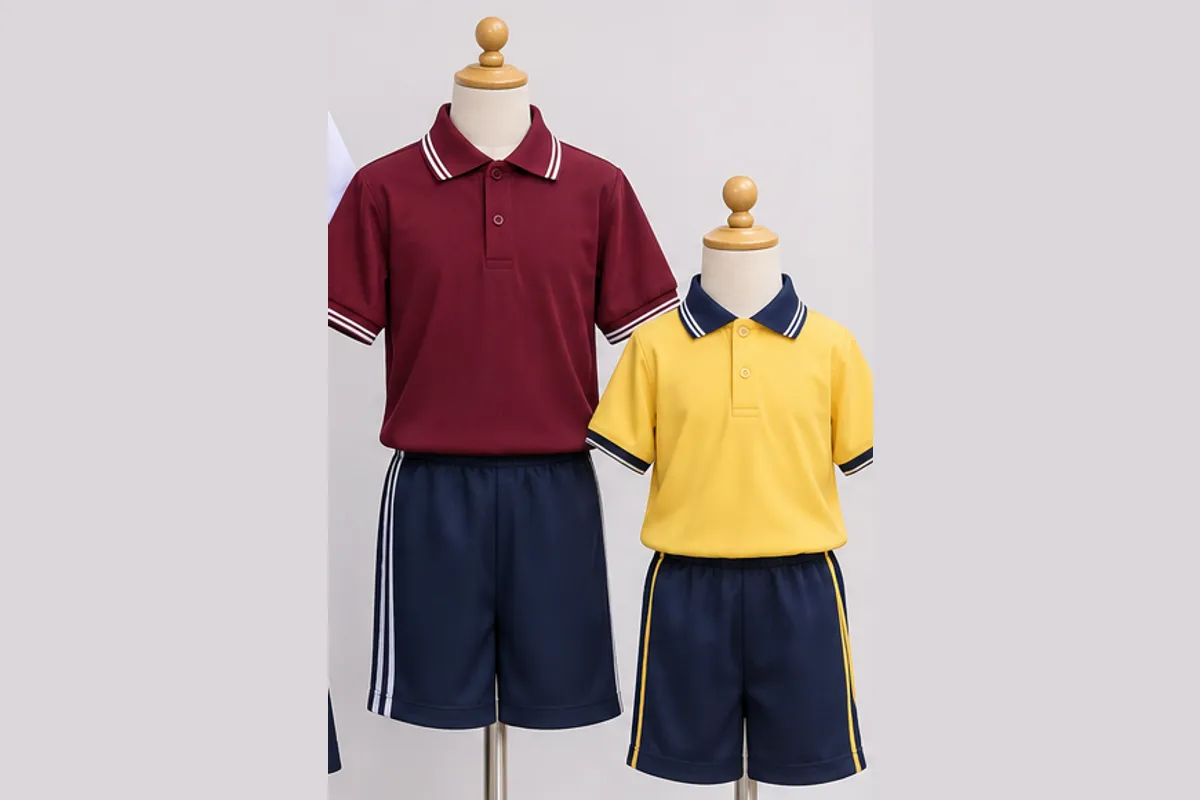
T shirt jersey fabric is a knitted fabric made from one set of loops interlocking in rows, which gives a smooth face with fine vertical lines and a slightly textured back. It stretches comfortably, drapes softly and is the fabric of the everyday T-shirt. For school PE, jersey is made in cotton or in polyester, and we make PE T-shirts in cotton jersey or polyester knit.
Understanding how jersey behaves helps a buyer read a sample and explain the garment to customers.
How jersey is made
Jersey is a weft knit. A knitting machine feeds yarn across a row of needles, forming loops that hang from the loops of the row before. The result is a continuous tube or sheet of fabric that stretches because the loops can open and close.
“Single jersey” is the plain form used for most T-shirts. It has:
- A face, the smooth side, showing columns of tiny V shapes
- A back, showing rows of small curved loops, slightly rougher to the touch
T-shirts are made with the face outward. Prints are applied to the face, because its smooth surface takes ink evenly.
Jersey compared with other knits
| Knit | Structure | Feel | Common use in school kit |
|---|---|---|---|
| Single jersey | One layer of loops | Light, soft, stretchy | T-shirts, PE tops |
| Piqué | Textured, honeycomb-like surface | Firmer, structured | Polo shirts |
| Rib | Alternating raised and sunken columns | Very stretchy across the width | Neck bands, cuffs |
| Interlock | Two layers knitted together | Smooth both sides, thicker | Heavier T-shirts, some sportswear |
| Fleece | Brushed back | Warm, soft inside | Sweatshirts |
This is why a PE T-shirt often combines two knits: a jersey body and a rib collar. The rib’s stretch lets the neck go over the head and spring back.
Characteristics a buyer should know
Edges curl
Single jersey curls at its cut edges, rolling towards the face at the top and bottom and towards the back at the sides. This is normal and is why hems and necklines are always finished, never left raw. You may see it on a swatch; it does not affect the finished garment.
Stretch is greater across the width
Jersey stretches more from side to side than from top to bottom. Patterns are cut so that the stretch goes around the body, which is where movement needs it.
It can twist
Because of how single jersey is knitted, the fabric can lean slightly, and the side seams of a T-shirt may move towards the front after washing. Good cutting and finishing reduce this, and it is worth checking on a washed sample.
It can relax or shrink
Cotton jersey in particular may shrink a little in the first washes if the fabric was not pre-treated. Polyester jersey tends to hold its dimensions more steadily. Measure the sample before and after a wash.
What to tell us about jersey
When ordering PE T-shirts, the fabric is confirmed at quotation. Helpful information includes:
- Cotton or polyester, or a tee you already sell as a reference
- Whether the tee should feel light or more substantial
- Colour, matched to a physical reference
- Whether a large print will be applied to the face
- How customers have found the current tee after washing
Our fabrics and colour matching page lists the fabric options for each garment and how we match colour. The T-shirts, shorts and polos we make in India are on our PE kit and sports uniforms page. Send a reference tee or your fabric preference, and we will make a sample and quote by fabric, quantity and branding.
Questions buyers ask
Is jersey the same as cotton?
No. Jersey describes how the fabric is knitted, not what it is made of. It can be knitted from cotton, polyester or other fibres. A cotton jersey and a polyester jersey look similar but feel and wash differently.
Why does the swatch curl but the T-shirt does not?
Cut edges of single jersey naturally roll. In a finished T-shirt, every edge is hemmed, bound or joined to rib, which holds it flat. The curl on a loose swatch is simply a feature of the knit.
Is jersey suitable for printing a school logo?
Yes. The smooth face of jersey takes printed logos and house names evenly, which is one reason printing is common on PE T-shirts. The print is shown on the sample before bulk production.