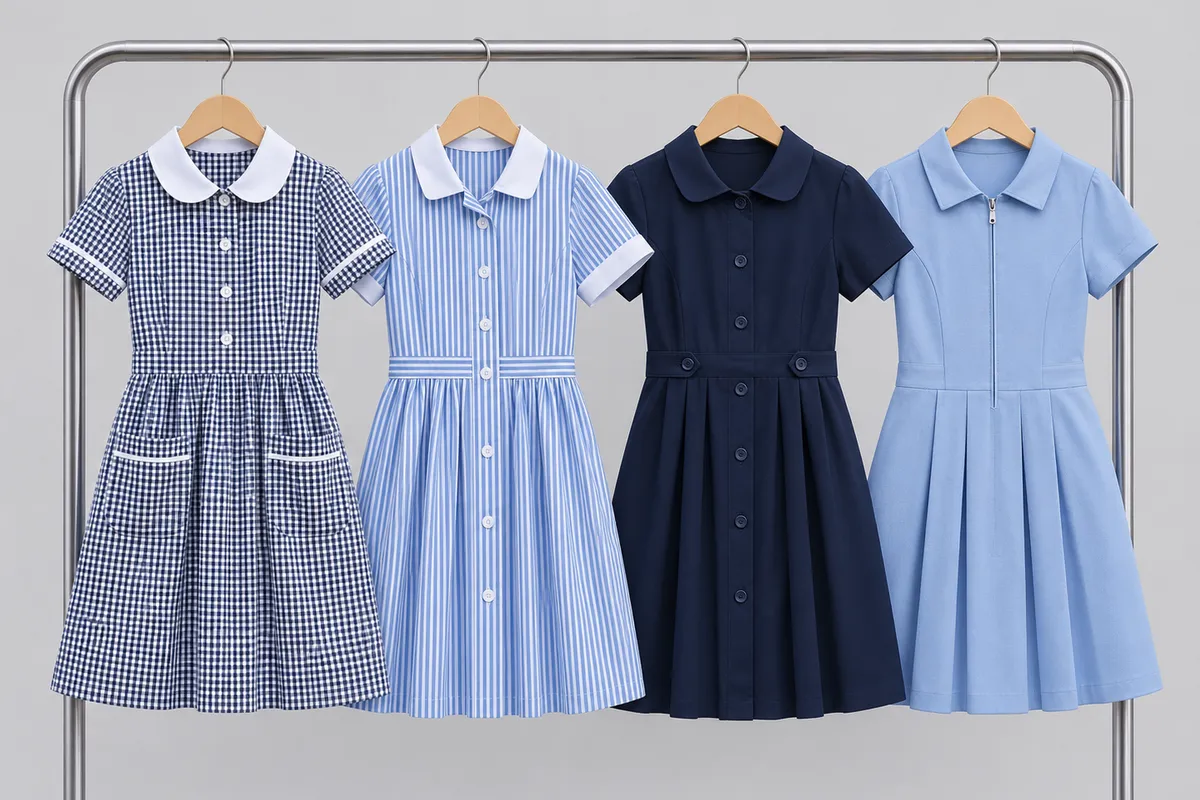
A school dress belt on a summer dress is part of the garment, cut from the dress fabric or a matching solid, rather than a separate leather belt. The usual forms are a full tie belt threaded through loops, a half belt fixed at the back, and a sash sewn into the side seams and tied behind. A half belt or sewn-in sash cannot be lost; a loose tie belt can, which is the main trade-off.
This post sets out each belt type so a school or shop can choose one and specify it clearly.
Why put a belt on a summer dress at all?
A belt draws the dress in at the waist, which makes one size fit a wider range of children. A dress that is loose on a slim child can be pulled in neatly with a belt. It also gives the dress a finished, traditional look and can add a second colour that links the dress to the rest of the uniform.
The downsides are that a belt is one more part to iron, and a loose belt can be lost at PE or in the wash.
How do the belt types compare?
| Belt type | How it works | Adjustable? | Can it be lost? | Notes |
|---|---|---|---|---|
| Loose tie belt | Separate strip through side loops, tied at front or back | Yes, widely | Yes | Most flexible fit |
| Sewn-in sash | Ties stitched into the side seams, tied at the back | Yes | No | Younger children need help tying behind |
| Half belt | A short fixed band across the back waist | No, or slightly with buttons | No | Neat, tailored look |
| Buttoned half belt | Half belt with a button at each end | A little, by button position | No | Allows small adjustment |
| Self-fabric belt with buckle | Fabric belt with a covered or plain buckle | Yes | Yes | More formal; extra trim to approve |
| No belt | Waist shaped by seam or elastic | No | No | Simplest |
For younger children who change for PE, a sewn-in sash or a half belt avoids lost belts. For older students who like to adjust fit, a loose tie belt is popular.
Belt loops and placement
If the belt is loose, the dress needs loops to hold it. Common practice is one loop at each side seam, at waist level. Points to agree:
- Loop type: fabric loops sewn into the seam are firmer; thread loops are lighter and less visible.
- Height: the loops should sit at the waist seam, or at the natural waist on a seamless dress.
- Width: loops must be wide enough for the belt to slide through easily when folded.
On a sewn-in sash, the ties join the side seam at waist height and are usually long enough to tie a bow at the back for the largest size in the range. Ties that are too short for older children are a common sample-stage correction.
Fabric and colour for the belt
The belt can be cut from the dress fabric, which keeps the look simple, or from a solid colour. A solid belt in the school’s jumper colour ties the whole uniform together but adds another colour to match on every order.
On gingham, a self-fabric belt can be cut on the bias so the check runs diagonally. That looks deliberate and also lets the belt stretch slightly when tied. A belt cut on the straight is firmer and holds a crisp edge.
Specifying a belt in your enquiry
- Belt type: loose tie belt, sewn-in sash, half belt or none
- Fabric: self-fabric or solid colour
- Cut: straight or bias, for gingham
- Width of the belt
- Length by size, so it ties comfortably on every size
- Loop type and position, for a loose belt
- Buttons or buckle, if any
For a shop, the “lost belt” question is worth thinking about. If families often come back for a replacement belt, a sewn-in sash or half belt saves both the family and the shop trouble. If you do choose loose belts, you may want spare belts made in the same order. Our page for uniform shops and retailers explains how shops plan their summer stock.
The belt is fixed on the approved sample, and bulk production follows it. Dresses start at a minimum of 50 pieces per style, with sizes mixed. Our school summer dresses page shows the dress styles we make. Send us your belt choice with colour, opening and size range for a quotation, priced per style by fabric, quantity and branding.
Questions buyers ask
Can spare belts be ordered on their own?
Spare belts can be added to a dress order, cut from the same fabric so they match. Ask for them in your enquiry, with the number you expect to need, and the quantity is confirmed in the quotation.
Should the bow be tied at the front or the back?
Tying at the back is the traditional look and keeps the front tidy. Younger children cannot always tie behind themselves, so some schools prefer a front tie or a fixed half belt for infant sizes.
Does a belt change how the dress is sized?
A belt lets the waist be drawn in, so the dress can be cut with a little more ease and still look neat. The size chart itself does not change, but the dress fits a wider range of children within each size.