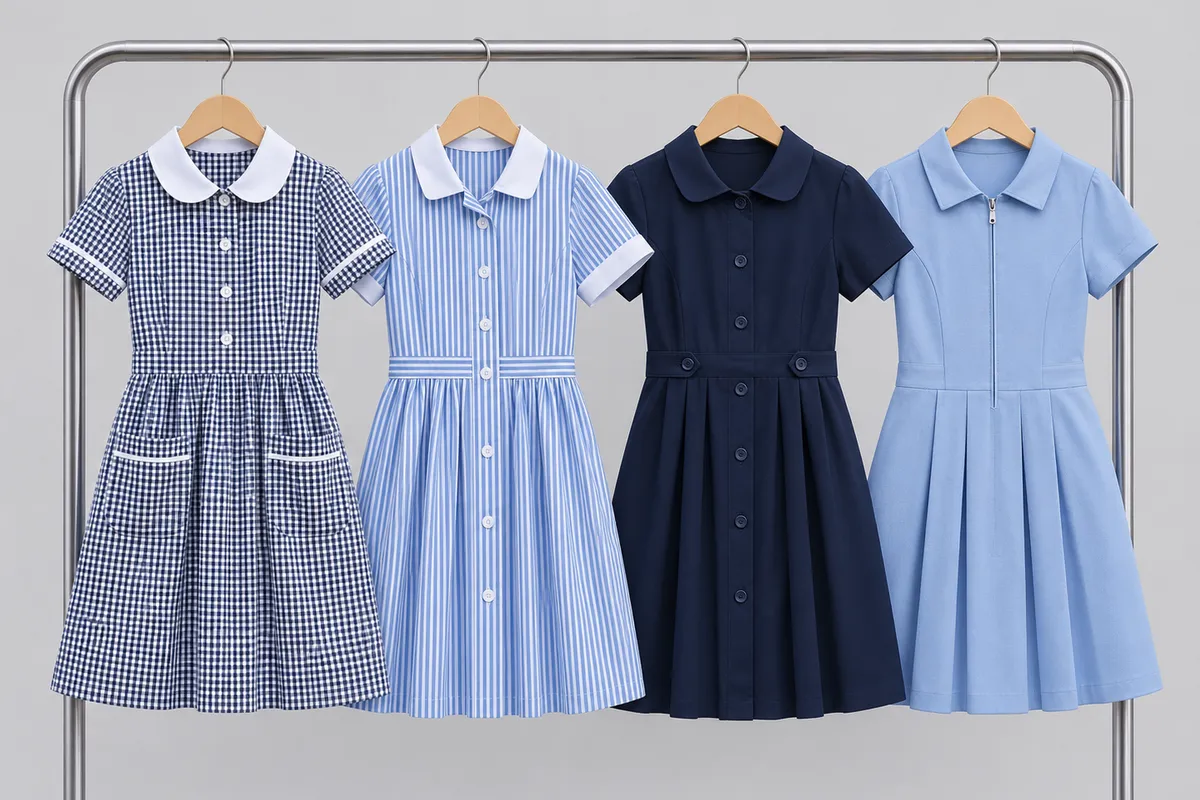
A summer uniform quantity split decides how many summer dresses to order against skirts, skorts and shorts when the school lets students choose. Start from what students chose last summer, then adjust for changes to the list, giving the dress the larger share in the younger years and expecting it to shrink as students get older.
This post is about quantities, not about which garment to put on the list. It helps shops, suppliers and schools divide one summer budget between dresses and the alternatives.
Why the split is hard to judge
When a uniform list says “summer dress, or skirt and blouse, or shorts and polo”, every family makes a choice, and the shop has to guess the result. The split varies by age, by school culture and by the weather in a given year. It can also shift suddenly when a school adds a new option, such as shorts for all students.
The dress is usually the riskiest part of the split. It is a single-season garment with no other use, while a skirt or shorts may be worn in other terms too.
Where do you get a first estimate?
Use the strongest data you have, in this order:
- Last summer’s sales, by garment and by year group.
- A school survey or pre-order, asking families which option they plan to buy.
- A fitting day count, recording each student’s choice.
- Observation, if the school can count what students wore last summer.
- Judgement, if none of the above is available.
Data by year group is far more useful than a single school-wide figure, because choices change with age.
An example split to adjust
The table is a starting example for a school where the list allows a dress, a skirt or skort, or shorts. It is not a forecast; change every figure against your own sales or survey.
| Year group stage | Summer dress | Skirt or skort | Shorts |
|---|---|---|---|
| Infants | Larger share | Small share | Small share |
| Lower primary | Larger share | Rising | Rising |
| Upper primary | About half | Rising | Steady |
| Lower senior | Smaller share | Larger share | Steady |
| Upper senior | Smallest share | Largest share | Steady |
The usual pattern is a dress that dominates the young years and gives way to separates later. Where that pattern does not hold in your school, trust your own figures.
Protecting the dress order from the uncertainty
Because dresses carry the most risk, plan them with some caution:
- Order dresses closer to the low end of your estimate for the main order
- Order separates that can carry into other terms a little more freely
- Book a top-up date for dresses in case demand runs higher
- Keep the dress in one style and one colour where possible, to concentrate stock
- Keep plain dresses, which carry over between schools, where the school allows
Each style must reach our minimum of 50 pieces for woven garments, with sizes mixed. If the dress share is small, it may be wise to keep it to a single style so the minimum is easy to meet.
Adjusting the split year by year
After each summer, compare the planned split with the actual sales by year group. If the dress share fell in one year group, ask whether that was weather, a list change or a lasting shift in preference. One season is a signal; two seasons in a row is a trend.
We manufacture school summer dresses in India, along with skirts, skorts and shorts in matching colours. The dress styles are on our school summer dresses page. If you sell through a uniform shop, our page for uniform shops and retailers sets out how we work with shops. Send us your intended split with your enquiry, and we will quote each style.
Questions buyers ask
Should a shop stock all three summer options in every size?
Not necessarily. Core sizes of each option are worth holding, but the edge sizes of a less popular option can be ordered on demand or through a top-up. That keeps the shop from holding three full ranges with slow sizes in each.
Does adding shorts to a uniform list reduce summer dress sales?
It often does, especially among older students, but the size of the change differs between schools. Record the first summer after the change carefully, and expect the dress share to settle over two or three seasons.
Can the dress and skirt be made in the same gingham?
Yes. A matching gingham or stripe across the dress and the skirt keeps the summer uniform consistent. The fabric is matched to your reference, and each garment is ordered as its own style.