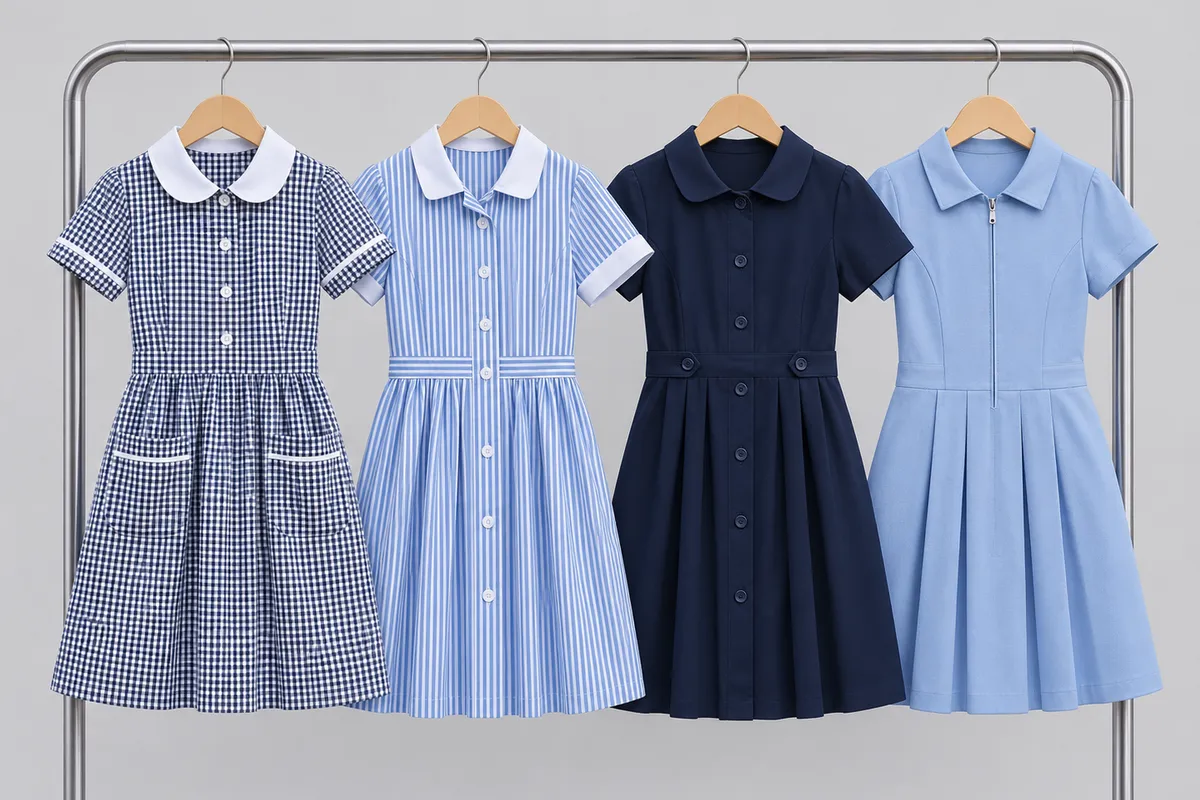
A striped school dress uses a fabric of coloured lines on a white or pale ground, usually running vertically from shoulder to hem. To order one accurately, a buyer needs to state three things: the width of each coloured stripe, the gap between stripes, and whether there is a second colour. Those three measurements define the fabric as clearly as the colour name does.
Stripes are chosen less often than gingham for school summer dresses, which is exactly why some schools pick them: a striped dress is easy to tell apart from the gingham worn at neighbouring schools.
What kinds of stripe are used on school dresses?
Stripe names overlap, so the descriptions below are working terms rather than fixed definitions.
| Stripe type | What it looks like | Typical use |
|---|---|---|
| Candy stripe | Coloured and white bands of equal width | The most common summer dress stripe |
| Pinstripe | Very fine coloured lines with wide white gaps | Reads as near-white; suits older students |
| Bengal or bold stripe | Wider coloured bands, often several millimetres | Bright and distinctive |
| Multi-line stripe | Two colours, or a main band with a fine line beside it | Used to carry two school colours |
| Seersucker-style stripe | Alternating puckered and flat bands | A textured look; specify only if you have a reference |
A candy stripe is the closest thing to gingham in feel: bright, regular and familiar. A pinstripe looks cooler and more grown-up, which is why some secondary schools use it for senior girls.
How to describe a stripe in an enquiry
Measure across the fabric, at right angles to the stripes:
- The width of one coloured band.
- The width of the white or pale band beside it.
- The width of any second-colour line, and where it sits.
- The full repeat: the distance until the pattern starts again.
A measurement over several repeats, divided by the count, is more accurate than measuring a single band. Send a photo with a ruler laid across the fabric, and if you have a piece of the fabric itself, send that too. A physical piece always gives the closest match.
How are stripes placed on the dress?
Stripes are directional, which brings some cutting decisions that gingham does not.
Vertical or horizontal. Almost all striped school dresses run the stripe vertically. Horizontal stripes are possible but are uncommon on school dresses.
Centre front. On a button-front or zip-front dress, the opening should sit either in the middle of a coloured band or in the middle of a white band, the same on every dress. This is agreed on the sample.
Side seams. Vertical stripes meet at the side seams. They will not always line up perfectly as stripes run straight but the body tapers, so the aim is a clean, consistent join.
Waist seam. If the dress has a gathered skirt, the gathers fan the stripes out below the waist. A fitted A-line skirt keeps them straighter.
Details on the cross. Pockets, cuffs, yokes and belts can be cut with the stripe running across rather than down. This is a deliberate design detail and should be specified, not left to the cutter.
Stripe versus gingham in practice
Compared with gingham, a stripe is easier to match at most seams but harder to keep consistent at the centre front, because one off-centre opening is very visible. Stripe fabrics with two colours need both shades approved. And a stripe on a white ground shows the white more, so the ground colour becomes an important part of the swatch approval. Our fabrics and colour matching page explains how swatches are approved before bulk fabric is made.
Specifying checklist for a striped dress
- Stripe type: candy, pinstripe, bold or multi-line
- Coloured band width, in millimetres
- Ground band width
- Second colour and its width, if any
- Ground colour: white or tinted
- What sits at the centre front: coloured or white band
- Any details cut across the stripe
- Collar in white, in a solid colour or in the stripe fabric
We make our striped dresses in poly-cotton, with the stripe matched to your colour reference and repeat. The minimum is 50 pieces per style, with sizes mixed within it. See the striped style on our school summer dresses page. When you send your measurements or a fabric piece, we will quote per style, by fabric, quantity and branding.
Questions buyers ask
Can a striped dress carry an embroidered logo?
Yes. A logo on the left chest or pocket can be embroidered on striped fabric. A fine pinstripe makes a calm background, while a bold stripe can make small lettering harder to read, so the logo size and position are confirmed on the sample.
Do vertical stripes make a dress look longer?
Vertical lines draw the eye up and down, so a striped dress often looks slightly longer and narrower than the same dress in gingham. This is a visual effect only; the measurements follow the agreed size chart either way.
Is a two-colour stripe harder to reorder?
It needs both colours matched each time, so there are two shades to check against the approved swatch rather than one. Keeping the approved swatch and a sample dress on file makes that check straightforward when you reorder.