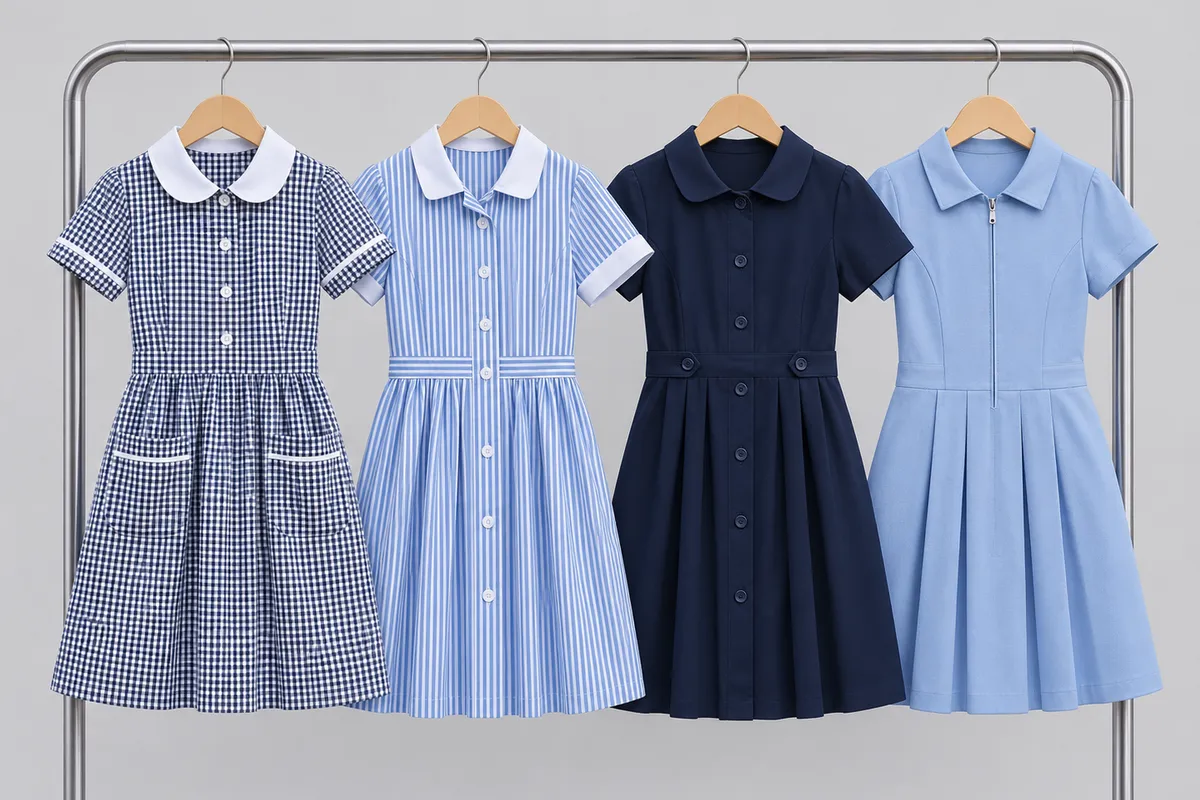
Many families buy a summer dress a size up for growth, hoping it will last the whole warm term and perhaps a second summer. For a shop or school, that habit moves demand one band higher than the roll suggests, so stock planned purely from ages will run short in the larger sizes and sit unsold in the smaller ones.
This post explains why families size up, how to spot the effect in your own sales, and how to plan a summer dress order that allows for it.
Why do families size up on summer dresses?
A summer dress is worn for one season and then put away for months. Parents know a child may grow over the break, so a dress that fits exactly in spring may not fit the following year. Buying one band up spreads the cost over two summers.
Summer dresses also make sizing up easy. A loose dress still looks acceptable, especially with a tie belt or elastic back. A slightly long hem can be turned up at home. The same parent might not size up on a blazer or trousers, where a poor fit shows more.
How the habit shifts demand
The effect is clearest when you compare the size a student’s age suggests with the size actually sold.
| Factor | Effect on demand | Where it shows |
|---|---|---|
| Families sizing up | Sales move one band higher | Upper core sizes sell out first |
| Dress with a forgiving waist | Sizing up is easier, so it happens more | Larger bands across the range |
| Fitted, sewn-waist dress | Sizing up looks poor, so it happens less | Demand follows age more closely |
| Order bought late in the season | Less reason to size up for growth | Demand drops back to age |
| Dress also worn the following year | Sizing up becomes common | Strongest in younger bands |
None of these is a fixed rule. They are reasons to check your own figures rather than assume age equals size.
How do you spot it in your own sales?
Compare two lists: the number of students in each age group, and the number of dresses sold in the matching band. If sales in each band are lower than the age group and sales in the band above are higher, families are sizing up.
A school with a fitting day can check directly. Record the size each student measured at and the size they bought. The gap between the two is the sizing-up habit in your community.
Planning stock when families size up
Once you know the habit exists, plan for it:
- Shift the ratio up one band in the core sizes, rather than adding extra pieces overall.
- Keep the smallest band lean. Fewer families buy the size their child fits today.
- Strengthen the largest age band and first chest size, which absorb children sizing up at the top.
- Watch exchanges. If many sized-up dresses come back as too big, guide families at the counter rather than cutting stock.
- Note the time of sale. Early-season buyers size up more than late buyers.
Size-ratio tables should always be treated as a starting example. Adjust them against your own sales, and let the sizing-up effect show you where the hump in your range really sits. Our size charts page explains how the measurements behind each band are agreed.
Dress details that help a sized-up dress work
If your community sizes up, a few specification choices make the dress look better on a child who has not grown into it yet: an elastic back or tie belt at the waist, a hem deep enough to let down later, and a sleeve that does not look oversized when slightly large. These follow your specification and are fixed on the approved sample.
We manufacture school summer dresses in India to your size chart and size mix. See the styles on our school summer dresses page. When you send an enquiry, tell us whether your families tend to size up, and we will suggest a size mix that allows for it.
Questions buyers ask
Should a shop advise families to buy summer dresses a size up?
A shop can explain the option without pushing it. A dress that is too big for comfort, or so long it trips a young child, is not a saving. Counter staff should check the fit and suggest the larger size only when it still looks neat.
Does sizing up mean we need fewer dresses in total?
Not usually in the first season, since every student still needs a dress. Over several years it can reduce repeat purchases, because some dresses last two summers. That shows up as lower demand in the following year, mainly in returning students.
Is sizing up more common in summer dresses than other uniform items?
It is common in any item worn for one season and stored, because growth over the break is expected. Summer dresses are especially easy to size up because they hang loosely, unlike tailored garments that show a poor fit more clearly.