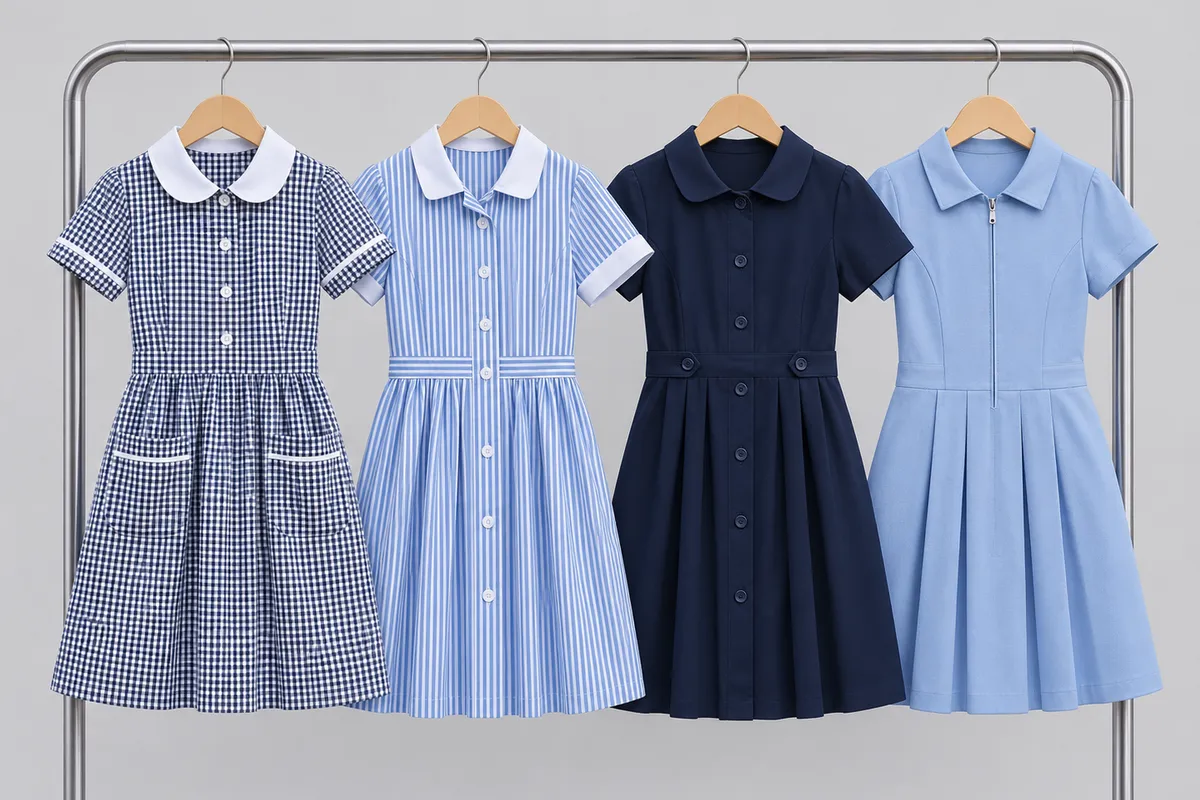
The switch from age to chest sizes on a summer dress usually comes where students move into the senior years, around age 12 to 14, because that is when age stops predicting fit. The exact point is a choice for each school or shop, and the aim is a smooth handover in which the last age band and the first chest size overlap rather than leave a gap.
This post helps buyers decide where to make the change on their summer dress range, how to bridge it, and how to explain it to families and counter staff.
Why make a switch at all?
Age bands work well while children grow at similar rates. In the early teens, rates diverge sharply. Some students are already adult height; others are still child-sized. A label like 13–14 then fits only part of the year group.
Chest sizes describe the student, not the birthday. They let a shop serve a twelve-year-old who needs an adult chest and a fourteen-year-old who does not, from the same rail.
Our summer dresses typically run in age bands from 3–4 to 13–14, then in chest sizes for seniors. A school can stop the age bands earlier if it wants chest sizing to start sooner.
Three places to make the switch
| Switch point | Suits | Watch for |
|---|---|---|
| After 11–12 | Schools where the dress ends at primary, or seniors wear a different dress | Senior students must find a chest size from day one |
| After 13–14 | Through-schools where the same dress continues into the lower senior years | Overlap between 13–14 and the first chest sizes |
| Age bands only | Primary schools with no senior dress | Tall older primary students may outgrow the top band |
There is no universal answer. A school that changes its uniform at senior entry has a natural break; a school with one dress for all ages needs a deliberate overlap.
How do you bridge the last age band and the first chest size?
The handover is where buyers most often get it wrong. If the first chest size starts well above the last age band, students in between have nothing that fits. If they overlap too much, the shop holds two near-identical sizes.
A practical approach:
- Take the chest measurement of the largest age band from the chart.
- Set the first chest size so its chest is one normal grade step larger.
- Compare lengths: the first chest size should be the same length or longer, never shorter.
- Check the shoulder and armhole too, since senior dresses are often cut for a more adult shape.
- Ask for both sizes on the sample if the change is new, and try them on students at the boundary.
Our size charts page explains how the full chart, including the handover, is agreed before the sample.
Labelling the change so families choose correctly
A size label that jumps from “13–14” to “84” can confuse a parent who expects the next age. Clear labelling solves most of it:
- Print the chest on the label for senior sizes, in the same unit used on the shop chart.
- Put a body chest guide on the age bands too, so parents can compare both systems.
- Show a single combined chart in the shop and on the school’s uniform page, with age bands and chest sizes in one table.
- Train counter staff to measure students at the boundary rather than sell by age.
Woven or printed own labels can be sewn in, so the size wording on the label is your choice.
Planning stock across the switch
Demand at the boundary is hard to predict in the first year. Hold modest quantities of both the top age band and the first chest size, record which one each boundary student takes, and use that record to set next year’s split. Sizes can be mixed within one style, so both sides of the switch can sit in the same order of 50 pieces or more.
We manufacture school summer dresses in India, sized to your chart on both sides of the switch. You can see our dress styles on the school summer dresses page. Tell us where you want the switch, and we will propose the first chest size before quoting.
Questions buyers ask
Can a summer dress range use chest sizes for every age?
It can, and some buyers prefer one system throughout. Younger families may find chest-only labels harder to use, so a body guide by approximate age on the shop chart helps them choose without measuring every child.
Do chest sizes on a dress match chest sizes on a blouse?
Not automatically. A blouse is tucked in and worn under other layers, while a dress hangs freely, so the ease differs. If you want matching size labels across both, agree it when the dress chart is set and check it on the sample.
What if a student is between the top age band and the first chest size?
Measure the student and choose the size whose chest clears the body comfortably. If this happens often, the bridge between the two sizes may be too wide, and the chart should be adjusted before the next order.