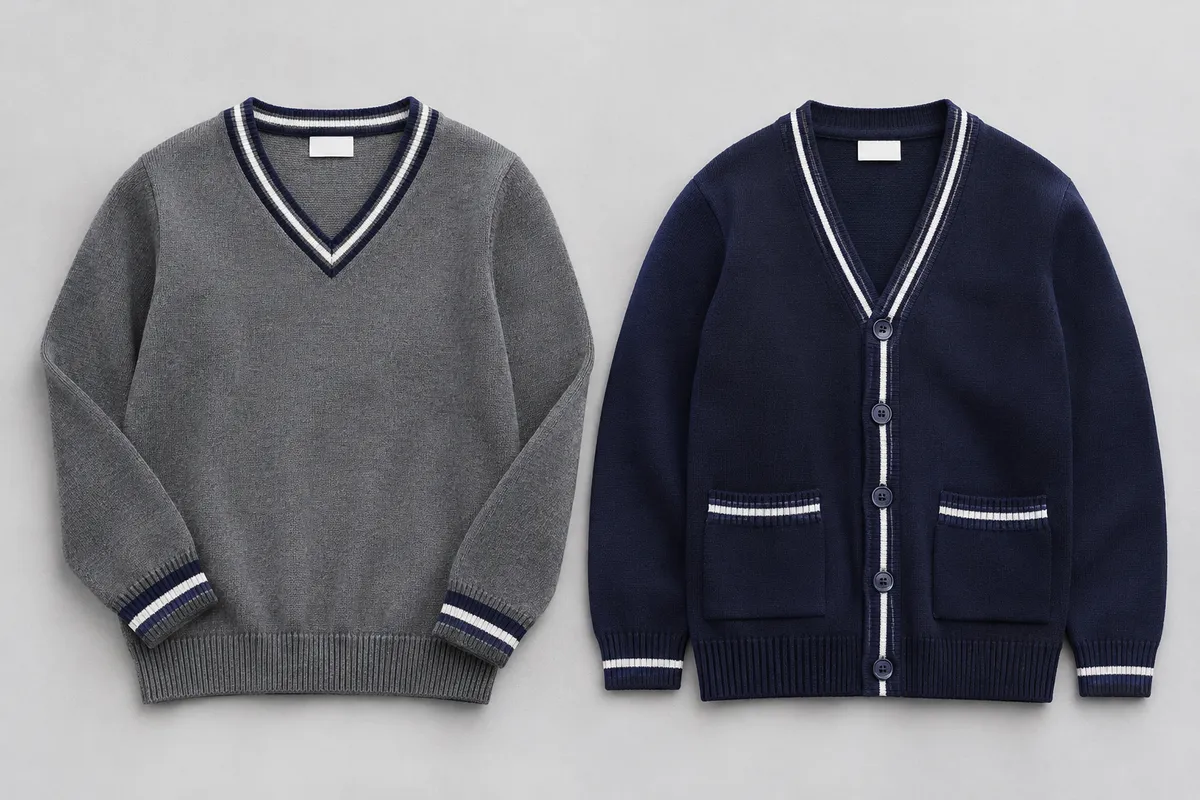
Slipovers in a school uniform range are usually a supporting line: an optional sleeveless layer that sells in smaller numbers than the jumper and at different times of year. The quantity to stock depends on whether the school lists it as an alternative to the jumper or as an extra, and on how many year groups are allowed to wear it.
This post helps schools and shops decide whether a slipover earns its place, how its demand behaves, and how to size the first order.
Does your range need a slipover at all?
A slipover is a knitted top with no sleeves, worn over a shirt. Schools add one for several reasons: as a lighter layer for warm classrooms, as something to wear under a blazer without bulk at the arms, or as a traditional look for older students.
Before adding it, ask the school:
- Is the slipover an alternative to the jumper, or an extra layer worn with it?
- Which year groups may wear it?
- In which months is it allowed?
- Is it the same colour and trim as the jumper?
If the answers are “optional, a few year groups, some months”, the slipover will be a small line. If it replaces the jumper for a whole section of the school, it becomes a core line and should be planned like one.
How slipover demand differs from jumper demand
The pattern through the year is often different from the jumper’s. Slipovers tend to sell in the cooler weeks either side of winter, when a jumper feels too warm, rather than in the coldest weeks.
| Point in the year | Jumper demand | Slipover demand |
|---|---|---|
| Start of the school year | High | Moderate, mostly new students |
| Weather turning cool | Rising | Steady |
| Coldest weeks | Highest | Lower; students switch to jumpers |
| Weather warming again | Falling | Can rise again |
| Warm months | Low | Low to moderate, where allowed |
This is a general pattern; your own sales will show whether it holds for your schools. The practical point is that a slipover top-up may be needed at a different time from a jumper top-up.
How many slipovers should the first order include?
Each knitted style has a minimum of 100 pieces, with sizes mixed. For a small school, 100 slipovers may be more than a single season needs. That is not always a problem, because plain or school-specific slipovers carry well into the next year if the uniform stays the same.
A planning approach:
- Count the eligible students. Only the year groups allowed to wear it.
- Estimate the share who will buy one. Ask the school what it sees in the playground; optional items are usually bought by a minority.
- Compare with 100. If the estimate is well below, decide whether to order 100 and hold the rest, or to wait a season.
- Split by size. Our slipovers are listed from age 7–8, then through to chest sizes for senior students; skip any sizes your eligible year groups will not need.
Schools ordering for their own office can read more on our page for schools and school groups.
Keeping the slipover in step with the jumper
If the slipover and jumper share a colour and trim, they should look like a set. Knitting both from the same yarn colour keeps them matched on the shelf. The stripe trim on the slipover sits at the V-neck and the armholes; on the jumper, at the neck, cuffs and hem. Confirm both on the samples together.
- Same body colour reference for both styles
- Same stripe colours and order, approved side by side
- Same size labels and pack stickers
- Logo in the same position, if one is embroidered
If you are considering a slipover for one of your schools, send us the eligible year groups and a colour reference, and we will quote your slipovers, jumpers and cardigans per style, by fabric, quantity and branding.
Questions buyers ask
Can a slipover replace the jumper in summer?
Some schools allow a slipover in warmer months instead of the jumper, especially where classrooms are air-conditioned. If so, demand will extend into the summer term and a larger quantity is justified.
Should a shop stock slipovers for schools that do not list them?
Usually not as a school item. A plain slipover in a standard colour under the shop’s own label can work as a general line, but only where local demand is known.
Do slipovers sell more to older students?
In some schools they do, because older students see them as a smarter option under a blazer. In others they are popular in primary. Ask each school, as habits vary.