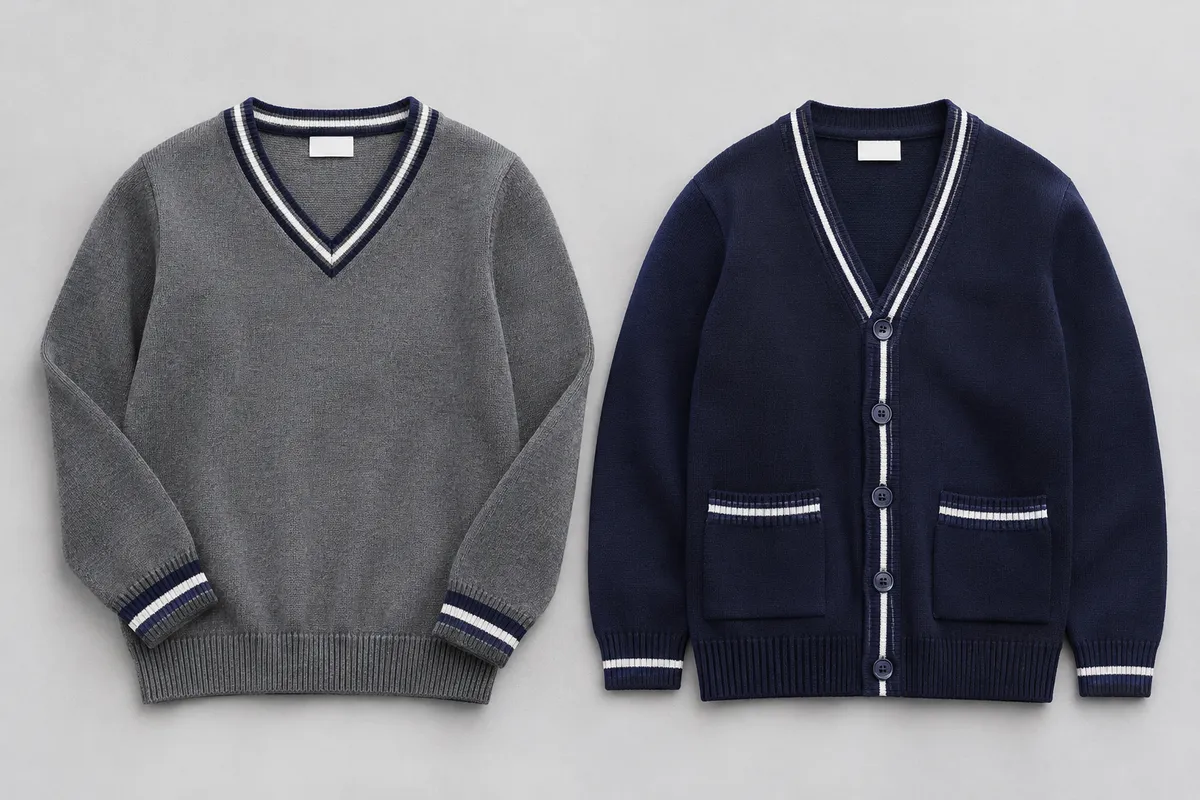
A snagged school jumper has a loop of yarn pulled out of the knit by something sharp or rough, such as a hook-and-loop fastener, a desk edge or a bag zip. Snagging is a normal risk with any knitted garment, because knit is made of loops; it is not a defect in itself. What buyers can influence is how easily loops are caught and how neatly the knit can be eased back.
This post explains why snags happen, which choices reduce them, and what shops can tell families.
Why knit snags at all
Woven fabric has threads locked in a grid. Knitted fabric is a chain of loops, each held by the next. When a sharp point catches one loop and pulls, the loop grows longer and draws yarn from its neighbours. The result is a raised loop on the surface and, often, a slight pucker either side where the yarn was taken from.
Unlike a hole, a snag usually leaves the knit intact. With care it can be eased back.
Common causes in school life
| Cause | Where on the jumper | Note for families |
|---|---|---|
| Hook-and-loop fasteners on bags, shoes or coats | Sleeves and body | Close fasteners before washing other items with the jumper |
| Rough desk or chair edges | Forearms and cuffs | Hard to avoid; small snags can be eased back |
| Zips on bags and jackets | Body and hem | Wash jumpers separately from zipped items or close zips |
| Jewellery, watches, badges | Cuffs and chest | Check clasps and pins |
| Playground surfaces and fences | Elbows and sleeves | Part of outdoor play |
| Pet claws at home | Anywhere | Not a school issue, but common |
Choices that affect snagging
Knit structure
Plain knit with a smooth, tight surface has fewer exposed loops than open or textured stitches. That is one reason school jumpers are usually plain knit with rib edges. Cables and loose textures snag more easily.
Gauge and tension
A finer, firmer knit holds its loops more closely, leaving less to catch. A loose knit is softer but more vulnerable.
Yarn
Smooth yarns snag less than hairy or slubby ones. Acrylic and cotton-acrylic yarns for school knitwear are spun to be fairly smooth. The yarn is confirmed at quotation and on the sample.
We do not give snag resistance ratings. The most useful way to judge is to handle the sample: run a fingernail lightly across the knit and see how readily a loop lifts, and compare against the jumper you sell now.
What shops can tell families
A short note at the till or on the shop website helps families keep jumpers looking tidy:
- Do not cut a snagged loop; that can start a hole
- Ease the loop back by gently stretching the fabric either side of it, along the row
- If the loop stays, push it through to the inside with a blunt needle or crochet hook
- Wash the jumper inside out, and keep it away from hook-and-loop fasteners and zips in the wash
- Dry flat, so the knit settles evenly
These are general care tips, not instructions from a test. They suit both acrylic and cotton-acrylic jumpers.
Checking a sample for snag risk
When you look at a sample, check the surface is even and firm, the rib is closely knitted, and the badge embroidery has no loose threads that could catch. Our page on fabrics and colour matching explains what we confirm about the yarn alongside the colour. We manufacture in India and make every repeat order to the same approved sample, so the knit you approve is the knit you receive.
If snagging has been a complaint with your current jumpers, tell us when you enquire, send one if you can, and we will quote your knitted jumpers and cardigans per style, by fabric, quantity and branding.
Questions buyers ask
Is a snag the same as a hole?
No. A snag is a loop pulled out of the knit, with the yarn still unbroken. A hole means the yarn has broken. A snag can usually be eased back; a hole needs mending.
Do cardigans snag more than jumpers?
Not because of the style. The knit is the same. Cardigans may snag slightly more at the front band if worn open and catching on bag straps, but the difference is small.
Can a snagged loop lead to a run, like in tights?
Knitwear can ladder if a broken loop is pulled, but an unbroken snag usually stays put. Easing it back or pushing it to the inside stops it getting worse.