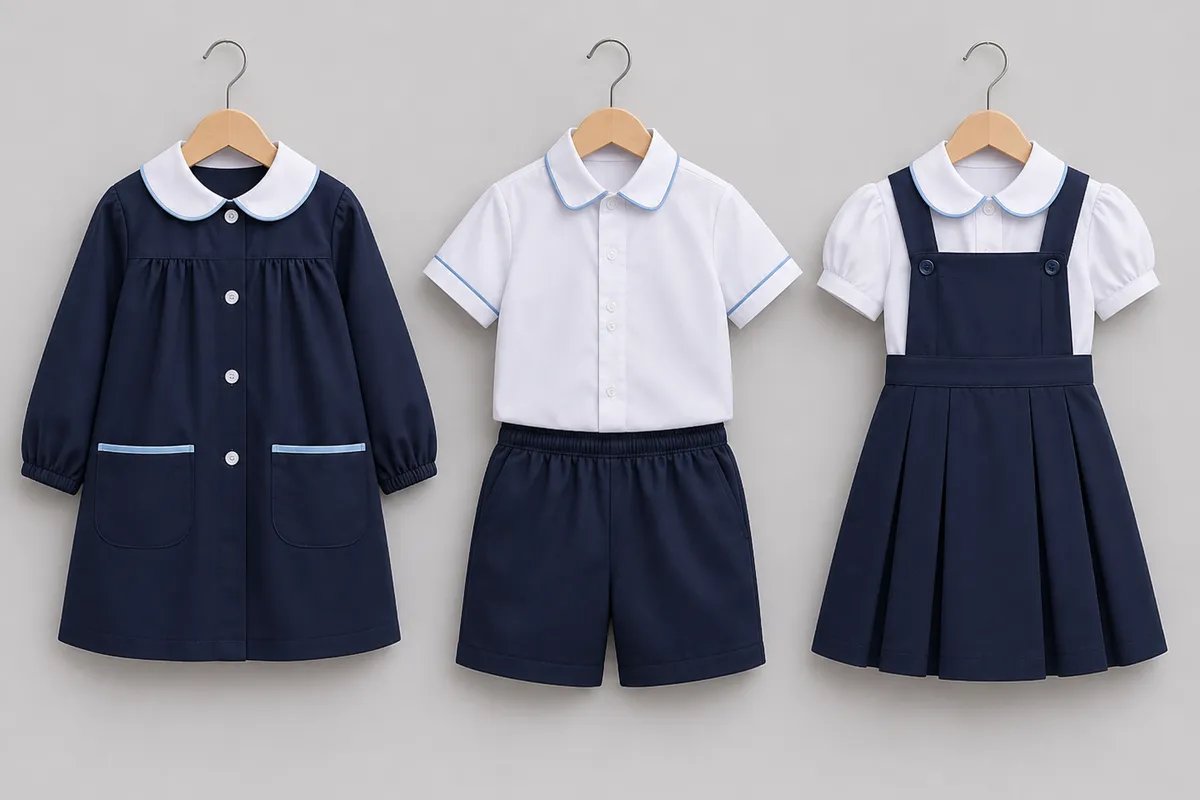
Plan nursery uniform sizes by room, not by age alone, and order each child one size ahead of the age band they are in now. Children between two and six grow fast and unevenly, so a size bought in September can be tight by spring, and a nursery that takes new children through the year needs stock on hand at more than one point.
This guide covers how to set your age bands, how to turn room numbers into an order, how sets and separate pieces change the plan, and when to top up.
Age bands for the early years
Our nursery styles are sized by age band. The smock runs from age 2–3 to 5–6, and the shirt-and-shorts set and pinafore set run from age 2–3 to 6–7. The size chart is agreed for each order, and your own size range may be narrower. A nursery that takes children only to age four may need just three or four sizes.
At this age, the label matters less than the fit. A tall two-year-old may need a 3–4; a small five-year-old may still fit a 4–5. Two practical rules help:
- Size up for growth. Order the size above the child’s current age for anything bought at the start of the year. A loose smock or elastic-waist shorts still fit; a tight one does not.
- Check length as well as chest. A smock or pinafore that is too short looks wrong sooner than one that is a little wide. Agree body length carefully on the chart.
Our size charts page explains how the chart is agreed and what measurements it covers.
From room numbers to an order
Nurseries usually group children by room, and each room covers a narrow age range. That makes room numbers a good base for planning. List each room, the number of children, and the age range, then assign sizes with a one-size step up for growth.
The table below is a starting example for a nursery with four rooms. Adjust it to your own rooms, roll numbers and past sales. It is a planning aid, not a forecast.
| Room (example) | Ages in room | Main size to order | Also order |
|---|---|---|---|
| Toddler room | 2 to 3 | Age 3–4 | A few 2–3 for the smallest children |
| Pre-school, younger | 3 to 4 | Age 4–5 | A few 3–4 |
| Pre-school, older | 4 to 5 | Age 5–6 | A few 4–5 and 6–7 |
| Reception or kindergarten | 5 to 6 | Age 6–7 for sets; 5–6 for smocks | A few 5–6 |
| Spare stock | All rooms | Spread across the two most common sizes | For new starters and accidents |
The spare stock line matters in a nursery. Uniforms get wet, painted and torn more than at any other stage, and new children may start at any point. Holding a small buffer in the most common sizes saves a rushed reorder.
In some nurseries, smocks are shared by several children in a messy-play area. If the nursery owns the smocks rather than issuing one per child, order fewer, in the larger sizes of each room’s range, so one smock fits most of the room.
Sets, separate pieces and the minimum
Woven nursery styles start at 50 pieces per style, and sizes can be mixed within a style. Whether you order full sets or separate pieces changes how you plan sizes.
- Full sets. The shirt and shorts, or pinafore and blouse, come in the same size and can be packed together in one bag with a size sticker. Simple to hand out, but a child who needs a different size top and bottom cannot be fitted from a set.
- Separate pieces. You can order more shirts than shorts, and size them independently. This suits shops and nurseries where tops are replaced more often than bottoms.
Tell us which you want at enquiry, and we confirm how the minimum applies in the quotation. Our minimum order and samples page explains the minimum in more detail.
Mid-year intakes and top-ups
Some nurseries take children at several points in the year, not only in September. Plan a main order for the largest intake and at least one top-up for the next. Lead time is confirmed in the quotation, so set each top-up date by counting back from the intake, with time for dispatch and delivery.
A useful habit is to record the size issued to each child. By the second order you have your own size data, which is far better than any starting example. Repeat orders are made to the approved sample and the agreed size chart, so new uniforms match the ones already in use.
A short checklist before you order:
- Rooms, age ranges and numbers listed
- Sizes stepped up one band for growth
- Spare stock in the two most common sizes
- Sets or separate pieces decided
- Smock quantity set by use: per child or shared
- Top-up dates set against each intake
You can see the nursery styles and size range on our nursery and kindergarten uniforms page.
Send us your room numbers, age ranges and intake dates, and we will prepare a quotation quoted per style, by fabric, quantity and branding.
Questions buyers ask
How many uniforms should each child have?
If the uniform is worn every day, plan for at least two per child so one can be in the wash, and more for smocks used at messy play. Adjust from what families actually buy once you have a term of records.
What if our nursery keeps children beyond age six?
The listed bands are planning examples, and your size range is agreed for each order. Older children usually move on to school uniform, which we make in shirts, trousers, skirts and pinafores in larger sizes.
How should sizes issued be recorded?
A simple sheet works: the child’s room, start date, the size issued and the date of each change. After two or three intakes it shows when children move up a size, which sharpens every later order.