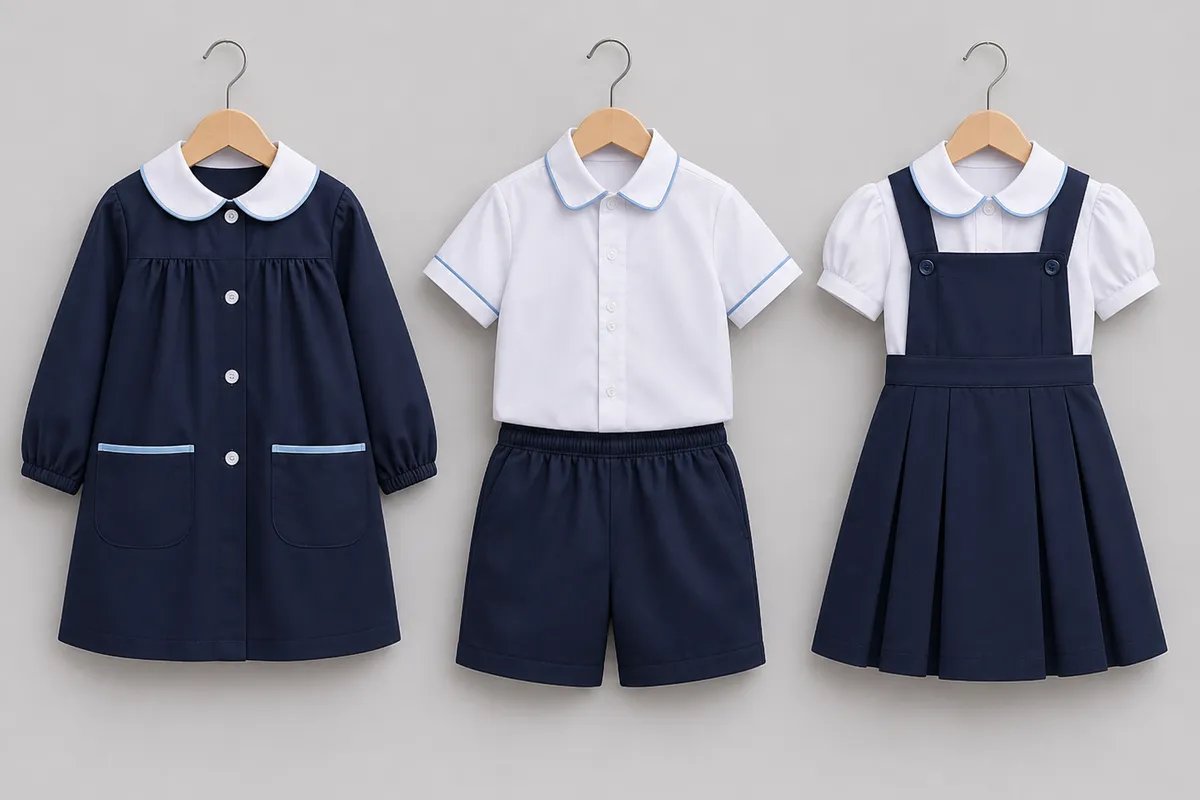
A nursery spare uniform box is a small stock of sets and smocks the setting owns and keeps in each room, so a child who has an accident or gets soaked can change straight away. A useful size for the box is enough to change a few children in one day in each of the room’s main sizes. Planning it as part of the main order means the spares match what children already wear.
Why should a nursery keep its own spare uniform?
Families are usually asked to send a change of clothes, but bags get forgotten, and the spare clothes are often the child’s own rather than uniform. A nursery-owned spare box solves several everyday problems.
- Toilet accidents in the toddler and pre-school rooms need a quick, calm change.
- Water and sand play soak clothes in minutes.
- Paint and food can mark a set beyond what a wipe will fix.
- Children who arrive without uniform can be lent a set for the day.
A matching spare also keeps the child looking like everyone else, which matters more to small children than adults sometimes expect.
How many spares does each room need?
The right number depends on the age of the room. Younger rooms need more changes per day, and older rooms fewer. The table is a starting example to adapt to your own rooms and laundry routine.
| Room | Example spare sets held | Example spare smocks | Sizes to cover |
|---|---|---|---|
| Toddler room (2 to 3) | 6 to 8 | 4 | 2–3 and 3–4 |
| Younger pre-school (3 to 4) | 4 to 6 | 4 | 3–4 and 4–5 |
| Older pre-school (4 to 5) | 3 to 4 | 3 | 4–5 and 5–6 |
| Kindergarten or reception (5 to 6) | 2 to 3 | 2 | 5–6 and 6–7 |
Weight the spares to the larger of the two sizes for each room. A slightly big set is fine for an afternoon; one that is too small is not.
Spare underwear, socks and other items are not part of the uniform we make, so source those separately for the same box.
Running a spare uniform loan box
A loan box only works if spares come back. A simple routine keeps it going.
- Label the box by room and size, and keep it where staff can reach it quickly.
- Log each loan on a sheet: child, date, item and size.
- Send a note home asking for the item to be washed and returned.
- Chase gently after a week, and write off items not returned at the end of each term.
- Restock from the shelf or the next order.
Some settings mark spare garments on the label with a small “spare” stamp or a coloured thread, so they can be spotted and returned. If you want this done during making, ask for it at enquiry and it is confirmed with the sample.
Ordering spares with the main order
The easiest time to buy spares is when you place the main order. They come from the same production, so shade and logo match exactly, and they add to the style total. Nursery styles start at 50 pieces per style, with sizes mixed, so adding spares can help a small nursery reach the minimum.
Use this checklist before you send the order:
- Spares counted for every room
- Sizes chosen at the larger end of each room’s range
- Spare smocks counted separately from sets
- Loss and non-returns allowed for over the year
- Spares included in the size split sent for quotation
Our page for schools and school groups describes how we work with settings ordering direct, and the garments are on our nursery and kindergarten uniforms page. Include your spare quantities when you ask us to quote, and they will be priced together with the rest of the order.
Questions buyers ask
Should spare nursery uniform carry the logo?
Usually yes, so a child in a spare looks the same as their friends. If the setting wants to keep costs down, plain spares in the same colour also work, as long as they are made to the same sample and shade.
How often should a nursery replace its spare uniform?
Check the box each term. Replace stained or worn items and anything not returned, and adjust sizes if a room’s age mix has changed. Most settings top up spares in their regular reorders rather than separately.
Can a nursery lend spares instead of asking families to buy more sets?
A loan box covers emergencies, not daily wear. Families still need enough sets for their child’s attendance, and the box should be kept small enough to manage and check easily.