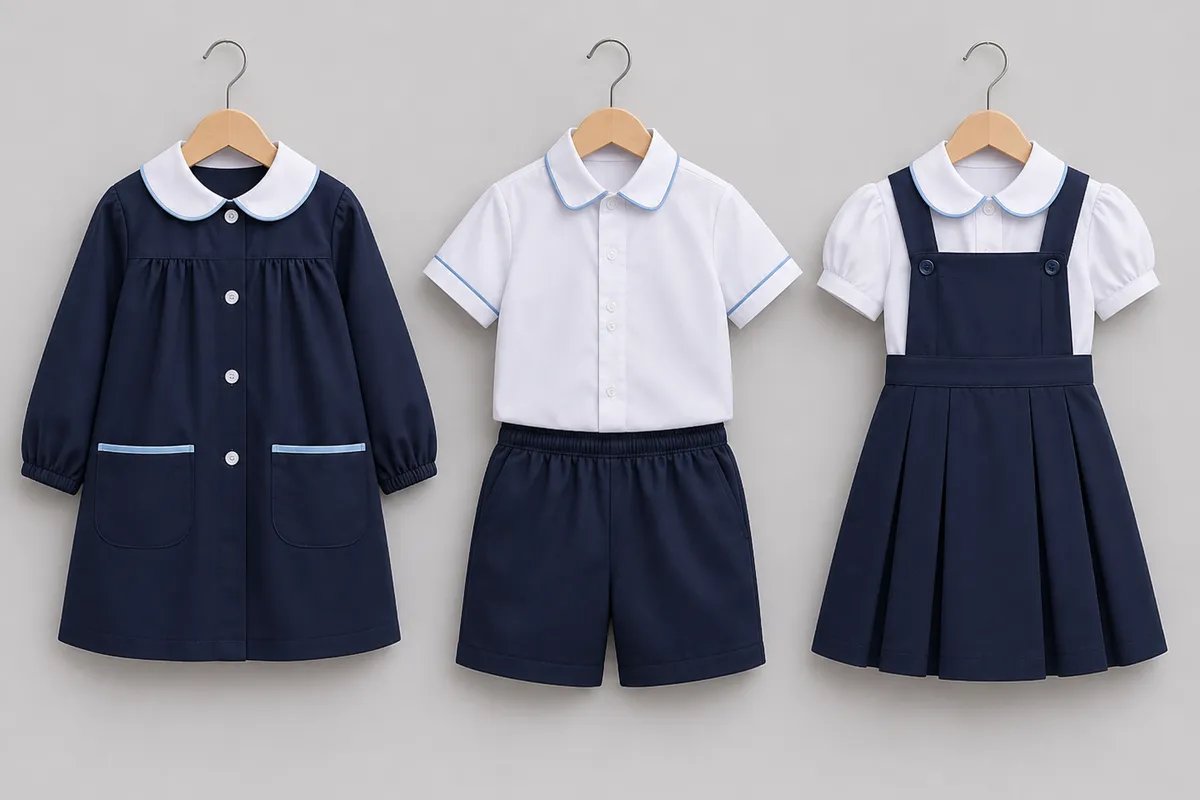
Nursery uniform trims are the small extras added to a garment for decoration: piping, braid, ribbon, bows, lace, appliqué and decorative buttons. Many buyers keep these few and small on nursery garments, because every extra part has to be matched, sewn, washed and reordered, and because young children pull at anything that sticks out. Character can come from colour, collar and logo instead, which repeat more easily from one order to the next.
What counts as a trim?
In this post, a trim is anything sewn onto a garment that is not needed for it to work. Fastenings, pockets and collars are functional parts; the list below is decoration.
| Trim | What it is | Common on nursery wear? |
|---|---|---|
| Piping | A narrow folded strip sewn into a seam or edge | Sometimes, on collars and pockets |
| Braid | A woven tape stitched on the surface | Occasionally, at hems or pockets |
| Ribbon or bow | A tied or stitched ribbon detail | Occasionally, on pinafores |
| Lace | A decorative edging | Rare on bulk uniform |
| Appliqué | A shape cut from fabric and stitched on | Rare; more common in fashion kidswear |
| Decorative buttons | Buttons with no fastening role | Rare |
Why buyers often choose fewer trims
Every trim needs its own reference. A navy piping must match the navy of the collar and the shorts. That is another shade to approve and another to match again on reorders.
Trims change the wash behaviour. A ribbon, braid or appliqué may react to washing differently from the main fabric. The garment ends up only as tidy as its weakest part.
Young children tug at things. Bows, loose loops and raised details invite pulling. Buyers often prefer flat, stitched-down details for that reason. This is a general design preference, not a statement about any standard.
Trims add making time. Each extra piece is cut, prepared and sewn, which shows in the quotation.
Trims date. A decorative detail that looks fresh this year may feel old-fashioned in three, while a plain set still looks right.
Simpler ways to give a uniform character
If the aim is a uniform that looks special without being fussy, these choices work hard and repeat easily:
- A contrast collar. One colour change, in a place everyone sees.
- A contrast pocket. Repeats the collar colour lower down.
- A well-placed logo. Logo embroidery or printing is available on the chest, pocket or bib.
- A distinctive main colour. A teal or a coral stands out more than any braid on navy.
- Topstitching in a contrast thread. A subtle detail sewn flat into the garment.
If you do want a trim
Some nurseries have a trim that has become part of their identity. If so, it is worth specifying carefully:
- Name exactly where the trim goes and how wide it is
- Supply a reference for its colour
- Ask for it to be stitched flat along its length, not only at the ends
- Check it on the sample after the garment has been worn and washed
- Record it on the specification sheet for reorders
For a smock, remember the fastening (buttons or press studs, as specified) and any trim should not compete for the same space at the front.
A note for shops and suppliers
A supplier dressing several nurseries from one base design will find plain garments with colour and logo variations easier to manage than one design with different trims for each nursery. Our page for schoolwear suppliers and distributors explains how multi-nursery orders are usually set up. The base styles are on our nursery and kindergarten uniforms page.
We manufacture nursery smocks and sets in India, plain or with the details you specify. Send your design and tell us which trims are essential, and we will quote the style and show every detail on the sample.
Questions buyers ask
Is piping a reasonable compromise between plain and decorated?
Often, yes. Piping is narrow, sewn into a seam or edge and lies flat, so it adds a line of colour without loose parts. It still needs its own colour reference, so treat it as an extra shade to approve.
Can a trim be removed at a later reorder?
Yes. Removing a trim is a change to the garment, so we confirm it on a new sample or by agreement in the quotation. Removing it can also simplify matching on later orders.
Do embroidered names or motifs count as trims?
A logo is usually treated as branding rather than trim. Additional motifs work like a second logo. Each needs artwork, a position and a size, which are confirmed on the sample.