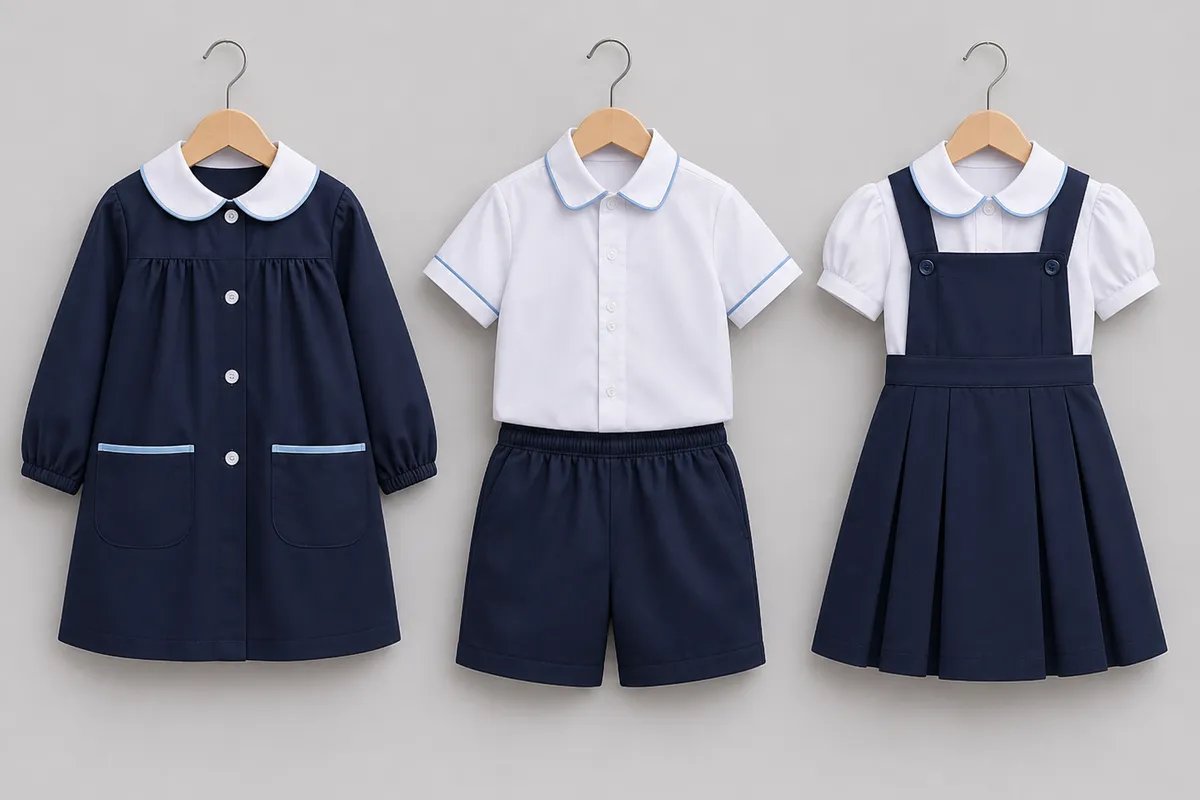
A back-opening nursery smock fastens down the back, so an adult does it up and the child cannot easily pull it open during painting or water play. A front-opening smock fastens down the chest, so older nursery children can begin to dress themselves and staff can see the fastening at a glance. Which one suits a nursery depends on the age of the children, how the smock is used during the day and where the logo will go.
How the two openings differ
| Point | Back opening | Front opening |
|---|---|---|
| Who fastens it | An adult, nearly always | An adult, or an older child learning |
| Child pulling it open | Unlikely | Easier |
| Logo space on the chest | Full front free | Logo sits beside the fastening or on a pocket |
| Speed for staff | Quick once the child turns round | Quick, face to face |
| Look from the front | Clean, apron-like | Shirt-like, with a visible placket |
| Common use | Art, messy play, younger rooms | Everyday wear, older nursery rooms |
Both openings use buttons or press studs, as specified. The type and number are confirmed on the sample.
When a back opening makes sense
Back-opening smocks come from the tradition of art overalls. They are designed to be put on, fastened by someone else and left alone until the activity ends. That suits:
- Younger rooms, where children are two or three and are not yet dressing themselves.
- Messy activities, where a child undoing a front fastening would let paint through.
- A clean front for a larger logo or a plain block of colour.
The drawback is independence. A child who wants to take the smock off for the toilet needs an adult every time, and a child who arrives already dressed cannot put it on without help. For a smock that is worn all day, that can add up.
When a front opening makes sense
A front opening treats the smock more like a garment the child wears than a cover the adult puts on. That suits:
- Older nursery and kindergarten children, who are practising fastenings.
- All-day wear, when the smock goes on at arrival and comes off at home time.
- Quick checks, as staff can see at once whether a smock is done up.
The front placket needs room, so a chest logo usually moves to one side or onto a pocket. Logo embroidery or printing is available in either position.
Questions to answer before choosing
- Is the smock worn all day or only for activities? All-day wear leans front; activity wear leans back.
- How old are the youngest children who will wear it? Two-year-olds are usually dressed by staff whatever the opening.
- Where should the logo go? A full-front logo is easier with a back opening.
- Do you want children to practise fastenings? If yes, front opening, with fastenings sized for small hands.
- Are there separate art overalls already? If so, the uniform smock can be front-opening and the art cover can stay as it is.
Some nurseries order both: a front-opening smock as the uniform and a back-opening version for art. Each counts as a separate style, with a minimum of 50 pieces per style and sizes mixed.
Checking the opening on the sample
The opening is where a smock gets the most handling, so check it carefully when the sample arrives:
- The opening is long enough for the smock to pass over the head and shoulders
- Fastenings line up when the smock is closed
- The placket lies flat and does not gape between fastenings
- A member of staff can fasten and unfasten it in a few seconds
- The logo, if any, sits where you expected relative to the opening
Our sample is made in your colour and fabric, so the opening you approve is the one that goes into bulk production. The smock and the other styles are on our nursery and kindergarten uniforms page, and nurseries ordering directly can read our page for schools and school groups.
We manufacture smocks with either opening in India. Tell us which opening you want, or send a smock you already use, and we will quote and make a sample for you to try on a child.
Questions buyers ask
Can a back-opening smock have a pocket on the front?
Yes. With the fastening at the back, the front is free for a pocket, a logo or both. A single patch pocket below the logo is a common arrangement on back-opening smocks.
Is a shoulder opening an alternative to front or back?
It is. A shoulder opening keeps both front and back plain and suits a round neck that needs a little more room to pass over the head. It is usually fastened by an adult, like a back opening.
Are press studs easier than buttons on a back opening?
Press studs are often quicker for staff working behind a child, because they close with a press rather than a twist. Buttons look more traditional. Both are possible, and the choice is confirmed on the sample.