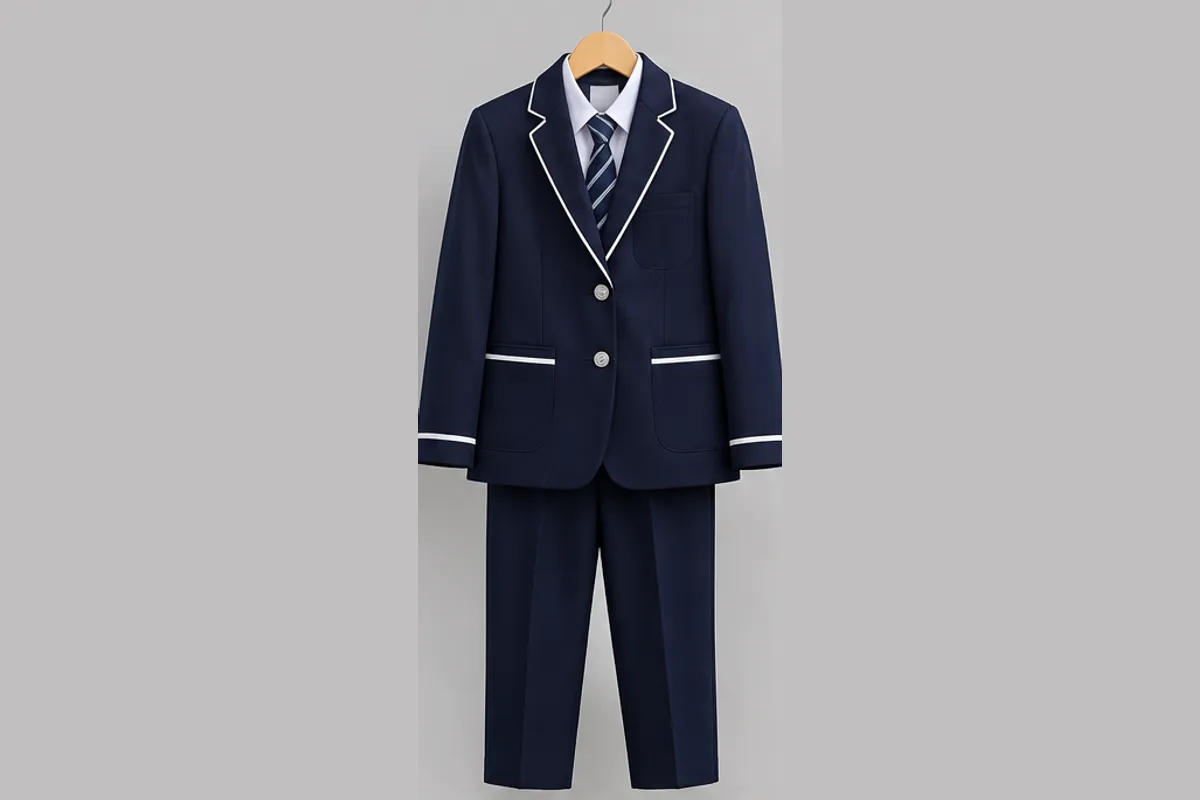
A sew-on blazer badge is a school badge made as a separate embroidered piece, with its own backing and finished edge, which is then stitched onto the breast pocket. It suits shops and suppliers who hold plain blazers and badge them later, and schools whose badge has fine detail that needs a firm base. The size, edge finish and stitching are all confirmed on the sample.
The alternative is embroidering the badge straight onto the pocket. Both look smart; the right choice depends on how the blazers are stocked and sold rather than on appearance alone.
How is a sew-on badge made and attached?
The process has four stages:
- Artwork. You send the badge artwork. We confirm the finished size, thread colours and any small text that may need simplifying.
- Embroidery on a base. The badge is embroidered onto a backing fabric, often in the blazer colour or a solid colour that suits the design.
- Edge finish. The outline is finished so it does not fray, typically with a dense satin-stitched border or a cut edge sealed and backed.
- Attachment. The badge is positioned on the breast pocket and stitched round its edge, by hand or machine, keeping clear of the pocket opening.
Logo embroidery or printing is available for badges, and the method, size and position are confirmed when you see the sample garment.
Sew-on or direct embroidery: which suits your order?
| Question | Sew-on badge | Embroidered on the pocket |
|---|---|---|
| Can plain blazers be badged later? | Yes, badges can be stocked separately | No, the badge is part of the blazer |
| Fine detail and small text | Often clearer on a firm base | Depends on the cloth and stitch density |
| Look on the pocket | Slightly raised, with a visible border | Flat, part of the cloth |
| One blazer for several schools | Easy: one plain blazer, many badges | Needs a badged style for each school |
| Moving a badge to a new blazer | Possible, with care | Not possible |
For a single school buying badged blazers for all students, direct embroidery is often the neater choice. For a shop serving five schools that share navy blazers, sew-on badges let one plain stock line serve every school.
What size should a sew-on blazer badge be?
The badge has to fit the pocket with a margin on all sides, and sit below the pocket mouth so it is not caught when students put pens in. Points to agree:
- width, measured across the widest part of the badge
- the gap left at the top of the pocket
- whether one badge size is used for all blazer sizes, or a smaller badge for junior sizes
- the border colour, which frames the badge against the cloth
A single size across the range is simpler to stock. If the smallest blazers have narrow pockets, a second, smaller badge can be made. We check the fit on the smallest and largest sizes you order.
Supplying badges separately to a shop
Some shops want blazers and badges supplied together but unattached, so they can sew badges on as they sell. Others want blazers delivered badged, with a quantity of spare badges for repairs and for families who buy a second-hand blazer. State the split on your enquiry, so packing and labelling match how you plan to sell. Our page for uniform shops and retailers explains how plain and badged lines are combined in one order.
Send your artwork, the blazer colour and how many badges you want attached or loose. We quote school blazers by fabric, quantity and branding, and you approve the badge on a sample blazer before production.
Questions buyers ask
Can families sew a replacement badge on themselves?
They can, if the shop sells loose badges. A badge stitched round its border by hand holds well. Some shops offer to attach badges themselves, which keeps the position consistent across the school.
Does a sew-on badge add weight to the pocket?
A little. A firm backing helps the badge sit flat, and a light badge on a well-made pocket does not pull it out of shape. We check that the pocket still lies flat on the sample.
Can the badge backing match the blazer cloth?
Yes. Using a base close to the blazer colour makes the border blend in, so the badge looks almost embroidered in place. A contrast base, framed by the border, gives a more traditional crest look.