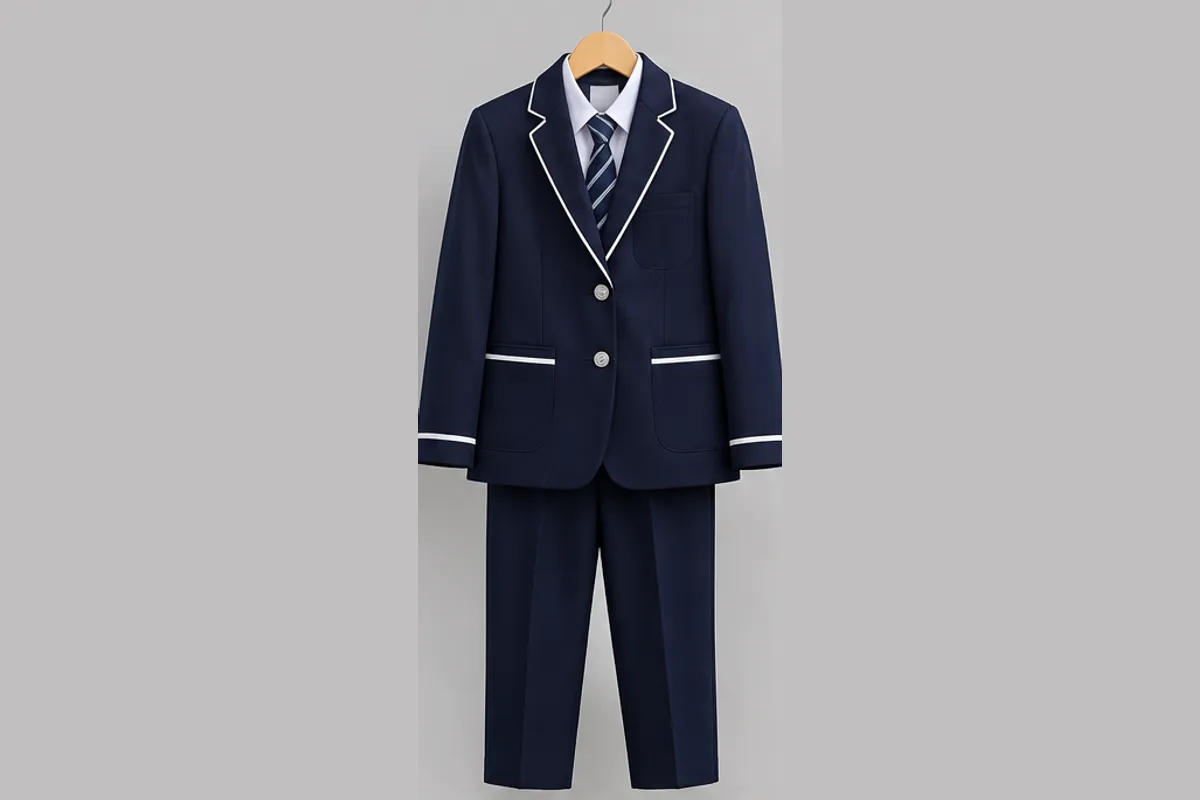
Blazer shoulder pads are shaped layers of soft material placed inside the shoulders to give a smooth, defined line; sleeve heads are narrow strips sewn into the top of the sleeve so it rounds out neatly instead of dimpling. On school blazers, both are usually light or absent: a soft, natural shoulder suits growing students and survives washing better than heavy padding. Whether to include them, and how much, is a construction choice confirmed on the sample.
Few buyers think about the shoulder until something looks wrong: a sleeve that collapses below the shoulder seam, or a junior blazer that makes a small child look like a box. Both come down to these hidden parts.
What do pads and sleeve heads actually do?
Shoulder pads fill the hollow below the shoulder bone and smooth the line from collar to sleeve. Thin pads give a clean, tidy shoulder. Thick pads create a squared, structured look that is rarely suited to school wear.
Sleeve heads are strips of wadding or felt sewn into the top of the sleeve, along the armhole seam. They support the sleeve cap so it hangs in a smooth curve rather than caving in where it meets the shoulder.
They can be used together, separately or not at all.
Shoulder options compared
| Option | Look | Comfort | Works for |
|---|---|---|---|
| No pad, no sleeve head | Soft, natural, can dimple at the sleeve top | Very comfortable | Junior blazers, warm climates |
| Sleeve head only | Natural shoulder, smooth sleeve | Comfortable | Most school blazers |
| Light pad and sleeve head | Neat, gently defined shoulder | Comfortable | Senior blazers |
| Firm pad | Structured, squared shoulder | Can feel stiff | Rarely suited to school wear |
A sleeve head without a pad is a common compromise for school blazers. It keeps the sleeve looking smart while leaving the shoulder soft and adaptable as students grow.
Why light shoulders suit school blazers
School blazers are worn by students whose shoulders change shape year by year. A heavily padded blazer bought large for growing room tends to overhang the shoulders and look oversized. A softer shoulder sits more naturally across a range of builds.
Care is the other reason. Thick pads can shift, fold or lose shape when a blazer is washed, and they take longer to dry. If families will wash blazers at home, as some care labels allow, a lighter construction behaves better. Our fabrics and colour matching page explains how cloth and care choices are linked.
Boys’ and girls’ shoulders
The girls’ blazer has its own pattern, with a narrower shoulder and smaller armhole. Shoulder support should be scaled to suit it, not simply copied from the boys’ cut. Some schools prefer an entirely unpadded girls’ blazer for a softer line, while the boys’ blazer has a light pad. Approving both samples side by side shows whether the two still look like one uniform.
Checks on the sample
Put the sample on a student or mannequin of the right size and look at it from the front and side:
- the shoulder seam ends at the natural shoulder point, not beyond it
- the sleeve top curves smoothly, with no dent or pucker
- no visible edge of a pad through the cloth
- the blazer does not look boxy on the smallest size
- lifting the arms does not drag the whole blazer upwards
- after hanging overnight, the shoulders keep their shape
A shaped hanger, rather than a wire one, protects the shoulders in the shop and at home. Shops can pass this on with other care advice.
When you send your blazer specification, describe the shoulder look you want, soft and natural or neat and defined, and send a current blazer if you have one. We quote school blazers by fabric, quantity and branding, and the shoulder construction is shown on the sample.
Questions buyers ask
Can shoulder pads be removed from an existing blazer?
Pads are usually stitched in under the lining, so removing them means opening the lining at the shoulder. It can be done by a tailor, but the shoulder may then look hollow. It is easier to change the construction at the next order.
Do shoulder pads make a blazer warmer?
Only a little, because they cover a small area. Thicker pads add weight more than warmth. In hot climates, a soft shoulder with only a sleeve head keeps the blazer lighter and more comfortable.
Should junior and senior blazers have the same shoulder?
They can differ within one style if specified, though many schools keep the same light construction throughout. Senior blazers sometimes have a light pad for a more tailored look, while junior blazers stay unpadded.