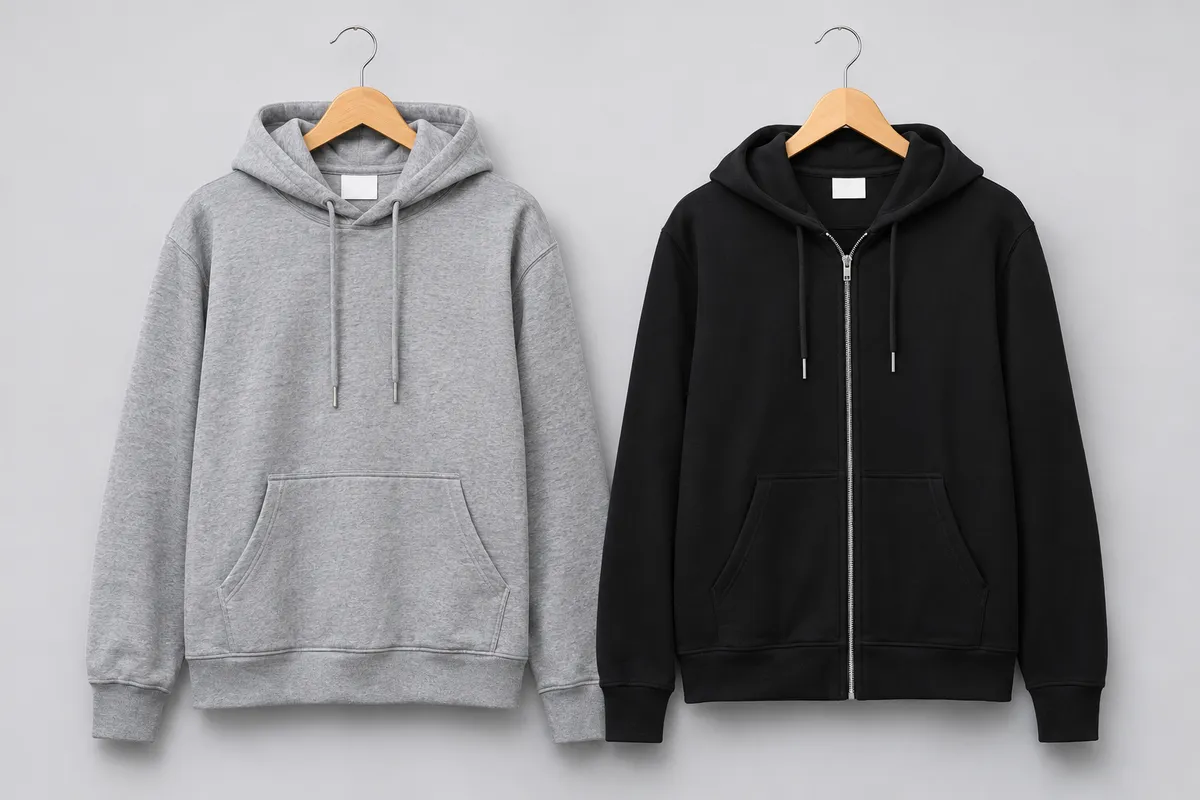
Seasonal uniform stock for shops is easiest to manage when the range is split into three groups: lines sold all year, lines bought once before the warm season, and lines bought once before the cool season. Each group gets its own buying date and its own end-of-season plan. A shop that treats every garment the same ends up holding knitwear through the summer and running short of summer dresses in the first warm week.
Sorting the range into three groups
| Group | Examples | Buying pattern |
|---|---|---|
| Year-round | Trousers, skirts, pinafores, PE T-shirts and shorts, everyday polos | Rolling reorders through the year |
| Warm-season | Summer dresses, school shorts, short-sleeve shirts, skorts if seasonal | One main order before the season, one small top-up |
| Cool-season | Knitted jumpers and cardigans, sweatshirts, blazers, long-sleeve shirts, tracksuits, fleece jackets | One main order before the season, one small top-up |
Some garments sit on the edge. Sweatshirts sell all year in many primary schools; blazers are bought mostly at the start of the year whatever the season. Use your own sales to decide where each line belongs.
Setting the buying calendar
Lead time is confirmed in the quotation, so the calendar is built backwards from each season’s start date in the schools you serve. A simple shop calendar has four buying points:
- Main warm-season order, placed early enough to land before the changeover to summer uniform.
- Warm-season top-up, placed when the first weeks of sales show which sizes are running short.
- Main cool-season order, placed to land before the changeover to winter uniform.
- Cool-season top-up, on the same basis.
Year-round lines are reordered alongside these, so one quotation can often cover several groups. Repeat orders are made to the approved sample, so new stock matches what is already on the shelf.
How deep to stock each season
A starting approach, to adjust against your own records:
- Stock warm-season lines deep in the sizes that sold out first last year, and lean in the extremes.
- Stock cool-season outer layers slightly toward the larger sizes, since families often buy them with room to grow.
- Keep the top-up order small and fast rather than the main order large and slow.
- Hold year-round lines at steady depth, watching for a bump at the start of the school year.
Minimums apply per style: 50 pieces for woven garments and 100 for knitwear and sportswear, with sizes mixed. A top-up below the minimum can often be combined with another style’s reorder or the next season’s main order.
Ending a season without waste
Seasonal stock left at the end of a season does not need to be lost. Uniform rarely changes from year to year, so a summer dress unsold in one year sells the next, provided the specification stays the same.
- Count remaining seasonal stock by style and size at the end of each season
- Store it clean, folded and labelled for the next year
- Deduct it from the next season’s main order
- Check with each school that the specification has not changed
- Note which sizes were left over, and lean the next order away from them
Our page for uniform shops and retailers explains how we handle shop orders under your own label. The school summer dresses and school sweatshirts and hoodies pages show two typical seasonal lines.
We manufacture in India and quote each style by fabric, quantity and branding. Send us your seasonal range and your season dates, and we will help you set up a buying calendar around them.
Questions buyers ask
How can a shop avoid running out of summer stock in the first warm week?
Place the main warm-season order early enough to land before the changeover, and plan a small top-up straight after the first weeks of sales. Schools can help by publishing changeover dates at the start of the year.
Should shops order seasonal stock under their own label?
Many do for plain lines such as gingham dresses and core-colour sweatshirts that sell across several schools. Logo garments for a single school are usually ordered per school. Own woven or printed labels can be sewn in.
What if a school changes its seasonal uniform?
Ask for notice well before the next season’s order. Existing stock can often be sold through a transition period, and the new specification is sampled and approved before bulk production.