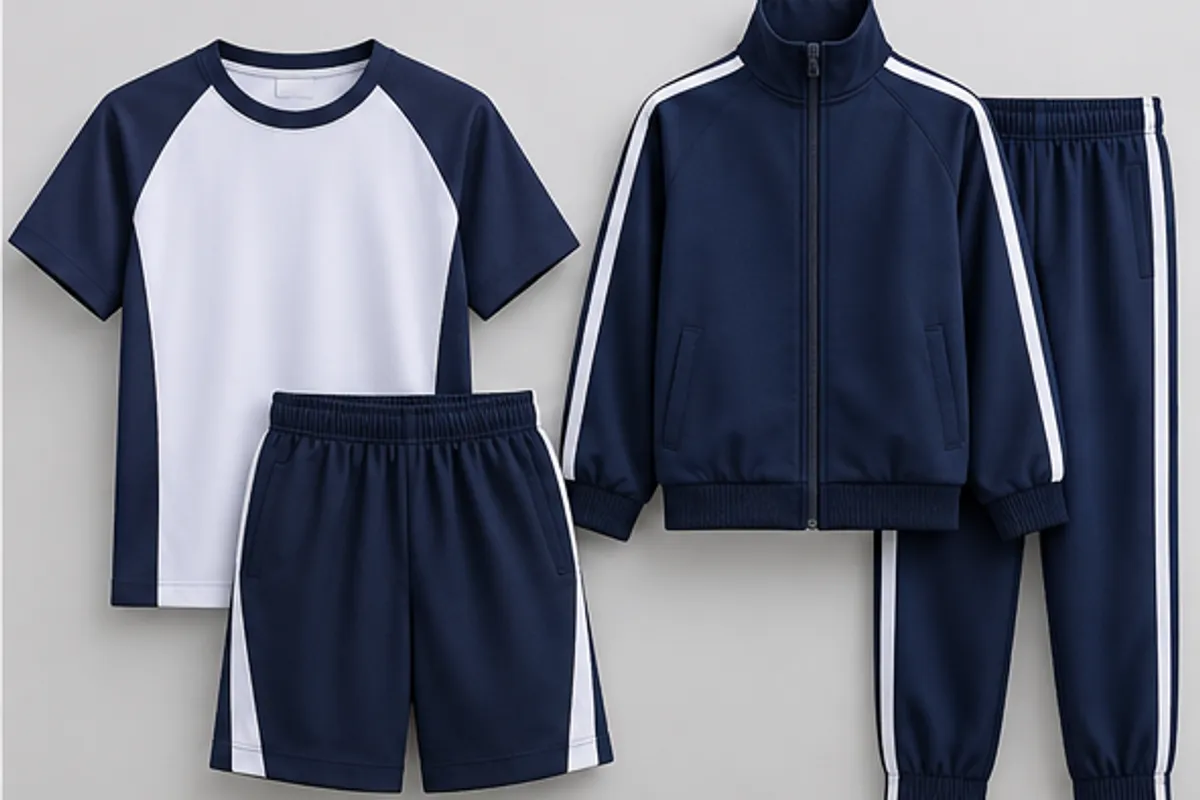
Tracksuit seams on a knitted sports garment are sewn with stitches that stretch with the fabric, so they do not snap when a student runs, bends or reaches. The three names buyers meet most are overlock, which joins and neatens the edges inside; cover stitch, which hems and topstitches with two or more parallel lines; and flatlock, which joins two edges flat with a decorative stitch on the outside. Each has its place on a tracksuit.
Knowing the terms helps when you read a sample, compare a garment from another source or explain a fault. It is not about choosing one seam for the whole garment, but about understanding why each seam is where it is.
The three stitch types
Overlock. A machine trims the fabric edges and wraps them in thread as it sews, joining the pieces and stopping the knit from unravelling in one pass. It is the standard join for side seams, sleeve seams and panel seams inside a tracksuit. On the outside you see a neat seam line; inside, a narrow band of looped thread.
Cover stitch. Two or three needles sew parallel lines on the outside, with looping thread underneath that covers the raw edge. It is used for hems, cuff turns and topstitching beside seams. It stretches with the fabric and looks like twin rows of stitching.
Flatlock. The two fabric edges are butted together and joined flat, with a wide band of stitching visible on one or both sides. It leaves no ridge inside, so it is comfortable against the skin. It is common on performance sportswear and can be a design feature in a contrast thread.
Where each seam usually goes
| Area of the tracksuit | Usual seam | Why |
|---|---|---|
| Side and sleeve seams | Overlock, sometimes topstitched | Strong, stretchy join |
| Panel and yoke seams | Overlock, with piping if specified | Holds the panel edge cleanly |
| Hem of the top | Cover stitch or a hem band | Flat, flexible finish |
| Open hem of the bottoms | Cover stitch | Stretches over the heel |
| Waistband channel | Cover stitch | Holds elastic, stretches |
| Feature seams | Flatlock | Flat, decorative |
| Zip setting | Straight stitch, often topstitched | Holds the zip tape firmly |
The construction for your order is shown on the sample before bulk production.
What makes a seam last?
A seam fails in one of three ways: the thread breaks, the fabric tears beside the stitching, or the seam twists out of line. Good practice that a buyer can check:
- Stitch density. Too few stitches per centimetre and the seam gapes; too many and the fabric can weaken along the line.
- Thread suited to the fabric. A polyester thread with stretch suits polyester tricot.
- Reinforcement at stress points. Pocket corners, the crotch seam and the bottom of the zip take the most strain. A bar tack or extra stitching helps.
- Straight lines. Seams on the sample should run true, without wandering, especially where a contrast panel makes any wobble visible.
Checking seams on the sample
Use this list when the sample arrives:
- Stretch each seam gently; it should give and recover without cracking thread
- Turn the garment inside out; seams should be neat with no loose ends
- Look at where seams cross, such as the underarm; they should meet cleanly
- Check the crotch seam and pocket corners for reinforcement
- Run a hand inside the collar and cuffs for rough seam edges
- Look along contrast panel seams for even width
Our page on fabrics and colour matching explains how the fabric and thread colours are agreed. We manufacture in India and run a quality check before dispatch, against the approved sample. You can see our tracksuit tops, bottoms and fleece jackets on the school tracksuits and jackets page.
If you have a tracksuit whose seams have failed and want to avoid the same problem, send it with your enquiry and we will look at the construction when preparing the sample.
Questions buyers ask
Is flatlock stitching more comfortable for children?
Flatlock leaves no ridge inside, which feels smooth against bare skin. On a tracksuit worn over a T-shirt, the difference is small, so overlocked seams are common and perfectly comfortable for most students.
Why are tracksuit seams sometimes twisted after washing?
A twisted seam usually comes from fabric cut slightly off grain, or from a knit that relaxes unevenly. Checking the sample after one wash shows whether seams stay straight before bulk production begins.
Should contrast thread be used on seams?
Contrast thread on a cover-stitched hem or flatlock seam can add a sporty detail in a school colour. Keep it to a few places, because any uneven stitching is far more visible in a contrast colour.