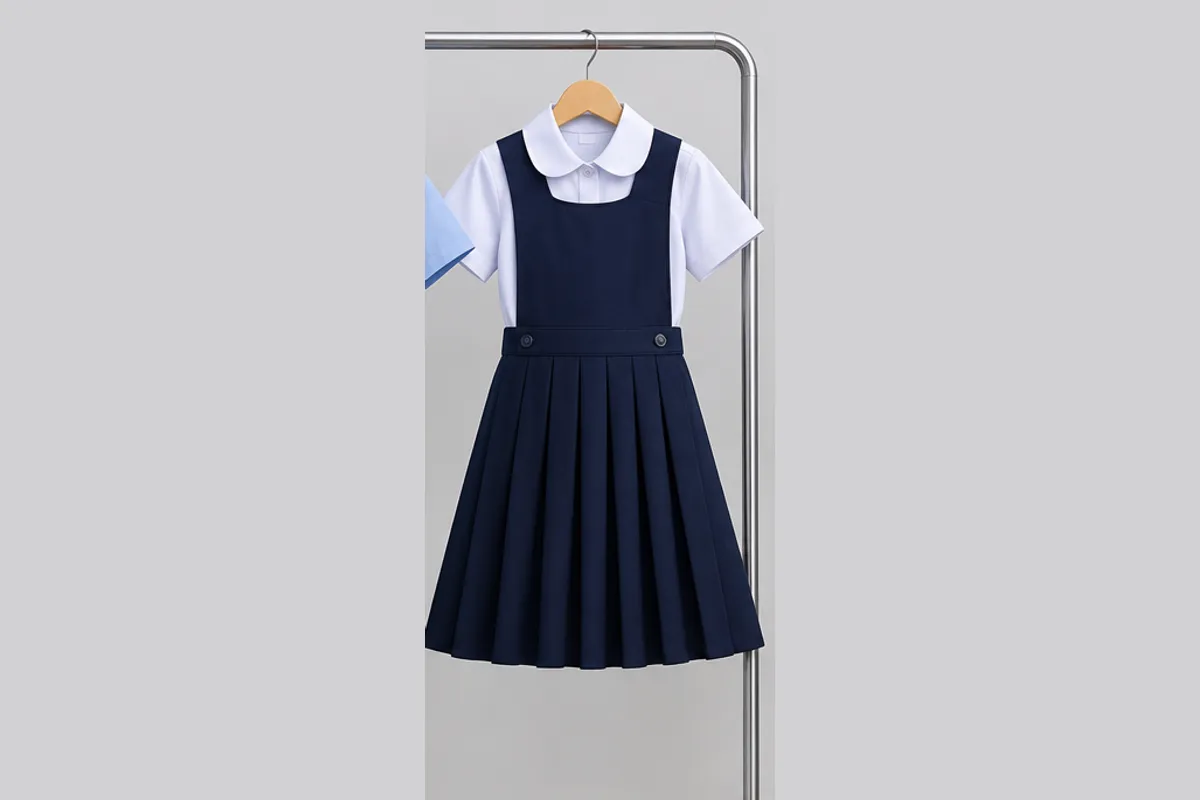
School tunic size by age runs higher than pinafore sizing, because tunics are often kept for older girls. We list tunics from age 3–4 to 13–14, and most buyers find their demand sits in the middle and upper bands, with length and hip becoming as important as chest from about age ten.
This article helps shops, suppliers and schools decide which tunic age bands to carry and how to weight them.
Where tunics sit in a girls’ uniform
A tunic is a sleeveless dress, usually pleated from a yoke or a dropped waist, worn over a shirt or blouse. In some countries it is the standard girls’ garment right through primary and into the first years of secondary. Elsewhere it replaces the pinafore once girls outgrow a bib style.
That difference shapes the size range. A school that uses the tunic from reception needs every band. A school that introduces it at age eight needs no small sizes at all.
| Where the tunic is worn | Bands to carry | Where most pieces go |
|---|---|---|
| Whole primary, from the first year | 3–4 to 11–12 | 5–6 to 9–10 |
| Upper primary only | 7–8 to 11–12 | 8–9 to 10–11 |
| Upper primary and early secondary | 8–9 to 13–14 | 10–11 to 12–13 |
| Secondary only | 11–12 to 13–14, plus any larger sizes agreed in your chart | 12–13 |
The last row is a reminder that the listed top band is a planning example. If your school’s tunic is worn beyond 13–14, add the sizes to the chart you agree with us before sampling.
How sizing changes as girls get older
For young children, chest and length move together, so an age label is a reasonable guide. From around ten, bodies vary far more within one year group. Two girls of the same age can be a full band apart in chest and two bands apart in height.
That is why older tunic sizes benefit from three measurements on the chart:
- Chest, for the yoke or bodice.
- Hip, because a dropped waist or belt line sits over the hips, and pleats that strain there do not hang straight.
- Length, measured from the shoulder, since the hem position matters more to older pupils and their schools.
Where a school has a strict hem rule, put the finished length for each band on the chart rather than leaving it to the pattern.
A starting mix for an upper-primary tunic
The example below is for 150 tunics in one colour for a school that uses the tunic from age eight to the end of primary, with a few larger pieces for early secondary. It is a starting example only; adjust it against your roll or past sales.
- 7–8: 12 pieces, mainly for tall younger girls and early movers
- 8–9: 24 pieces
- 9–10: 30 pieces
- 10–11: 30 pieces
- 11–12: 26 pieces
- 12–13: 18 pieces
- 13–14: 10 pieces
The shape is a broad hump in the middle with short tails. If your records show the top year selling heavily, move pieces up from 8–9.
Planning for growth in the older bands
Older girls often grow quickly over one school year, and families tend to buy a tunic expected to last. That shifts sales one band higher than the age alone suggests. A shop that orders strictly by age often runs out of the upper middle bands first.
Two habits help. First, check last year’s returns and exchanges: if many were swaps up one size, your mix was too low. Second, keep a small top-up in reserve rather than ordering deep in every band at the start. Tunics count as their own style, so a top-up is planned against the 50-piece minimum for that style, with sizes mixed as you need.
Our size charts page sets out how the chest, hip and length columns are agreed with each buyer.
Getting a quotation
Send us the age bands you need, the measurements you use and an estimated quantity per band. We manufacture in India, and you can see the tunic alongside the pinafore styles on our school pinafores and tunics page. Each style is quoted by fabric, quantity and branding.
Questions buyers ask
Is a tunic sized the same way as a pinafore?
Both use age bands and chest, but tunics more often need a hip measurement because of the dropped waist or belt line. Older bands also benefit from a finished length on the chart, so the hem sits where the school expects.
Can a tunic range go beyond age 13–14?
Our listing shows tunics to 13–14 as a planning range. If your school keeps tunics into later secondary years, add the larger sizes to the size chart we agree with you, and they are confirmed on the sample before production.
Do older girls need a separate tunic style?
Not always. Many schools keep one tunic pattern throughout and simply grade it upwards. A separate style is worth considering only if the older girls’ design differs, such as a different pleat or a belt.