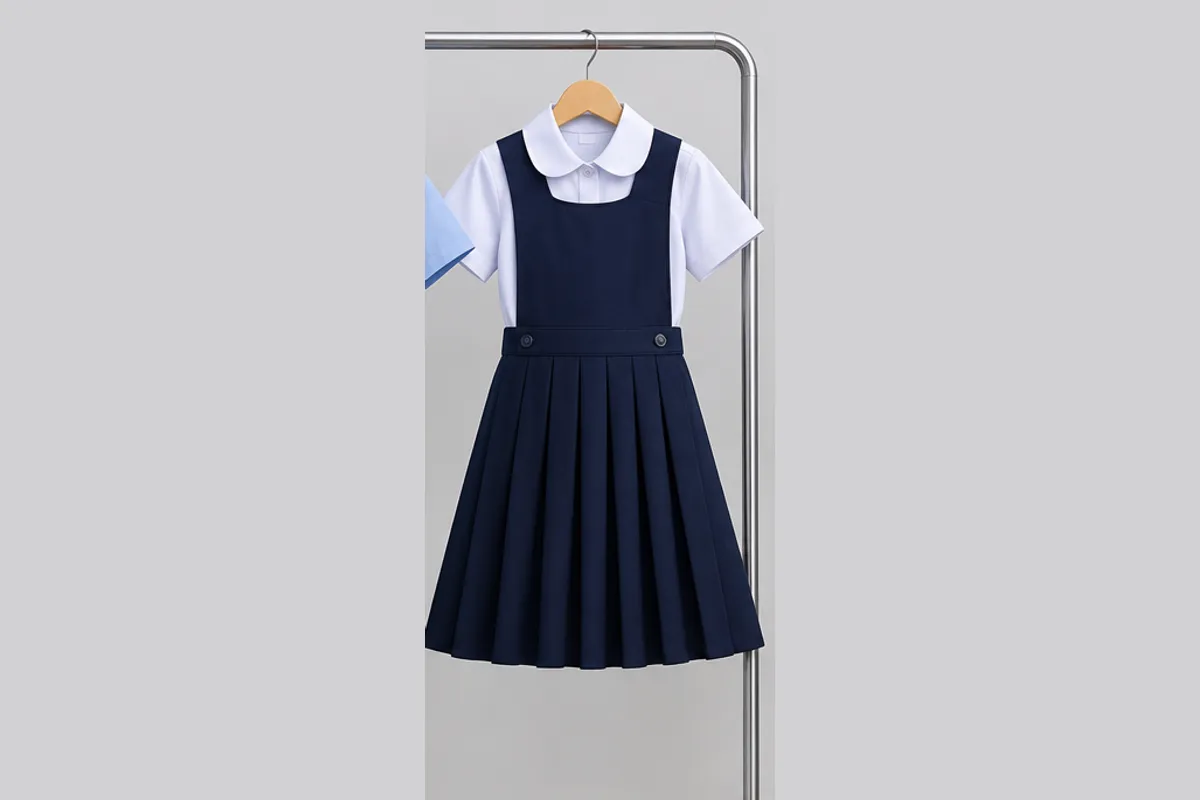
A school tunic in South Africa is typically a pleated, sleeveless dress worn over a shirt as the winter uniform for girls, often from Grade R through primary and, at some schools, into high school. Because the school year starts in January, in summer, the tunic’s main selling season comes before the mid-year winter switch, with a second, smaller peak for January’s new intake.
This guide covers what a South African uniform shop or school should specify, and how to time tunic orders around the local calendar.
The tunic’s place in a South African uniform
Many South African school lists give girls a summer outfit, often a dress, and a winter outfit built around the tunic, worn with a shirt, a jersey and tights. Schools frequently specify details closely: box pleats, the school colour, a set length and sometimes a girdle or belt. Because these details belong to the school, most tunics are school-specific lines rather than plain stock shared across schools.
That has two consequences for a shop:
- Each school’s tunic is its own stock line, with its own size mix.
- The range runs higher in age than a typical pinafore range, since older girls also wear the tunic.
What to specify for a South African tunic
| Point | What schools often expect | What to send |
|---|---|---|
| Colour | The school’s own shade, sometimes unusual | A tunic or cutting from current stock |
| Pleats | Box pleats from a yoke, or knife pleats | A current tunic, for pleat count and depth |
| Neckline | Square or round, worn over a collared shirt | A photo or garment |
| Belt or girdle | Common at some schools | Note if needed; a woven girdle is sourced separately |
| Logo | Often none; badge carried on the blazer or jersey | Artwork only if the tunic is branded |
| Size range | Your size range; often from age 5–6 into the early teens | Last year’s sales by size |
Our listing shows the tunic from age 3–4 to 13–14. If your schools need larger sizes for high school girls, add them to the size chart we agree with you.
Timing around January and the winter switch
The school year in South Africa starts in January. That gives tunic stock two moments:
- The January intake. New learners buy the full uniform, including the tunic, even though winter is months away. Stock the younger bands for this.
- The winter switch. Schools move to winter uniform around the second term, from about April or May. This is the bigger tunic peak, as returning learners outgrow last year’s tunic.
Working back, many shops enquire around the middle of the year before, so tunics for January and for the winter switch can be planned together and shipped in time. Sea or air freight is chosen in the quotation, which also confirms lead time. Splitting deliveries, one before January and one before the second term, can ease storage.
Planning sizes for an older range
Because tunics run into the early teens, sizing varies more than with a younger pinafore. Points to consider:
- Add hip and finished length to the chart for the upper bands.
- Consider a long fitting if the school sets a firm hem rule.
- Keep size labels consistent with the summer dress and shirts in your range.
- Record sales separately for the January and winter peaks, since their size mix differs.
Shops supplying several schools can read our for uniform shops and retailers page for how we quote school-specific lines.
To plan your next season, send us a tunic from each school you supply, with size breakdowns and target arrival dates. We manufacture in India and make tunics alongside the pinafore styles listed on our school pinafores and tunics page, quoted per style by fabric, quantity and branding.
Questions buyers ask
Can each school’s tunic be matched to its existing stock?
Yes. Send a tunic from current stock and we match the colour, pleats and measurements, then send a sample for approval. Repeat orders are made to that approved sample, so new tunics sit beside old ones on the rail.
Is a tunic order for one school too small?
A single school’s tunic needs 50 pieces of that style, with sizes mixed. Most schools reach that in one season. A very small school can combine a January and a winter quantity into one order.
Do tunics need a different chart from the summer dress?
Yes. They are different garments with different fits, so each has its own chart. Keeping the same size labels on both makes it easier for families and shop staff to move between them.