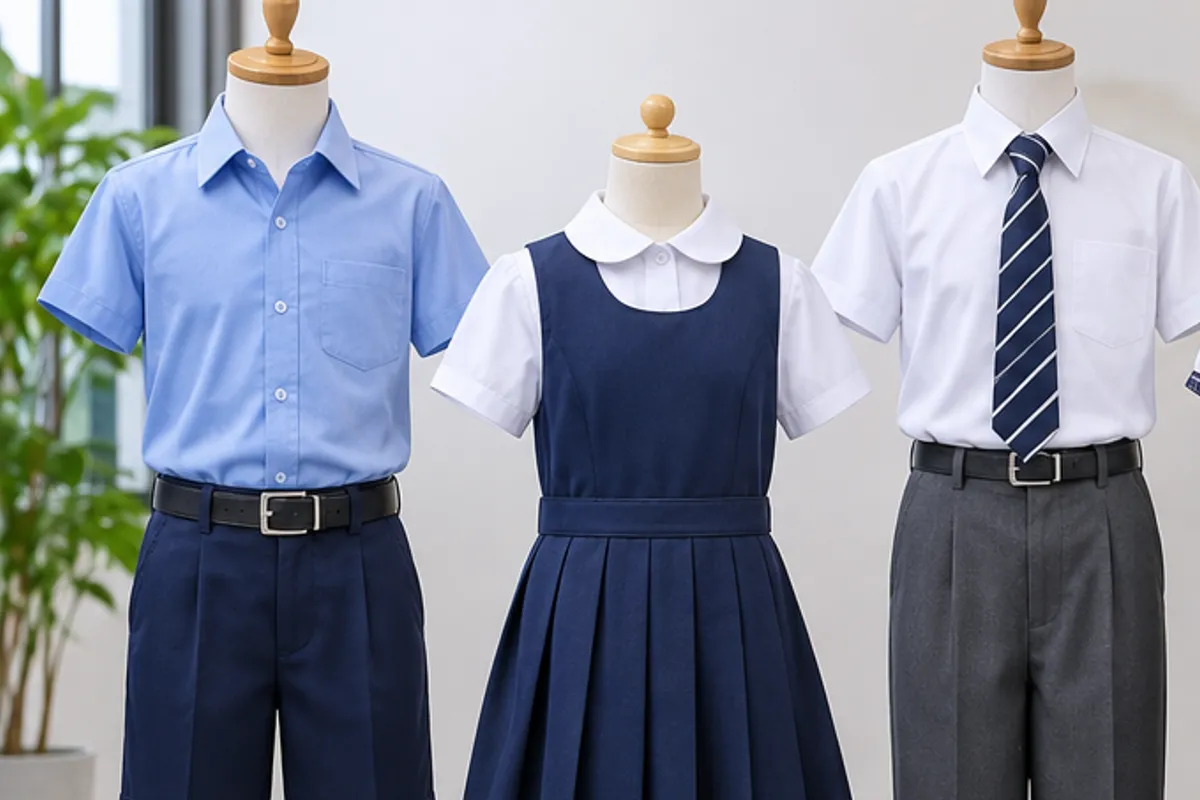
A school trousers hem for growth is a hem with extra fabric folded inside, so a parent can unpick it and let the leg down when a child grows taller. It lets one pair last longer, which matters to families and to charity programmes buying for a whole year. The two common ways to build it are a deep plain hem and a turn-up, and each has trade-offs.
Children often grow in height before they grow in the waist. A trouser that still fits round the middle but stops above the shoe is a common sight by the spring term. Growth allowance in the hem is the simplest fix.
Deep hem or turn-up?
A deep hem is a plain hem with a wider fold of fabric turned up inside the leg. From the outside it looks like any plain hem.
A turn-up, also called a cuff in some countries, is a fold of fabric turned to the outside at the bottom of the leg. It is a visible style feature, and the fabric inside it can also be let down.
| Point | Deep plain hem | Turn-up |
|---|---|---|
| Look | Plain, modern | Traditional, formal |
| Growth allowance | Hidden inside the leg | Some length in the fold |
| Letting down | Unpick and re-hem | Unpick, press out, re-hem |
| Mark after letting down | A faint line where the old fold was | A more visible line |
| Catches dirt? | No | The fold can gather grit |
| Suits | Most school trousers | Senior or formal uniforms |
For most school trousers, a deep plain hem is the practical choice. Turn-ups suit schools that want a traditional look, usually in senior sizes.
How much extra length?
There is no fixed amount. The allowance needs to be generous enough to be useful, but not so heavy that the hem drags or looks bulky. Some considerations:
- Younger children grow faster, so a deeper allowance helps most in the junior sizes.
- Very deep hems make the bottom of the leg heavier and can change how the trouser hangs.
- Slim fit and tapered legs have less room to let down, because the leg is narrower near the hem than above it.
Rather than fixing a number in advance, ask to see the hem allowance on the sample and judge whether it gives meaningful extra length for your age bands.
The faint line after letting down
When a hem is let down, the old fold line often stays visible, especially on darker colours and firm fabrics. Pressing with a damp cloth helps, but the line may not vanish fully. It is worth telling families this at the counter, so they know what to expect. Some shops print a short note on the pack.
Hems on shorts
Shorts are not usually let down, because a shorts length is a style choice rather than a fit problem. A neat plain hem, or a turned hem with a small fold, is standard. If a school wants knee-length shorts to stay that way as children grow, the answer is the next size up, not a deeper hem.
Specifying the hem
Before quoting, decide:
- Plain hem or turn-up, for each style.
- Whether extra growth allowance is wanted, and in which sizes.
- How the hem is stitched: a blind stitch that is almost invisible, or a visible machine stitch.
- Whether elastic-back junior trousers should have the same hem as fixed-waist styles.
Charity buyers often value growth room most, because each pair needs to last as long as possible; our page for charities and uniform programmes explains how we keep simple specifications consistent. Deep hems can be added to any of the styles on our school trousers and shorts page.
Send us the hem detail you want, or a pair whose hem you like, and we will quote by fabric, quantity and branding.
Questions buyers ask
Does a deep hem affect the sizes on the size chart?
No. The inside-leg measurement on the chart is the finished length as sold. The growth allowance is extra fabric inside the hem, so it does not change the size the family buys.
Can a shop offer to let hems down for customers?
Some shops do, as a service. It is simple work for a tailor with a deep hem. If you plan to offer it, make sure the hem is blind-stitched, which is quicker to unpick neatly.
Are turn-ups practical for younger children?
They tend to collect grit, sand and grass in the fold, and they add a formal look that young children rarely need. Most buyers keep turn-ups for senior or ceremonial trousers and use a deep plain hem elsewhere.