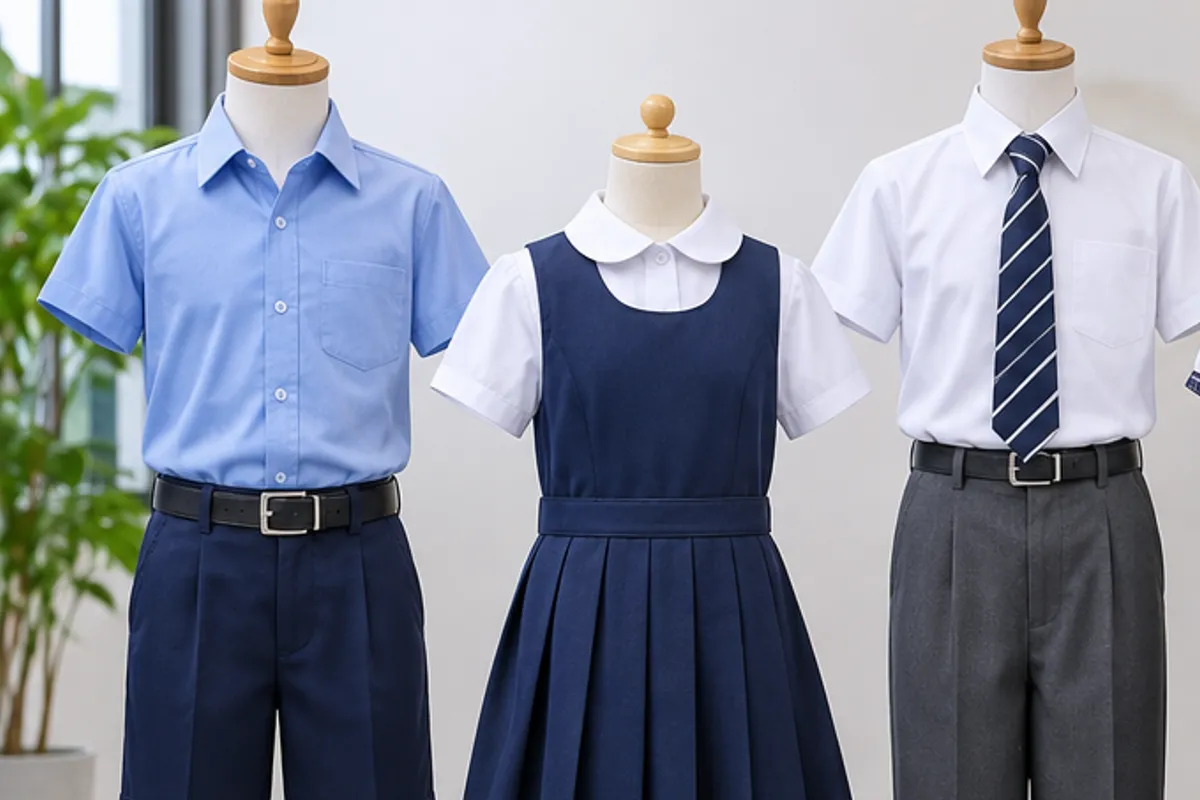
Planning for how many school trousers per student usually starts at two pairs for each student who wears them, so one can be washed while the other is worn, plus at least one replacement pair during the year for active younger students. Older students who wear trousers more gently may manage with two pairs a year; younger students who kneel and play outside often need three.
For a shop or a school buying in bulk, that figure is the bridge between the school roll and the size of the order.
What changes the number of pairs
Several practical factors push the figure up or down.
| Factor | Pushes the number up | Pushes it down |
|---|---|---|
| Age | Infants and juniors play on floors and fields | Seniors sit more and wear more carefully |
| Wash routine | Daily washing, slow drying in wet weather | Weekly washing, quick drying |
| Shorts season | Short or no shorts season | Long shorts season replaces trousers for months |
| Days worn | Trousers worn every school day | PE kit or tracksuit replaces trousers on some days |
| Growth | A growth spurt year | A stable year |
| Second-hand supply | Little second-hand uniform available | An active pre-loved scheme |
No single number is right for every school, but working through the table for each school you serve gives a figure you can defend.
A worked estimate for a shop
Here is how a shop might turn the figure into an order for one school’s regular fit grey trouser.
- Count likely wearers. Take the number of students in the years that wear trousers. Remove students who choose a skirt, or who will wear shorts for most of the year.
- Choose pairs per wearer. For example, two pairs for seniors and three for juniors.
- Allow for families who buy elsewhere. Not every family buys every pair from your shop. Reduce the total by your own estimate of your share.
- Allow for second-hand. If the school runs a pre-loved rail, reduce again.
- Split across the year. Put most of the total into the main order before the year starts, and hold some back for a top-up.
The result is a planning figure in pairs, which you then spread across sizes using your size ratio.
How many pairs should a school keep as spares?
Schools that buy direct, or that run their own uniform counter, often keep a small stock of spare trousers as well. These cover accidents, students who arrive without uniform, and families who need help.
A simple guide is a few pairs in each of the most common sizes for each age group, rather than a full size run. Infant and junior classes need spares most, particularly in the smallest sizes. Spares should be in the same colour and fit as the main stock so they do not stand out.
Turning pairs per student into a planning checklist
Use this to pull the estimate together for each school.
- Number of students who wear trousers, by year group
- Pairs per wearer for juniors and for seniors
- Months of the year when shorts replace trousers
- Your estimated share of the school’s trouser sales
- Any reduction for second-hand supply
- Spares the school wants held
- Split between the main order and a later top-up
Trousers are a woven style with a minimum of 50 pieces, and sizes can be mixed within a style, so even a small school’s figure often reaches it once a few sizes are combined.
Checking the estimate against real sales
After the first full year, compare the planning figure with what you sold. If you sold more pairs per student than planned, the likely causes are knee wear in juniors or a stronger share of the school’s sales than you assumed. If you sold fewer, check whether shorts or second-hand supply took more of the demand than expected. Adjust the pairs per wearer, not just the total, so the reasoning carries over to next year.
Our page for uniform shops and retailers explains how we work with shops ordering for several schools. The trouser fits and matching shorts are on our school trousers and shorts page. Send us your estimate in pairs and sizes, and we will prepare a quotation.
Questions buyers ask
Do students need more trousers than shirts?
Usually fewer. Shirts are washed after every wear, while trousers are often worn two or three days between washes. The exception is younger students, whose trousers get muddy or worn at the knee and may need replacing as often as shirts.
How should a charity programme decide pairs per child?
Most programmes provide two pairs per child where funding allows, so one can be washed while the other is worn. If funds only stretch to one pair, add a pair of shorts in matching fabric where the climate allows, so the child has a second bottom.
Does the figure change for students who only wear trousers in winter?
Yes. A student who wears shorts for half the year may need only two pairs of trousers that last the whole of the cool season. Count them as part-year wearers when you estimate the total.