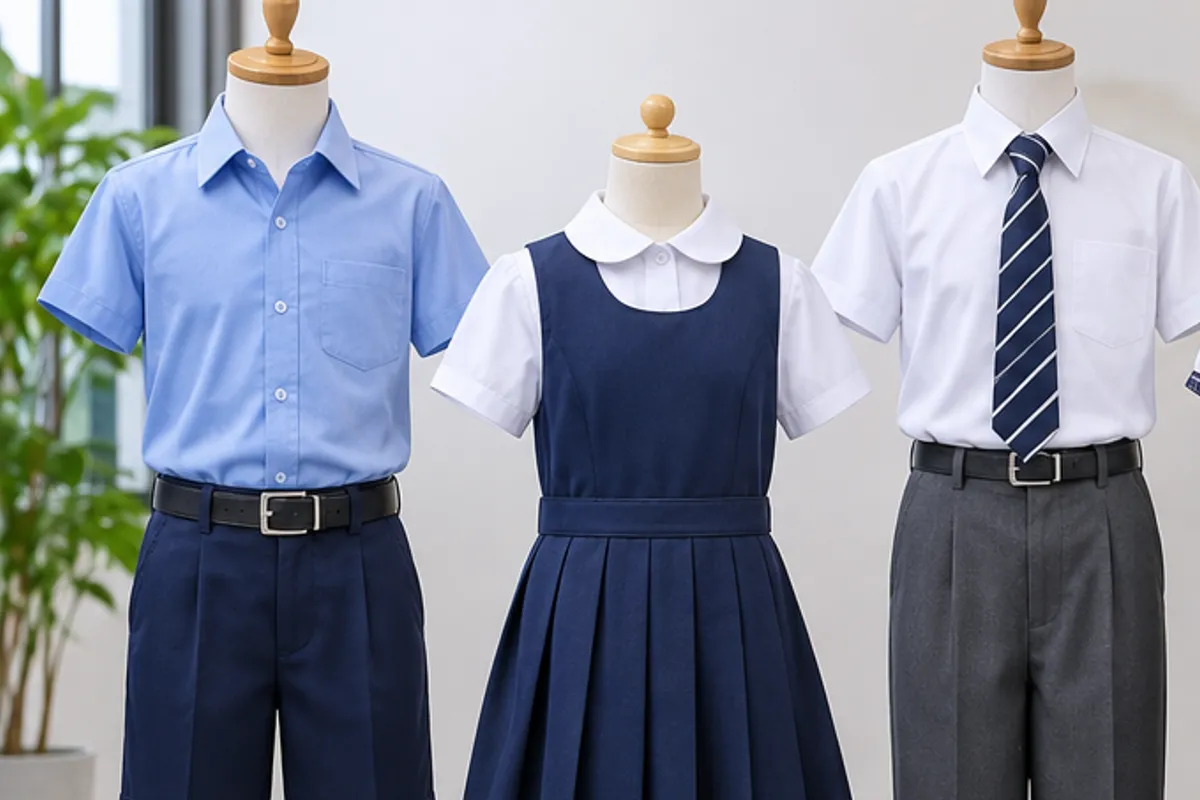
A workable school trousers size range uses age bands for younger students and a grid of waist and inside-leg sizes for seniors, with only the combinations that actually sell. Keep the grid tight at first, then widen it as reorder data shows where the gaps are.
Trousers are harder to size than shirts. A shirt mostly varies in one direction. A trouser varies in two: around the waist and down the leg. Every extra length you offer multiplies the number of sizes you must stock and reorder.
Age bands for juniors, measurements for seniors
For younger students, age bands are simple and familiar. Our trousers typically run from age 3–4 up to 15–16 by age band. Shorts usually stop at 13–14, and elastic-back waist styles at around 11–12. These are planning examples; your own range is agreed for each order.
Each age band has a set waist and leg length. Families buy by age, and a deep hem allowance lets them let the leg down for a taller child. That keeps the junior range to a handful of sizes.
From the senior years, students vary too much for age bands to work. Two fifteen-year-olds can share a waist size and differ by several centimetres in leg length. So senior sizes move to waist and inside-leg measurements, which we agree with you. Our size charts show the starting measurements.
Building a senior size grid
The grid below is a starting example for senior trousers, to adjust against your own sales or roll data. It shows which waist and leg combinations a first order might carry, and in what relative depth.
| Waist | Short leg | Regular leg | Long leg |
|---|---|---|---|
| 26” (66 cm) | Stock lightly | Stock | Skip at first |
| 28” (71 cm) | Stock lightly | Stock deeply | Stock lightly |
| 30” (76 cm) | Stock lightly | Stock deeply | Stock |
| 32” (81 cm) | Skip at first | Stock deeply | Stock |
| 34” (86 cm) | Skip at first | Stock | Stock lightly |
| 36” (91 cm) and up | Skip at first | Stock lightly | Stock lightly |
The idea is simple. The regular leg carries most of the order. Short legs matter at the smaller waists, where younger seniors sit. Long legs matter at the middle and larger waists, where taller students are. The corners of the grid, such as a large waist with a short leg, sell slowly and can wait for a reorder.
Within one style, all these sizes can be mixed to reach the minimum of 50 pieces, so even a modest first order can cover the core of the grid.
Fits change the grid
If you carry more than one trouser style, each needs its own size plan. A few points help:
- Regular fit covers the widest range and usually gets the full grid.
- Slim fit often starts at age 7–8. Its senior waists may run smaller, because larger students tend to choose a regular fit.
- Girls’ trousers are cut with their own rise and seat, so they need their own waist and hip measurements, not a copy of the regular fit chart.
- Shorts have no leg length to manage, so the size plan is waist or age band only.
Agree the size chart for each style before the sample stage. Changing measurements after production starts means a new pattern.
Planning reorders
Trousers sell steadily all year, and the same sizes tend to come back term after term. That makes them well suited to planned reorders rather than one large annual buy.
A practical reorder routine:
- Track sales by waist and leg, not just by waist
- Note which combinations sold out and how early
- Note which combinations have not moved in a term
- Add a length only where requests or sell-outs show demand
- Drop or reduce corners of the grid that have stayed on the shelf
- Group each reorder so every style still reaches the minimum
- Check the lead time in the quotation and order well ahead of term start
Because every repeat order is cut from the same approved pattern, a reorder pair matches the first batch in fit, fabric and shade. A student buying a second pair mid-year gets the same trouser.
Common sizing mistakes to avoid
- Too many lengths too soon. Three lengths in every waist size spreads stock thin. Start with the regular length and add others where data supports it.
- Ignoring hem allowance. A generous hem in junior sizes lets families adjust the leg, which reduces demand for extra lengths.
- Copying another brand’s chart. Waist sizes are not always measured the same way. Agree measurements with us directly and check them on the sample.
- One chart for all fits. Girls’ and slim fits need their own measurements.
You can see our regular, slim, girls’ and elastic-back styles on the school trousers and shorts page. Send us your size range or a pair of trousers you sell now, and we will prepare a quotation by fabric, quantity and branding.
Questions buyers ask
How is inside leg measured for school trousers?
Measure along the inner seam of a pair that fits well, from the crotch seam down to the hem. On a student, measure from the top of the inner thigh to the floor without shoes, then allow for the length the school prefers.
Should waist sizes be marked in inches or centimetres?
Either works, and many shops show both. Size labels and pack stickers are printed as you specify, so match what your customers already know. Buyers selling in several countries often prefer both units on the label.
What if a student falls between two waist sizes?
Fit the waist that sits comfortably and adjust the leg with the hem. Record these requests as they come in: a pattern of in-between students shows where your grid may need an extra size at the next reorder.