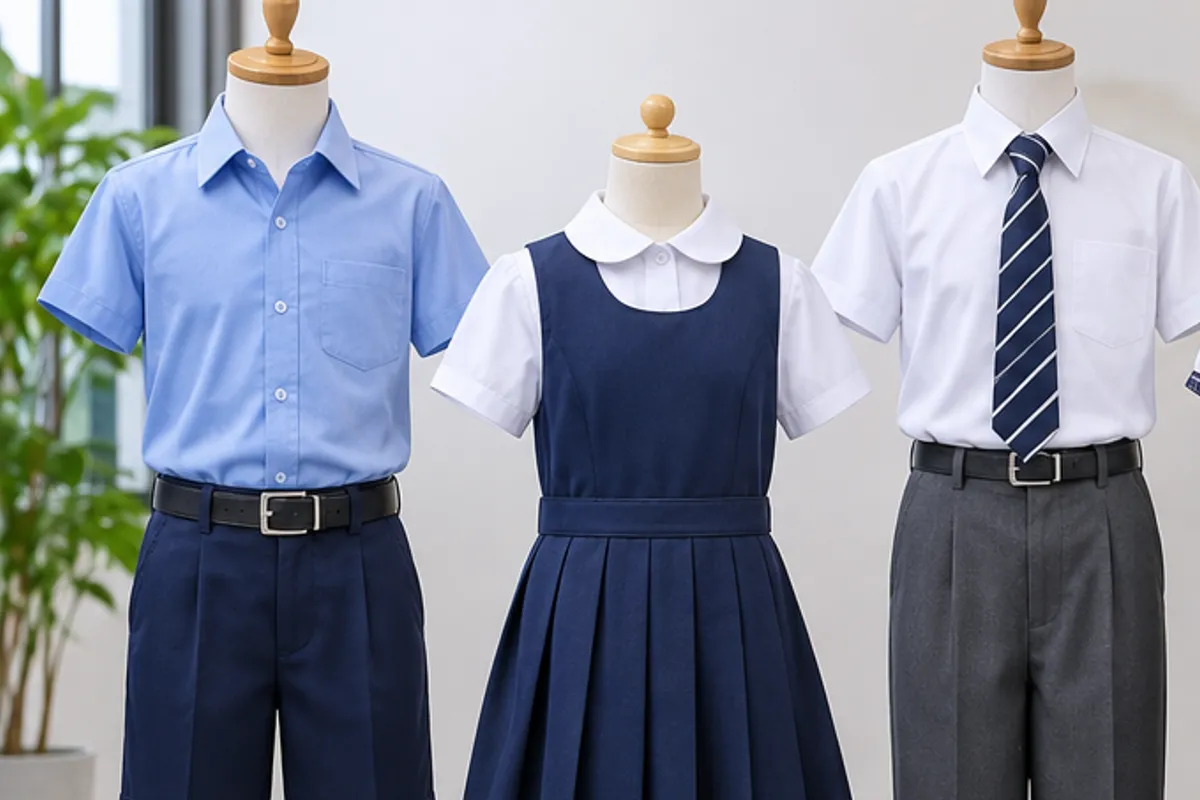
A complete bulk school trousers specification answers four questions: which fits you need, how the waist is made, which fabric and colour, and what size range. Settle those, add your label and packing, and we can quote each style and make a sample that matches the bulk order.
Trousers are less visible than shirts or blazers, but they are on most uniform lists all year. Shops reorder the same colours and sizes term after term, so the decisions you make now will repeat in every order that follows.
Decide the fits you will carry
We make regular fit trousers, slim fit trousers, girls’ trousers, shorts, and elastic-back waist trousers and shorts for younger children. Each is a separate style, with its own pattern and its own minimum of 50 pieces.
The main choice is how many fits to stock. More fits serve more students, but each one adds a line to manage and a minimum to reach.
| Fit or style | Who it suits | Trade-off to weigh |
|---|---|---|
| Regular fit | All ages; the default for most lists | Widest appeal, but some seniors find it loose |
| Slim fit | Older students, often from age 7–8 | Popular with seniors, but a second line to stock |
| Girls’ trousers | Girls who wear trousers; cut with its own rise and seat | Better fit for girls than a unisex cut, but another style |
| Shorts | Younger children, summer terms | Seasonal; plan quantity around the summer term |
| Elastic-back waist | Younger age bands, typically up to 11–12 | Easy to put on and allows for growth; less tailored |
A shop serving several schools may hold regular and slim fits in grey and black, and add girls’ trousers where schools list them. A single school may need only regular fit plus shorts for the younger years.
Waistband, pockets and finishing
Small details decide whether trousers suit the age group. Work through them for each style:
- Waistband. A fixed waistband with button and zip, or an elastic-back waist. Elastic-back is common in younger sizes because it copes with growth and is easier for children to manage.
- Fastening. Zip fly with button or hook, or pull-on for the smallest sizes.
- Belt loops. Useful for seniors; often left off younger sizes.
- Pockets. Side pockets, back pockets, or both. Fewer pockets mean a cleaner line; more pockets suit older students.
- Creases and hems. Pressed front creases give a formal look. A deeper hem allowance lets families let the leg down as a child grows.
If you already sell trousers that work, send us a pair. Pockets, belt loops and waistband details follow your current garment, and we show you the result on the sample.
Fabric, colour and label
Our trousers are made in poly-viscose or polyester twill. Poly-viscose has a softer, slightly richer handle. Polyester twill is firm and hard-wearing. The fabric is confirmed at quotation, and if you send a pair you sell now, we can match it.
Grey, black and navy are the usual colours. Because trousers sit next to skirts, pinafores and blazers on the same uniform list, a shade that is slightly off stands out. Send a fabric cutting or garment, and we match the shade and send a swatch for approval before cutting.
Most schools order trousers without a logo, so one style can be sold to many schools. We sew your woven or printed label inside the waistband with size and care details. A small embroidered logo on the hip or pocket can be added if a school asks.
Sizes, quantities and timing
Trousers usually run by age band, from age 3–4 up to 15–16, then by waist and inside-leg measurement for seniors. Slim fit typically starts at age 7–8, and shorts often stop at 13–14. These are planning examples; you set your own range, and we agree the size chart for each order.
For seniors, decide which leg lengths you need for each waist size. Offering every waist in several lengths multiplies the size count quickly. A common approach is a regular length in most waists and a longer length only in the larger ones.
Then plan backwards from the date the trousers must be on your shelf. Lead time is confirmed in the quotation, and the sample and approval stage comes before production. Our how to order page sets out each step.
Checklist before you ask for a quotation
- Fits and styles, with a quantity for each at or above the minimum
- Waistband type and fastening for each style and age band
- Pockets, belt loops, creases and hem allowance
- Fabric: poly-viscose, polyester twill, or “match our current pair”
- Colour, with a cutting or garment for matching
- Label artwork, and whether any school wants a small logo
- Size range, including waist and leg lengths for seniors
- Packing: by size or by school
- Delivery country and the date stock must arrive
If you supply several schools from one trouser pattern in different colours, our page for schoolwear suppliers and distributors explains how we handle repeat specifications. The full range is on our school trousers and shorts page.
Send us your completed list, and a pair of your current trousers if you have one. We will quote each style by fabric, quantity and branding.
Questions buyers ask
Can trousers and shorts be made in the same fabric and shade?
Yes. Both are made in poly-viscose or polyester twill, and approving their swatches together keeps the colour consistent across the list. They remain separate styles, so each needs its own quantity at or above the woven minimum.
Can elastic-back trousers still look tailored?
They can. The elastic sits at the back while the front keeps a flat waistband, and a fly front, belt loops or pressed creases can be specified. Seen from the front, the trouser looks close to a fixed-waist style.
How are trousers packed for a shop?
Trousers are folded with the size marked on each pack, and cartons are made up by size or by school, as you choose. Tell us at enquiry if you need a particular carton mix, so it is set out in the quotation.