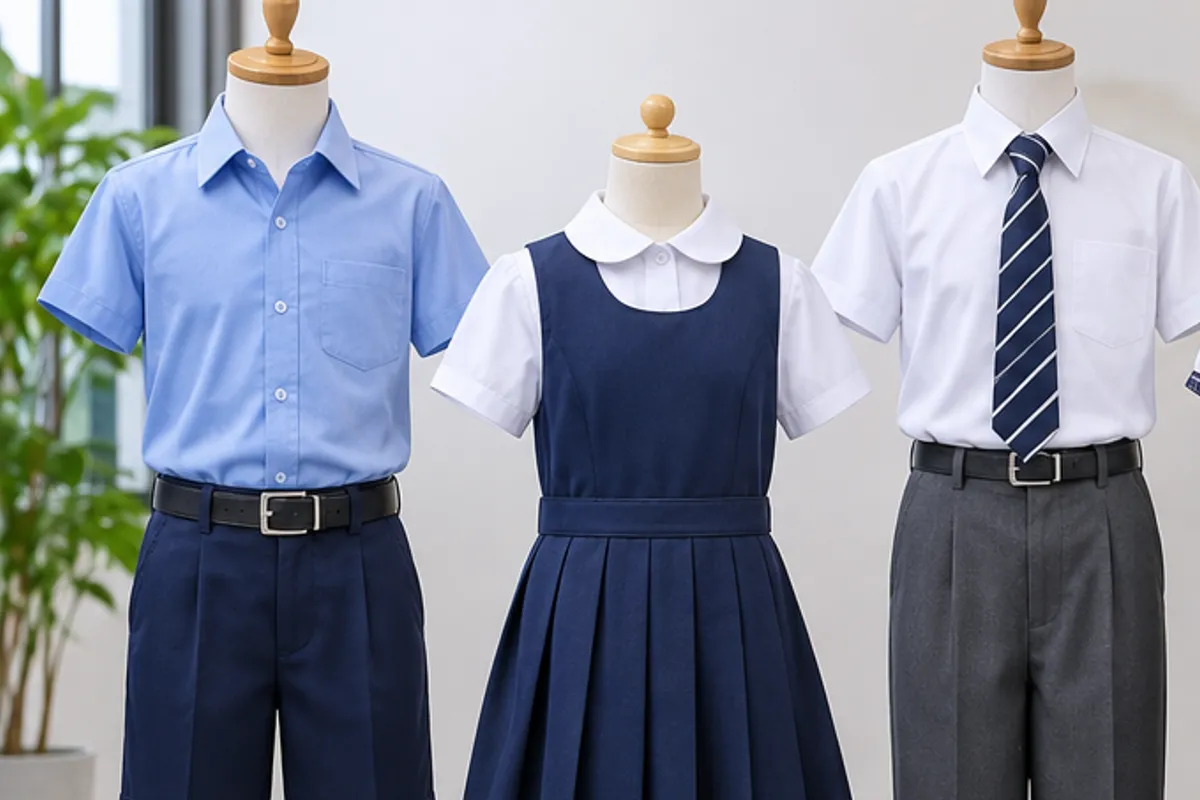
A school trouser size ratio is the share of an order given to each size, written as parts of a whole, such as 1:2:3:3:2:1 across six sizes. The middle sizes of the age range carry the most pairs, the smallest and largest carry the fewest, and the ratio should always be checked against your own sales or school roll data before you place the order.
Trousers need their own ratio rather than one borrowed from shirts or polos. Students often take a different size in bottoms than in tops, trousers wear out at the knee and hem at a different rate, and senior trousers split by leg length as well as waist.
Why trousers sell in a different pattern to tops
Three things shape a trouser ratio.
- Wear. Knees and hems go before seams and collars do. Active primary students wear through trousers faster than shirts, which pushes extra pairs into the junior middle sizes.
- Growth in length. A child can keep the same waist size for a long time while the leg grows. Families then buy the next size up for length, so the upper junior sizes often sell more than the roll alone suggests.
- Shorts in summer. Where shorts replace trousers in the warm term, junior trouser demand drops for part of the year, while senior trouser demand stays level.
A worked example for a first order
The table below is a starting example for a regular fit trouser in one colour, spread across junior age bands. Adjust it against your own sales or roll data before you use it.
| Size | Ratio parts | Pairs in a 120-pair order |
|---|---|---|
| Age 3–4 | 1 | 6 |
| Age 5–6 | 2 | 12 |
| Age 7–8 | 3 | 18 |
| Age 9–10 | 4 | 24 |
| Age 11–12 | 4 | 24 |
| Age 13–14 | 3 | 18 |
| Age 15–16 | 3 | 18 |
| Total | 20 | 120 |
To use a ratio, add up the parts (here 20), divide your total order by that number to find the size of one part (120 ÷ 20 = 6), then multiply each size’s parts by that figure. Round to whole pairs and check the total.
The minimum for trousers is 50 pieces per style, and sizes can be mixed within a style, so even a smaller first order can follow the same shape at a lower total.
How do you turn a ratio into senior waist sizes?
Once students move to waist and inside-leg sizes, the ratio has two layers. First split the order across waist sizes, then split each waist across leg lengths.
A simple approach:
- Give each waist size its ratio parts, with the middle waists heaviest.
- Put most pairs in each waist into the regular leg.
- Give the short leg a small share at the smaller waists.
- Give the long leg a small share at the middle and larger waists.
- Leave out combinations that rarely sell until a reorder shows demand.
Keeping step 5 in mind stops a senior grid from swelling into dozens of thinly stocked sizes.
Adjusting the ratio with your own figures
A starting example is only useful until you have data of your own. These sources sharpen it quickly.
- Last year’s sales by size, including sizes that sold out
- The number of students in each year group on the school roll
- Requests you could not fill because a size was missing
- Sizes still on the shelf at the end of the year
- Any change to the uniform list, such as shorts being added for juniors
Sell-outs matter more than sales. A size that sold 30 pairs and ran out in the first week of term probably wanted more. Mark these sizes up first when you rework the ratio.
If you serve schools with very different intakes, keep a ratio per school rather than one blended ratio. A school with a large nursery and a small senior section needs a very different shape from a secondary school.
Ratios across colours and fits
When you carry grey and black, or regular and slim fit, each is its own style with its own ratio. A slim fit trouser is usually bought by older and slimmer students, so its ratio leans towards the upper age bands and smaller senior waists. Each style needs to reach the minimum on its own.
Our size chart is agreed for each order, and the size charts page explains how the starting measurements are set. The full list of trouser and shorts styles is on our school trousers and shorts page.
Send us your proposed ratio and total, and we will quote each style by fabric, quantity and branding.
Questions buyers ask
Should the smallest and largest sizes be dropped from a first order?
Not usually. Families who cannot find the smallest or largest size often go elsewhere for the whole uniform. Order them lightly rather than leaving them out, and watch how quickly they sell before changing the depth.
How often should a trouser size ratio be reviewed?
Review it before every main order, and at least once a year. A quick look at sell-outs and leftover stock after the busiest weeks of term usually shows which two or three sizes need moving up or down.
Can one ratio cover trousers and shorts?
It can be a starting point, but shorts usually stop at a younger age band and sell in a shorter season. Most buyers keep a separate ratio for shorts that leans towards the younger sizes.