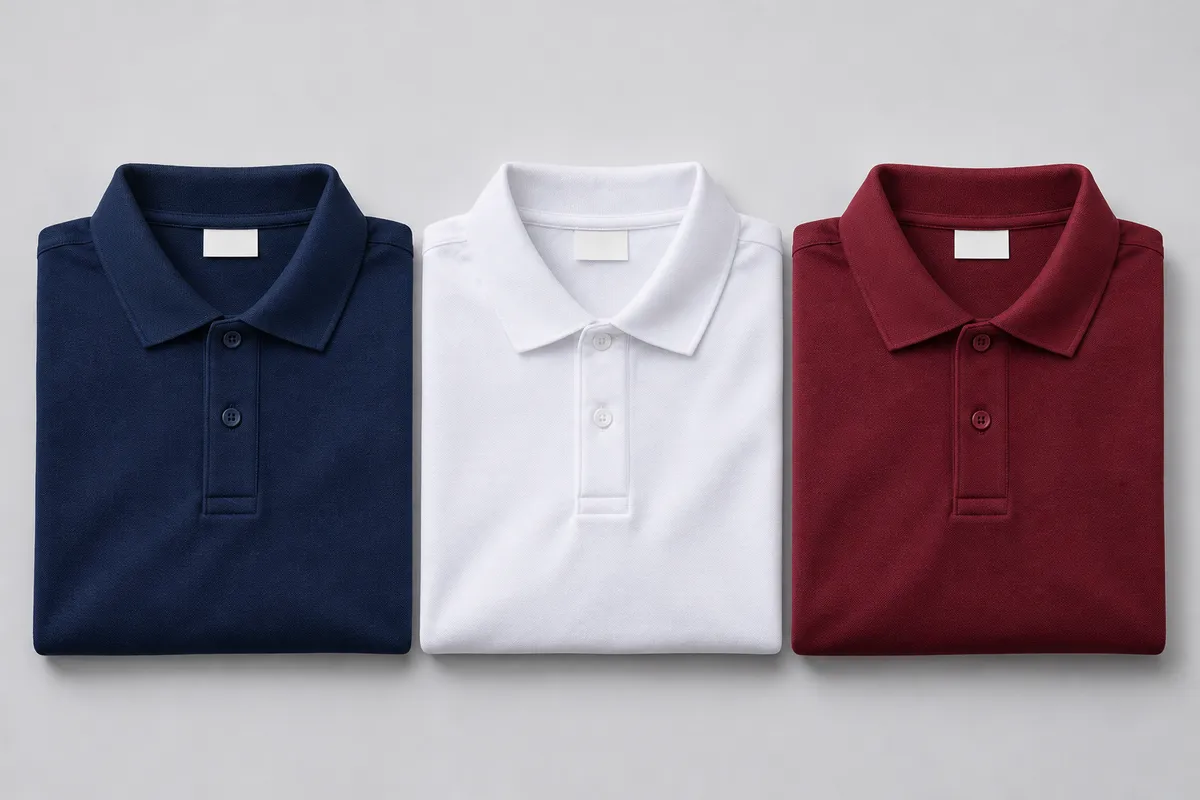
School polo terms vary by country: the same piqué knit shirt with a collar and buttoned placket is a “polo shirt” in the UK and Australia, a “polo” or “knit shirt” in the USA, a “golf shirt” in South Africa, and often a “polo T-shirt” or “collar T-shirt” in India. When you send an enquiry, the safest wording is the plain description, short- or long-sleeve piqué polo with a rib collar and buttoned placket, plus the local name you use, so nothing is lost between buyer and maker.
We write your own terms back into the quotation, so the garment names match what you use on your shelves and uniform lists.
The same garment, different names
| Country or region | Common names for the school polo | Watch for |
|---|---|---|
| UK and Ireland | Polo shirt, polo | “Sports polo” usually means a PE top |
| USA | Polo, knit shirt, piqué polo | “Interlock polo” names a smoother knit, not the piqué we list |
| Australia and New Zealand | Polo, polo shirt, sport polo | “Sport polo” is a separate PE style |
| South Africa | Golf shirt | “Polo” is understood but less used on lists |
| India | Polo T-shirt, collar T-shirt, T-shirt with collar | “T-shirt” alone may mean a round neck with no collar |
| Gulf countries | Polo, polo shirt, PE polo | Lists may name a polo per house colour |
The table reflects wording buyers commonly use. Your school or shop may use its own terms; tell us which.
Words for the parts of a polo
Part names also differ, and an enquiry that mixes them can lead to a wrong sample. These are the terms we use, with alternatives you may see:
- Rib collar: also “knitted collar” or “flat-knit collar”. The fold-down collar knitted in rib.
- Placket: also “button stand” or “front opening”. The buttoned strip below the collar.
- Contrast collar: also “tipped collar” or “trim collar”. A collar, and often cuffs, in a second colour.
- Piqué: also “honeycomb” or “pique knit”. The textured knit used for school polos.
- Left chest logo: also “badge”, “crest” or “emblem”. The logo position over the heart.
- Side vents: also “side splits” or “slits”. Short openings at the hem.
Size words differ too
Size names vary as much as garment names. UK buyers often use age bands such as “9–10”; US buyers, youth letters; Australian shops, even numbers such as 8, 10, 12; South African shops, ages then adult letters; Indian shops, numbered sizes often linked to chest in inches. None of these is wrong. What matters is that each label points to a measurement on the agreed size chart.
How to word an international polo enquiry
A clear enquiry avoids rounds of questions. Include:
- The plain description of the garment and your local name for it.
- Sleeve length: short or long.
- Colours, with the collar trim colour if any.
- Logo position and method.
- Size labels you use, with the measurement each one stands for.
- Quantities by style and size.
Our schoolwear suppliers and distributors page covers how buyers supplying several countries or regions usually order. Enquiries are welcome from any country; we set out shipping, terms and paperwork for each order in its quotation.
If you send a polo you sell now, the garment itself settles any doubt about names. Send it with your quantities and we will quote per style, by fabric, quantity and branding. Our polo styles are listed on the school polo shirts page.
Questions buyers ask
Is a polo T-shirt different from a polo shirt?
No. “Polo T-shirt” is a common name in India and some other markets for the same collared knit shirt with a buttoned placket. If you mean a round-neck T-shirt with no collar, call it a PE T-shirt instead.
What is a tipped collar?
A tipped collar has one or more stripes of a second colour along the edge of the rib collar. Some buyers use the term for a fully contrasting collar as well, so describe or show exactly what you mean.
Will our quotation use our local terms?
Yes. Tell us the names you use, and we write them into the quotation alongside our style names, so your team can check the lines against your own stock list.