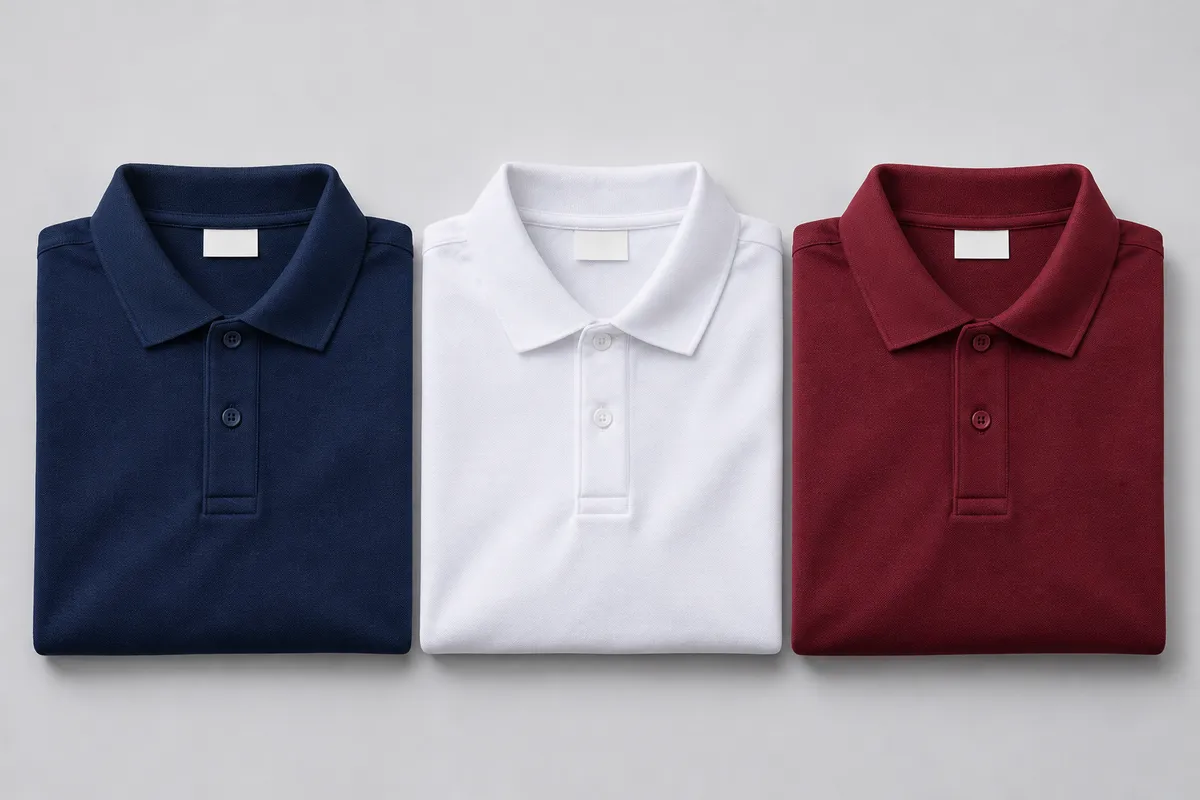
Our school polo shirt minimum order is 100 pieces per style, and sizes can be mixed freely within those 100. A style is one polo design: short-sleeve, long-sleeve and contrast-collar polos are separate styles, and each needs 100 pieces on its own. The colour split within a style is confirmed at quotation.
Polos fall under our knitwear and sportswear minimum, which is higher than the 50 pieces per style for woven garments such as shirts. The reason is in how knitted fabric is prepared and dyed, which makes very small runs impractical.
What counts as one style?
This is the question that matters most when you plan around the minimum. The table shows common cases.
| What you are ordering | Counted as | Notes |
|---|---|---|
| Short-sleeve navy polo, sizes 4–5 to chest L | One style | Any size mix within 100 |
| The same polo with and without a logo | Ask at quotation | Branding is confirmed per order |
| Short-sleeve and long-sleeve navy polo | Two styles | 100 each |
| Navy polo and contrast-collar navy polo | Two styles | 100 each |
| Navy polo for School A and for School B, different logos | Two styles | Each school’s polo is its own style |
| Plain white polo, own label, for several schools | One style | Shared across all those schools |
| Navy and white polo, same design | One style, two colours | Colour split confirmed at quotation |
When a case is unclear, ask before you plan. We set out each style on its own line in the quotation, so you can see how each one is counted.
Why sizes mixing makes the minimum easier
Because sizes are mixed within a style, 100 pieces can cover a full range. A small primary school might take 100 polos spread across six age bands. A shop topping up might take 100 spread across only the four sizes that sold out. You never need 100 of a single size.
Reaching 100 pieces when you are small
A school of 150 students, or a shop with only one or two schools, can find 100 pieces a lot for a second or third polo style. Ways buyers handle it:
- Order the main polo first. Put the bulk of the order into the polo every student wears, and add other styles once numbers allow.
- Cover more than one season. If a long-sleeve polo sells slowly, order a year’s need in one go rather than a term’s.
- Use plain stock across schools. A shop can hold one plain white polo that many schools accept, under its own label.
- Combine a school’s needs with the next year’s intake. Order for the incoming class and current students together.
- Drop styles that do not earn their place. If a contrast-collar polo sells only a few dozen a year, ask whether the list needs it.
Our minimum order and samples page sets out how the minimum is counted across every garment we make.
The minimum on top-ups and reorders
The same 100-piece minimum applies to each later order of a style, with sizes mixed. Top-ups are easiest when you plan them early: group sizes that will run low within a few weeks of each other, and place one order of 100 rather than several small requests.
What to send with your enquiry
- Each polo style you need, with the quantity per style
- Your size range and a first split by size
- Colours, and the quantity of each within a style
- Logo artwork, or note that the polo is plain
- Your neck label and size label wording, if you have them
We quote per style, by fabric, quantity and branding, then make a sample for approval. Our full polo range is on the school polo shirts page.
Questions buyers ask
Is the polo minimum per order or per style?
Per style. An order with three polo styles needs 100 pieces of each, so 300 in total, while an order with one style needs 100. Other garments in the same order follow their own minimums.
Can a polo and a PE T-shirt be combined to reach 100?
No. They are different garments and different styles, each with its own minimum. Both sit in our knitwear and sportswear group, so each needs 100 pieces per style.
Does the minimum change for a sample?
A sample is made before bulk production for you to approve, and it is not counted towards the minimum. How samples are arranged is confirmed in the quotation.