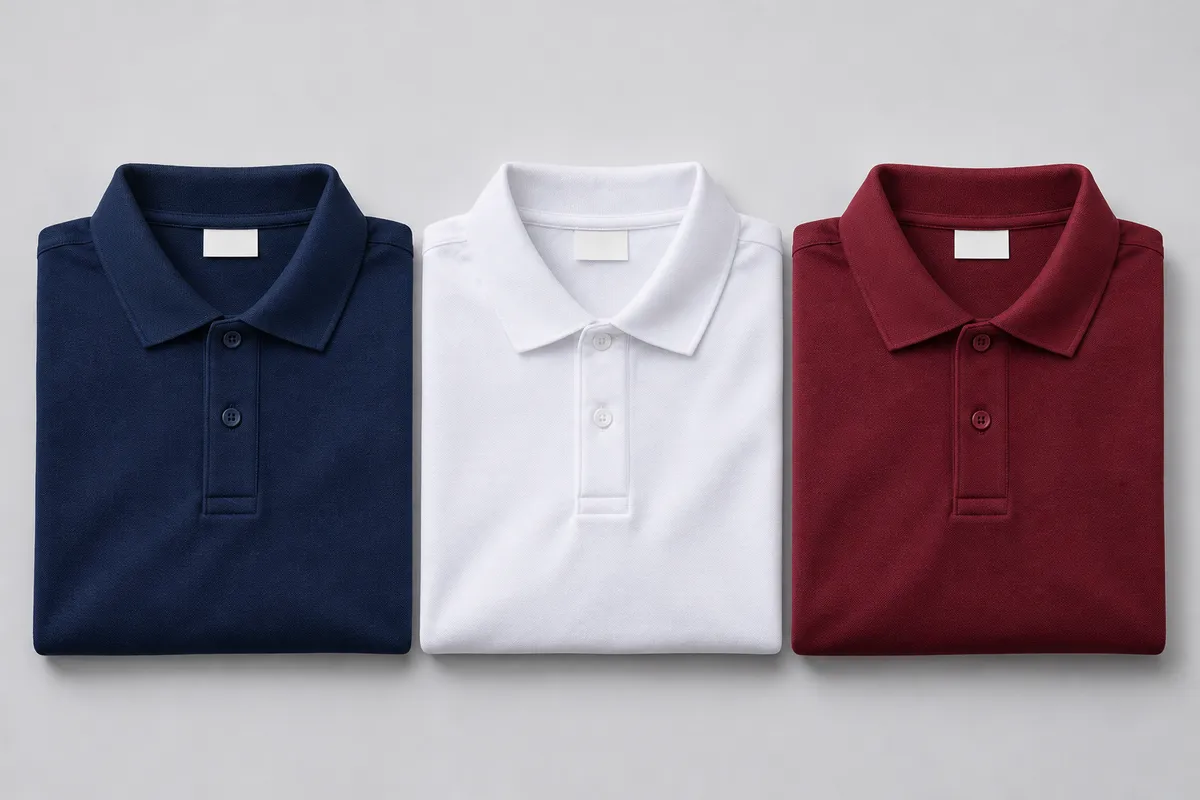
Polo shirt stitching on a well-made school polo uses stitches that stretch with the knit: overlocked seams inside, twin-needle or coverstitched hems outside, and firm bar tacks at stress points. Because piqué stretches, a stitch that cannot stretch with it will snap when the polo is pulled over a child’s head. Knowing the main stitch types helps a buyer judge a sample quickly.
This post explains where each type of stitch appears on a polo and what to look for.
Why does a knitted polo need different stitching?
A woven shirt barely stretches, so a simple straight stitch holds it together. A piqué polo stretches every time it is put on or taken off. If the seams and hems are sewn with a rigid stitch, the thread breaks before the fabric does, leaving gaps in a seam or a hem that pops open.
Stitches for knitwear are built from loops that give a little with the fabric, then return.
Which stitches are used where on a polo?
| Stitch | Where you find it | What it does |
|---|---|---|
| Overlock | Side seams, shoulder seams, sleeve seams (inside) | Joins and finishes the edge in one step; stretches with the knit |
| Twin-needle / coverstitch | Body hem, sleeve hem (outside) | Two parallel rows on the face, a looped stitch inside; stretches and looks neat |
| Single-needle topstitch | Placket edges, collar seam | Holds parts flat and gives a crisp line |
| Bar tack | Base of the placket, top of side vents | Short, dense stitch that reinforces stress points |
| Lockstitch | Labels, some trims | Secure stitch for parts that do not need to stretch |
On the outside of a well-made polo, the hem shows two neat parallel rows. Inside, the seams are overlocked edges, often covered at the neck by tape.
How do you spot weak stitching on a sample?
You do not need special tools. Turn the sample inside out and use your hands:
- Stretch the hem gently. It should stretch and recover, with no popping sound or broken stitches.
- Look along the side seams. The overlock should be even, with no gaps or loose loops.
- Check the ends of seams. Threads should be secured, not left long or unravelling.
- Look at the hem rows. The two rows should be parallel and the same distance from the edge all round.
- Check the placket base and vents. A bar tack should sit firmly across each stress point.
- Look for skipped stitches. Gaps in a row show where the needle missed.
We check these points on the sample and in our quality check before packing.
Stitch colour and finish
Thread colour usually matches the body, so stitching blends in. On a contrast-collar polo, the collar seam may use thread matched to the collar or the body; either is fine, as long as it is consistent.
Stitch density affects both look and strength. Very sparse stitching looks cheap and can open; very dense stitching can stiffen the hem and make it wave. A balanced, even stitch is the aim.
The fabric itself matters too. A piqué that has been relaxed before cutting keeps the hem flat after washing, while unrelaxed fabric can draw the stitches into ripples. Our page on fabrics and colour matching explains how fabric is confirmed for each order.
Bringing it together
Good stitching is something families never notice, which is the point. Poor stitching shows quickly, as split seams or rippled hems after a few weeks. A careful look at the sample saves returns later.
Our school polo shirts page shows each polo style we sew this way. If a polo you currently sell has stitching problems, send one with your enquiry and say what has gone wrong; we will take it into account when preparing your quotation and sample.
Questions buyers ask
Why do some polo hems look wavy?
A wavy hem usually means the fabric was stretched as it was stitched, or the stitch was too tight for the knit. It can also come from fabric that was not relaxed before cutting. The sample shows whether the hem lies flat.
Is twin-needle stitching stronger than a single row?
For a knitted hem, a twin-needle or coverstitch finish is generally more suitable than a single straight stitch, because its looped underside lets the hem stretch. It also gives the neat double line buyers expect on a polo.
Should seams be checked after washing?
Yes, if possible. Washing a sample once shows whether seams pucker, hems ripple or stitches break. It is a simple step that tells you more than inspecting a fresh sample alone.