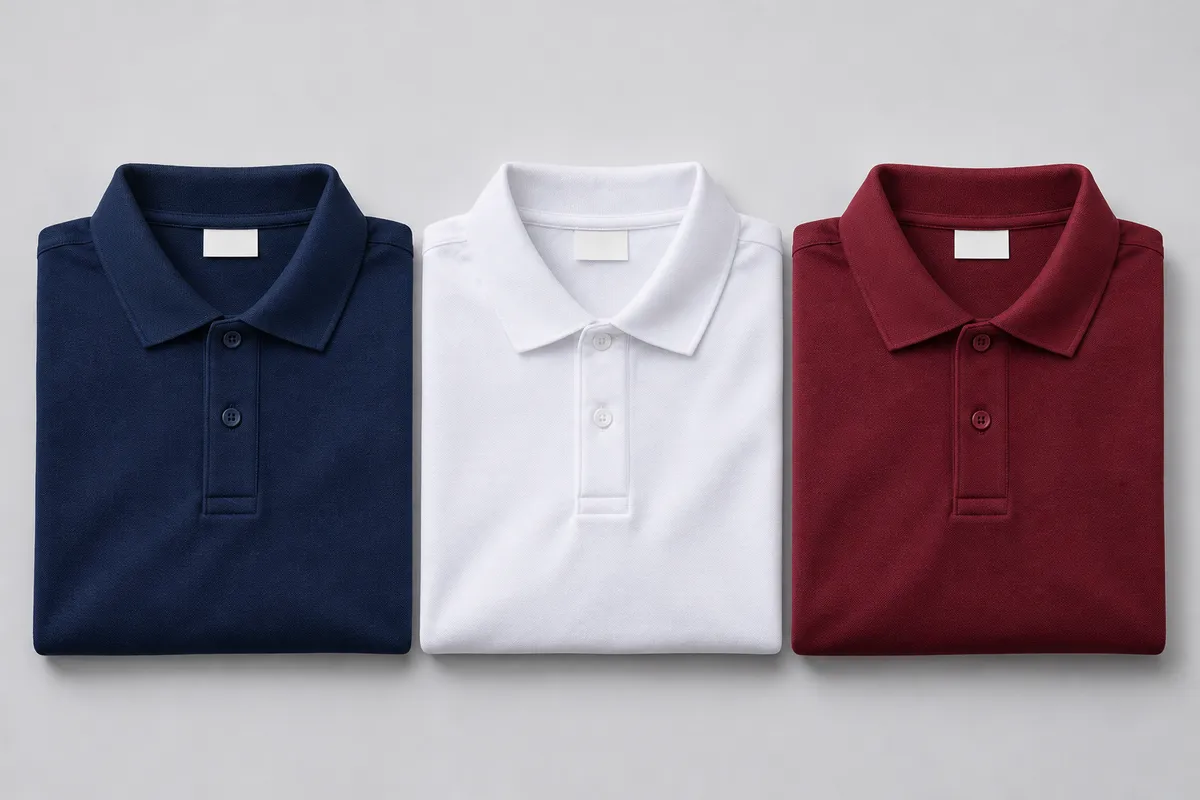
A school polo colour split is the share of an order given to each body colour, such as white, navy and a school colour like bottle green or royal blue. Plan it from how each colour is used on the uniform lists you supply: a colour every student wears daily takes the largest share, while a colour worn by one year group or for one season takes a small one. Each colour must also reach enough pieces to be worth producing, and the split is confirmed at quotation.
White and navy are common polo colours on school lists in many countries, which is why shops often hold them in depth. School colours are where the planning gets harder.
Why colour needs its own plan
A size ratio tells you how many of each size to make. A colour split sits above it: it decides how many polos of each colour you order before the sizes are split. If the colours are wrong, a perfect size ratio still leaves you with too many green polos and too few white.
There are three common patterns.
| Pattern | Example | How the split behaves |
|---|---|---|
| One colour for all | Every student wears a navy polo | No split needed |
| Main colour plus white | Colour polo daily, white for formal days | Main colour takes most of the order |
| Colour by age or group | Younger years in one colour, seniors in another | Follows the roll of each group |
| Plain colours for many schools | A shop’s own-label white and navy | Follows the shop’s total sales by colour |
How to work out the split
- List every polo colour on every uniform list you supply.
- Note who wears each one: which year groups, which days, which seasons.
- Estimate polos per student for each colour.
- Multiply by the number of students wearing that colour.
- Compare with past sales, if you have them, and adjust.
The result might be, for example, a navy logo polo taking most of the order, a white polo a smaller share, and a contrast-collar senior polo the remainder. Each of those is then split into sizes.
The minimum per colour
For our polos, the minimum is 100 pieces per style. Colours of one style share a style, and the colour split is confirmed at quotation, so ask how a low-volume colour fits before you commit. A colour worn by a small group may be better ordered less often, in a larger batch, than topped up in tiny amounts. Our minimum order and samples page explains how the minimum is counted.
Matching each colour
Every colour is matched to your reference before production. Send a polo you already sell, a fabric swatch or a colour reference for each one. On contrast-collar polos, the collar and cuff trim are matched to a second colour as well. Matching white is rarely an issue; deep school colours such as maroon or bottle green deserve the closest look on the sample.
Common colour-split mistakes
- Splitting colours evenly when one is worn far more than the others
- Forgetting that white polos are often bought in larger numbers, as they mark easily
- Treating a seasonal colour as year-round stock
- Ordering a logo colour polo for a school that is about to change colours
- Leaving no room for a top-up in the colour that sells fastest
Our uniform shops and retailers page covers how shops usually plan plain and logo polo stock together.
Request a quotation
List your polo colours, who wears each one and your own estimate of quantities, then send them with your logo and size range. We confirm the colour split at quotation and quote per style, by fabric, quantity and branding. Our colours and styles are listed on the school polo shirts page.
Questions buyers ask
Which polo colours are most common on school uniform lists?
White and navy appear on many lists, followed by school colours such as royal blue, bottle green, red and maroon. The right split for you comes from your own lists and sales, not from what other schools choose.
Should white polos be ordered in larger numbers than coloured ones?
Often, yes, if white is worn daily. White marks easily, so families tend to buy more of them and replace them sooner. If white is worn only on certain days, the opposite may be true.
Can we change the colour split after the quotation?
Tell us as early as possible. The split is confirmed at quotation and fabric is prepared to it, so changes after that point may affect timing. We confirm any change in writing before production starts.