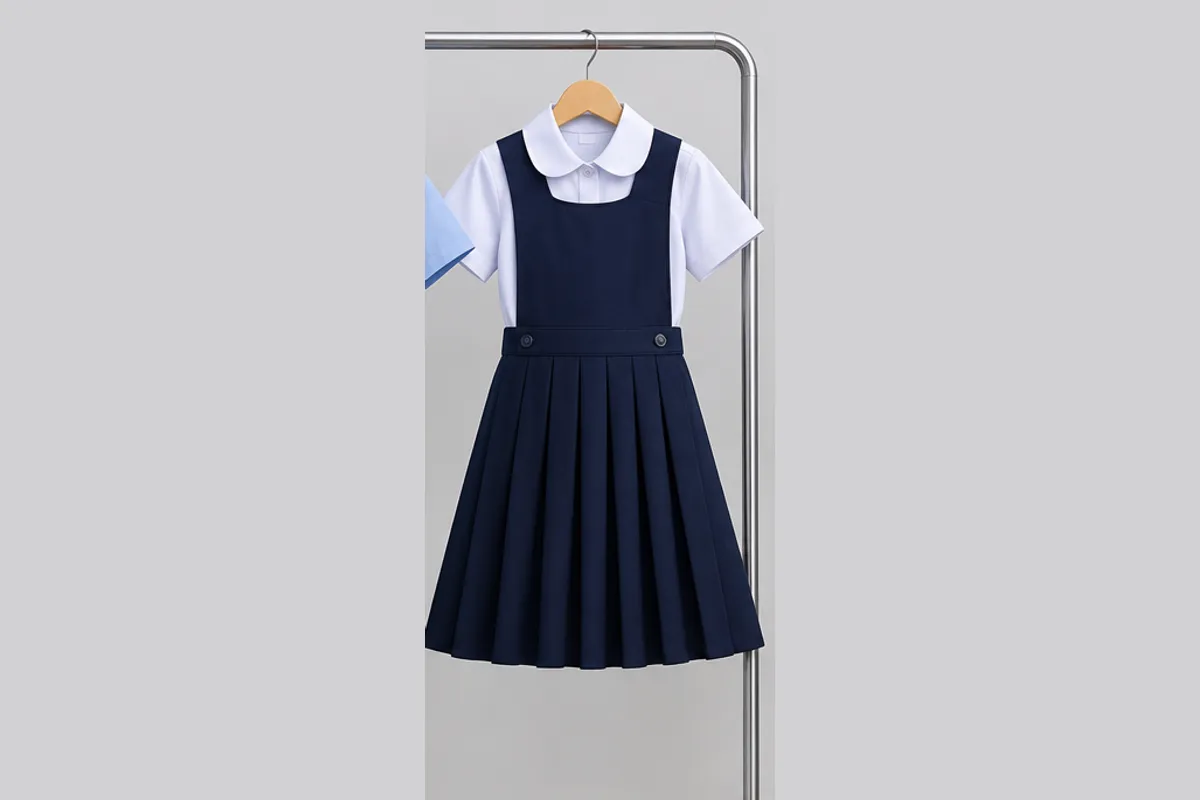
Pinafore straps should be wide enough to stay on a child’s shoulder, crossed at the back if they tend to slip, and long enough to allow some adjustment as the child grows. On a bib pinafore the straps are the main structural part, so their width, angle and fastening decide whether the garment sits neatly or keeps sliding off. Settle those three points in the specification and check them on a child, not only on a hanger.
Crossed or straight at the back?
Crossed straps run from the front of each shoulder diagonally across the back to the opposite side of the waistband. The cross pulls the straps towards the neck, so they rarely slip off narrow shoulders. They are the traditional choice for nursery and infant sizes.
Straight straps run straight down from the shoulder to the back waistband. They look simpler and leave the back of the blouse open in a clean line, but they slip more easily on small or sloping shoulders.
H-back straps are straight straps joined by a short horizontal band across the shoulder blades. The band stops them sliding outwards while keeping a straight look.
| Back style | Stays on small shoulders | Look | Ease of dressing |
|---|---|---|---|
| Crossed | Very well | Traditional, younger | Easy once fastened; can twist when taken off |
| Straight | Less well | Clean, simple | Easiest to put on |
| H-back | Well | Neat, slightly more grown-up | Easy |
How wide should straps be?
Narrow straps look light but dig in and slip. Wide straps spread the weight and stay put but can look heavy on small sizes. A common approach is to grade the width with the size, so a small child’s strap is narrower than an older child’s, keeping the proportions right.
Straps are usually cut double, from two layers of the same fabric or one layer folded and stitched, so they are firm and do not twist. Ask for edge stitching along both sides, which keeps them flat after washing.
Where the straps fasten
Straps join the garment in one of three ways:
- Buttoned at the front of the bib, which lets the child see and manage the fastening.
- Buttoned at the back waistband, which looks neat from the front but needs adult help.
- Sewn in at both ends, with the opening elsewhere. This is the simplest construction but gives no adjustment.
Two buttonholes on each strap, or two buttons on the bib, give a second length position. That one detail can add months of wear.
Specifying straps on your order
Put these into your enquiry:
- Back style: crossed, straight or H-back
- Strap width, or “graded by size”
- Fastening point: front, back or sewn in
- Number of length positions
- Edge stitching on straps
- Strap length per size, or follow our sample
If you are a supplier running one bib pinafore pattern across several schools, keeping the strap design the same makes the range easier to manage; only the colour and logo change. Our page for schoolwear suppliers and distributors explains how multi-school ranges are set up. We manufacture in India and grade the strap length across your size chart, which we agree for each order. You can see the bib pinafore and the other styles on our school pinafores and tunics page.
Send your strap details, or a pinafore to follow, with colours and quantities. The minimum is 50 pieces per style, and we quote per style, by fabric, quantity and branding.
Questions buyers ask
Why do pinafore straps keep falling off the shoulder?
Usually the straps are straight and set too far out towards the shoulder edge, or the child is at the small end of the size. Moving the straps closer to the neck, or crossing them at the back, normally solves it.
Can straps be made in a contrast colour?
Yes, as a design choice, but it changes the style and must be approved on the sample. Most schools keep straps in the body fabric so the pinafore reads as one colour.
Do crossed straps twist in the wash?
They can twist round each other if the pinafore is washed unbuttoned. Fastening the straps before washing keeps them flat, which is a simple tip for shops to pass on.