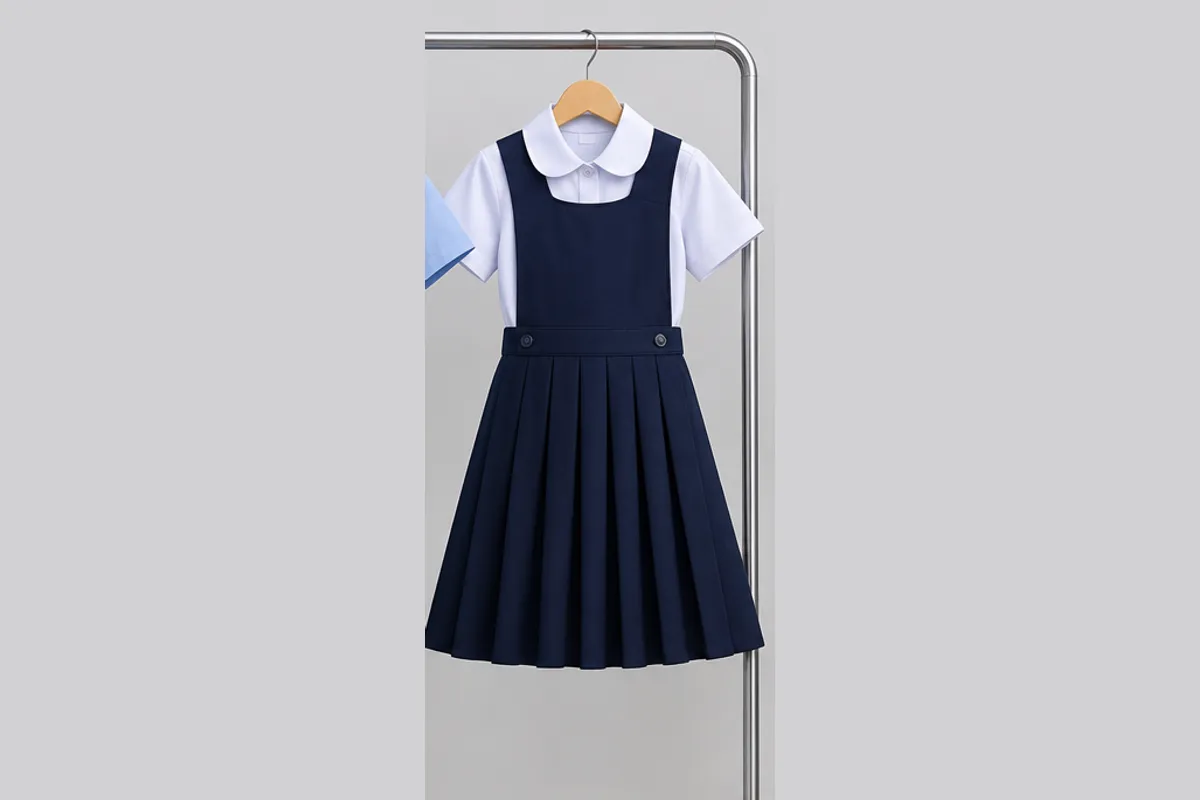
A school pinafore in Australia is usually part of the winter uniform, often called a winter tunic, worn over a blouse from around Term 2 until the weather warms. New Zealand schools follow a similar pattern. Because both school years start in summer, late January or early February, the pinafore’s main sales come months after the year begins, so it is ordered and timed differently from the summer dress.
This guide is for uniform shops, school-run shops and suppliers in Australia and New Zealand.
The winter tunic in an Australian or New Zealand list
A typical girls’ list in both countries has a summer dress in check or stripe, and a winter option that may be a tunic, a pinafore, a skirt or trousers. Where a tunic or pinafore is listed, it is often:
- In the school’s check or a solid school colour, sometimes matching the winter skirt.
- Worn over a long-sleeved blouse, with a jumper or fleece in the coldest weeks.
- Specific to one school, because of the check or colour, rather than plain shared stock.
Many schools run their own uniform shop on campus, sometimes managed by a parent body. Those shops buy direct and hold only their own school’s stock, which shapes order sizes.
Timing around a summer start
The school year in Australia starts in late January, and in New Zealand in late January or early February. The pinafore follows a different clock:
| Period | Pinafore activity | Ordering action |
|---|---|---|
| Late January to early February | New starters buy a full uniform, some including the tunic | Small stock of younger bands |
| Term 1, warm weather | Summer dress dominates | Hold pinafore stock in cartons |
| Late Term 1 to Term 2 | Winter switch; main pinafore and tunic peak | Main stock on the shelf before the switch |
| Terms 2 and 3 | Steady winter wear; growth top-ups | Top-up from early winter sales |
| Term 4 | Back to summer uniform | Let pinafore stock run down |
Working back, a shop that needs pinafores before the winter switch can plan that order alongside the summer dresses for January, with one or two dispatch dates. Lead times and the shipping method are confirmed in the quotation.
What to specify
When you enquire, include:
- The garment name your school uses, tunic or pinafore, and its style: pleated with a bodice, bib, zip-front or a tunic from a yoke.
- The check or colour, with a garment or cutting. A check must be matched closely, so send it early.
- Logo position, if any; many schools leave the tunic plain and carry the logo on the jumper.
- Your size labels, by age or by number, as families in your area know them.
- Separate quantities for January and the winter switch, if you want two deliveries.
For a school-run shop, our for schools and school groups page explains how we work with schools ordering their own uniform.
Differences between the two countries
The pattern above applies to both, but some details vary. In Australia, the state or territory affects term dates slightly, so a supplier serving several states should check each school’s winter switch. In New Zealand, the four-term year and a cooler climate in the south can stretch the winter tunic season longer, so southern schools may sell tunics for more of the year.
In both, older girls often move from a tunic to a skirt or trousers in secondary school, which keeps the tunic range concentrated in the primary years. Plan the size mix around that changeover.
When your next winter season is being planned, send us the check or colour, style and size breakdown for each school, choosing from our school pinafores and tunics range. We manufacture in India and quote per style, with a sample made to your check before production.
Questions buyers ask
Can a tunic match the school’s summer dress check?
Some schools use the same check for both; others use a heavier winter check. If they share a check, send the summer dress so the tunic fabric can be matched. If not, send a separate reference for the winter fabric.
Should a school-run shop hold tunics through summer?
Only a small number for new starters. Most tunic stock should be timed to arrive just before the winter switch, so the shop is not storing it through Term 1 when it rarely sells.
Is a pinafore or a tunic more common in New Zealand?
Both names are used, and the garment varies by school. Describe the style you need, such as pleated from a yoke or with a fitted bodice, and send a garment, so the right pattern is sampled.