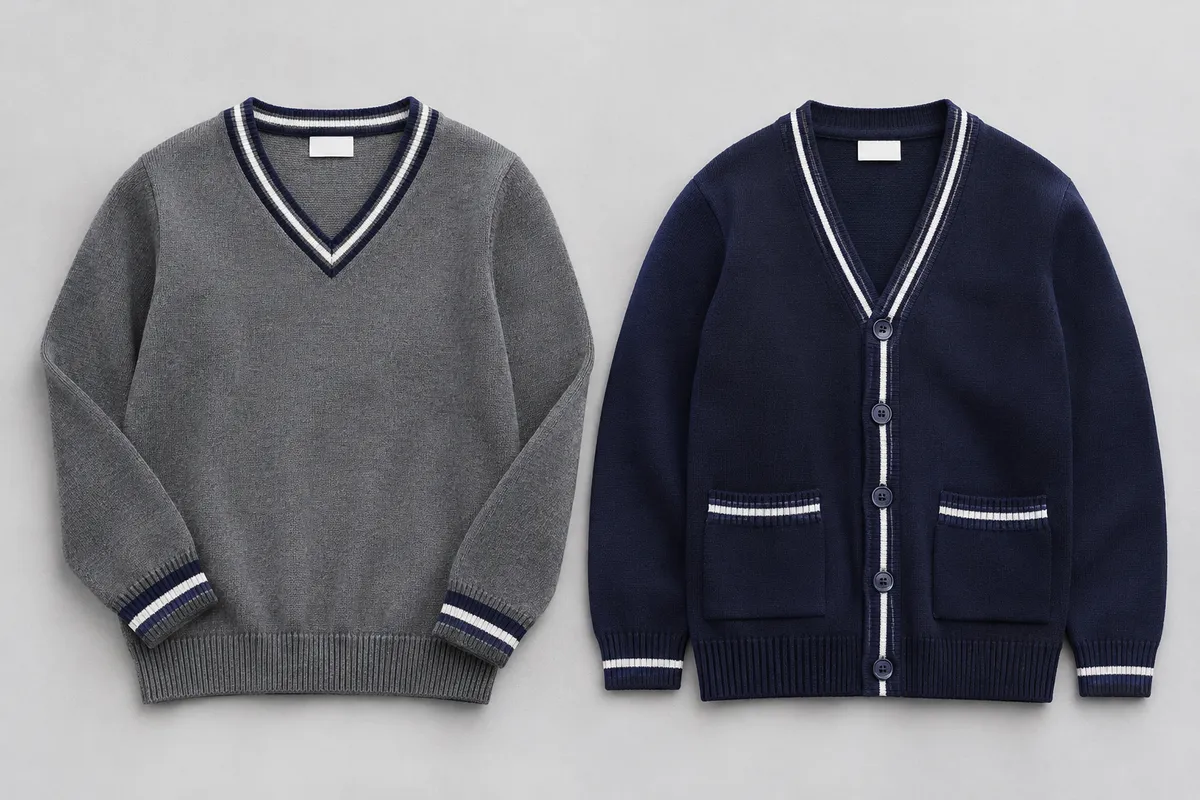
The usual school jumper knit stitch for the body is plain knit, also called single jersey: smooth V-shaped loops on the front and small bumps on the back. The edges use rib. Together those two structures make the familiar school jumper, smooth on the chest and springy at the neck, cuffs and hem.
Other stitches exist and appear on fashion knitwear, but school uniform rarely uses them. Here is why, and what each structure contributes.
The structures in a typical school jumper
Plain knit (single jersey)
Every stitch in a row is knitted the same way. The front shows neat columns of V shapes; the back shows horizontal loops. Plain knit is smooth, light and quick to knit, and it gives a clean surface for a logo. Its weakness is that the edges curl, which is why it is always finished with rib.
Rib
Rib alternates knit and purl columns, producing vertical ridges that stretch and recover. It is used where the garment needs grip or a flat edge: neck bands, cuffs, hems, cardigan front bands and slipover armholes.
Double knit or interlock
These are denser structures made on two needle beds. They give a thicker, firmer fabric. They are sometimes used for heavier knitwear but less often for standard school jumpers, which usually aim for a lighter feel.
Comparing knit structures for school use
| Structure | Surface | Stretch | Where it sits on school knitwear |
|---|---|---|---|
| Plain knit (single jersey) | Smooth front, loops on back | Moderate, mostly widthways | Body and sleeves |
| 1x1 or 2x2 rib | Vertical ridges | High widthways, good recovery | Neck, cuffs, hem, bands |
| Double knit or interlock | Smooth both sides, thicker | Lower | Occasional heavier styles |
| Cable or textured stitches | Raised patterns | Varies | Rarely; fashion rather than uniform |
Why textured stitches are rare on uniforms
Cables, moss stitch and other textures look attractive but bring problems for school uniform:
- Logos. Embroidery needs a smooth base. A badge on cable knit sits unevenly and can distort the pattern.
- Consistency. Textured stitches change the garment’s measurements more after washing, which makes sizes harder to keep consistent.
- Snagging. Raised loops catch more easily on desks, bags and Velcro.
- Matching other garments. A plain knit reads as uniform beside a sweatshirt or blazer; a heavy texture reads as personal clothing.
That is why we make school knitwear in plain knit with rib trims, in acrylic or cotton-acrylic. If a school has a specific textured design in mind, describe it in the enquiry and what can be made is confirmed at quotation.
Reading a sample by its stitches
Turn a sample jumper inside out and look at the reverse of the body. Even, regular loops mean consistent tension. Look at the join between the body and the rib: it should be straight across with no puckering. Stretch the rib and release; it should return to its shape.
| Check | What good looks like |
|---|---|
| Front of the body | Even columns of V shapes, no thick or thin lines |
| Back of the body | Regular horizontal loops |
| Body-to-rib join | Straight, flat, no gathering |
| Rib after stretching | Springs back quickly |
Our fabrics and colour matching page explains how the rib and body are matched in colour when knitted separately. We manufacture in India, and the structure you approve on the sample is used for every repeat order.
If you have a jumper whose knit you want copied, send it with your enquiry and we will quote your knitted jumpers and cardigans per style, by fabric, quantity and branding.
Questions buyers ask
Why does the inside of a school jumper look different from the outside?
Plain knit is a one-sided structure. The front shows V-shaped stitches and the back shows loops, so the reverse always looks rougher. That is normal and is one way to tell plain knit from double knit.
Can a school jumper body be knitted in rib all over?
It can, but an all-rib body clings closely and changes shape more. It is unusual for school uniform. Plain knit with rib edges gives a neater fit for most ages.
Does the knit structure change how warm a jumper is?
Yes. Denser structures such as double knit hold more warmth than single jersey in the same yarn. For most classrooms a plain-knit jumper over a shirt is warm enough, and the yarn choice matters more.