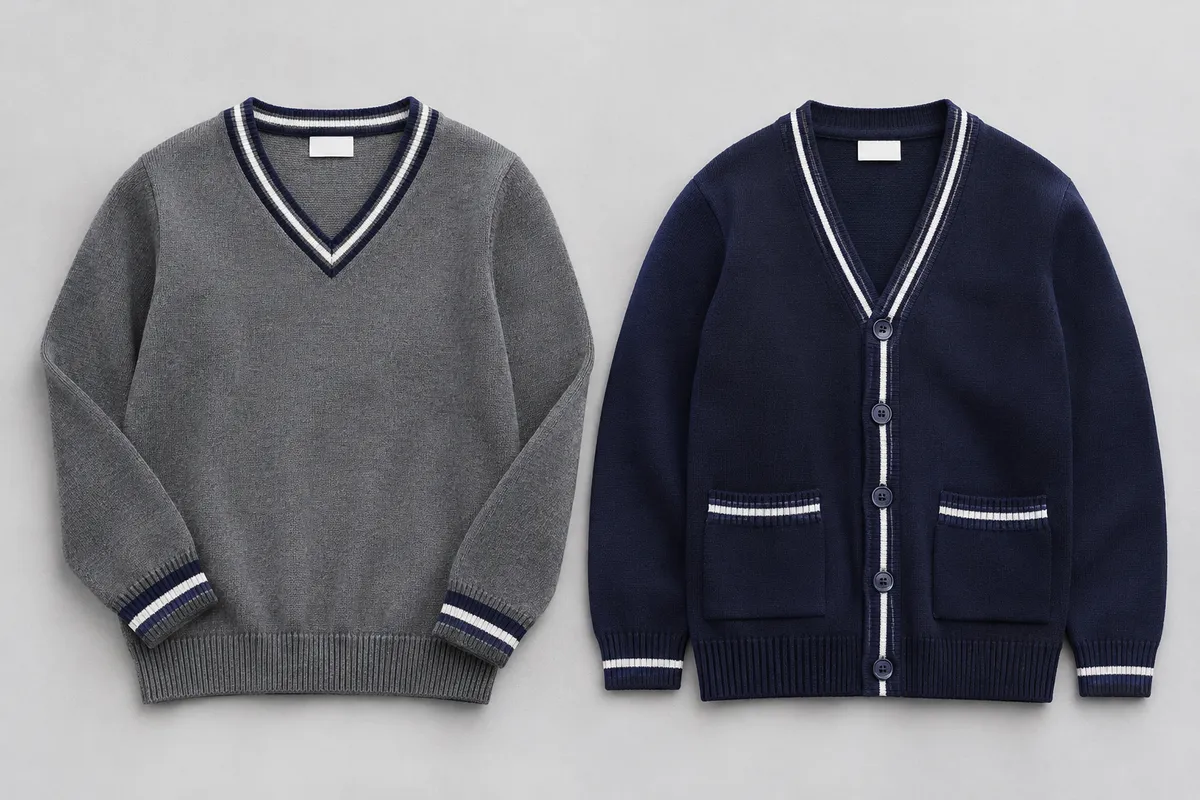
A first order of school knitwear goes smoothly when the buyer settles the styles, the colour and trim references, the size range and a rough quantity per style before the enquiry, then treats the sample as the point where every detail is fixed. Knitwear needs more care at the sample stage than woven uniform, because stripes and colours are knitted in and cannot be altered afterwards.
The plan below takes you from the first decision to the first carton, in the order things happen.
What to settle before the enquiry
Step 1: decide which knitted styles to order
We make V-neck jumpers, cardigans and sleeveless slipovers, each plain or with knitted-in stripe trim. For a first order, fewer styles is usually wiser.
- One school, one jumper. The simplest first order. One style, one colour, all sizes.
- Jumper and cardigan. Common where the list allows either. Two styles, each with its own minimum.
- Full range. Jumper, cardigan and slipover. Suits a large school or a shop that already knows its demand.
Each style needs at least 100 pieces, with sizes mixed. If a style will not reach that comfortably, consider adding it in a later order.
Step 2: gather the references
Knitwear is matched to what you send, so the quality of your references decides the quality of the match.
| Reference | What to send | Why |
|---|---|---|
| Body colour | A current jumper or a yarn swatch | Printed colour cards rarely match knitted yarn |
| Stripe trim | A current jumper, or a drawing with colours and widths | Stripes are knitted in and must be exact |
| Logo | Artwork file and the size you want | Embroidery or print is set on the sample |
| Sizes | One jumper in each size, or a measurement chart | So the fit matches what families know |
| Label | Your neck label design, or ask for ours | Sewn in during making |
If you have no existing jumper, describe the look you want and send a colour reference of any kind. We knit a sample for you to check.
Step 3: send the enquiry and receive the quotation
The enquiry lists styles, references, sizes and estimated quantities, along with the date you need stock on the shelf. The quotation sets out prices per style, by fabric, quantity and branding, plus lead time, shipping method and terms. Our how to order page sets out each step from enquiry to dispatch.
Read the quotation against your enquiry line by line. If a detail is missing, ask before the sample is made.
Step 4: approve the sample carefully
The sample is the reference for bulk production and every repeat order. Check it the way your customers will.
- Body colour against your reference, in daylight
- Stripe colours, widths and order at neck, cuffs and hem
- Logo size, position and thread colours
- Measurements against your size chart
- Neck label, care label and size marking
- Fit on a student, over a school shirt
- Feel and weight of the knit
Write down any change you want and send it together, not one point at a time. If the change is large, ask for a second sample.
After the sample: quantities, payment and delivery
Step 5: confirm quantities and pay the advance
With the sample approved, confirm the final quantity per style and the split by size. Then the advance payment starts production. The balance is paid before dispatch, after the quality check.
For a first order, it helps to split the year: a main order for the start of the season, and a planned top-up for the colder weeks. That reduces the risk of guessing the whole year’s demand from no history.
Step 6: receive and record
When the cartons arrive, count them by size against the packing list, check a few pieces from each size against the sample, and record opening stock. That record is the start of your sales history, which makes every later order easier.
When you have your styles and references ready, send them over, and we will quote your first order of school jumpers and cardigans per style, by fabric, quantity and branding.
Questions buyers ask
Can I order a sample before deciding on quantities?
You can share estimated quantities at enquiry and confirm them after the sample is approved. The quotation is based on the estimate, so a large change may mean a revised quotation.
How do I avoid a colour mismatch with existing stock?
Send a jumper from your existing stock rather than a colour name. If you hold stock from several deliveries, send the one most customers will compare against.
Should the first order include every size?
Yes, if the school needs them. A gap in the range sends families elsewhere. Order the smallest and largest sizes thinly, then adjust after the first season.