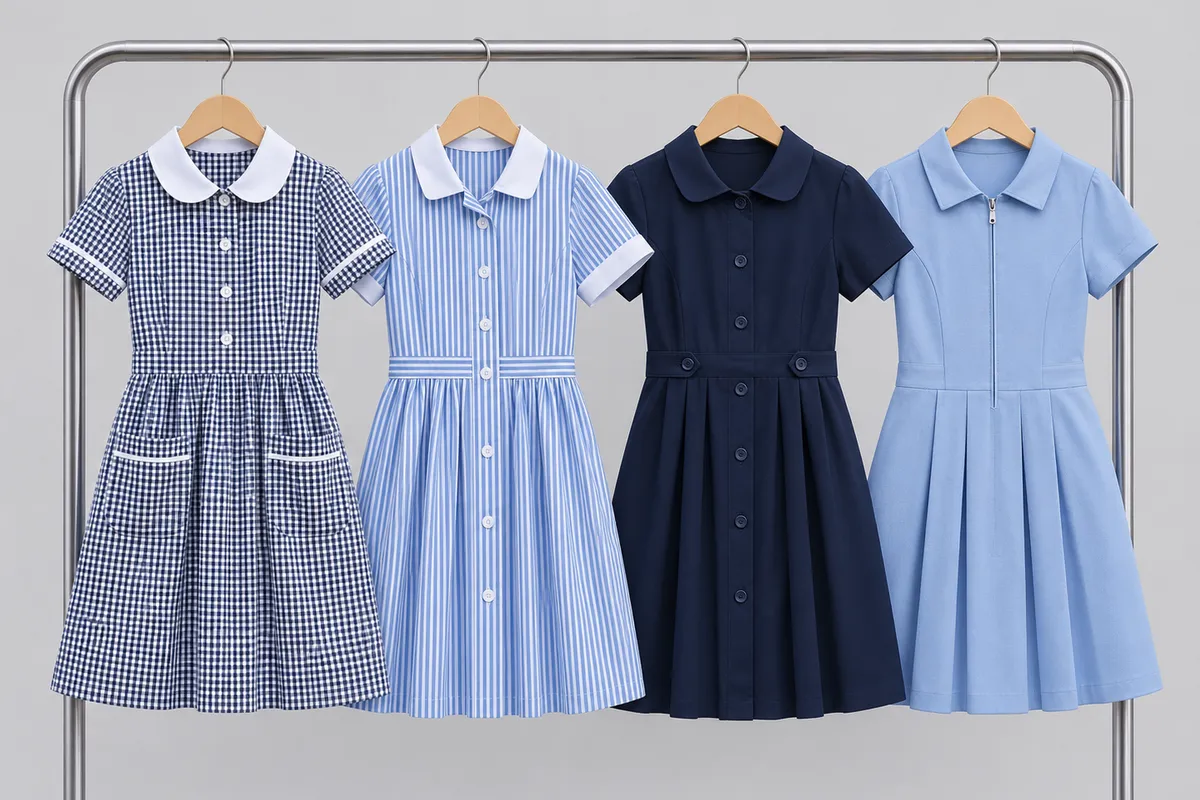
The school dress colour for summer is usually one of four gingham or stripe shades: blue, red, green or yellow, each on a white ground. A shop or school chooses the shade that sits well beside the rest of the uniform, then fixes the exact tone with a swatch so every delivery looks the same on the rail.
This post looks at the choice from the buyer’s side: the school or shop deciding which summer dress shade to put on the uniform list and keep in stock.
Which colours do school summer dresses usually come in?
Summer dresses are almost always a coloured check or stripe on white, rather than a solid colour. The white keeps the dress light in look and feel, and the coloured yarn carries the school’s identity. Within that pattern, a small set of shades covers most uniform lists.
| Shade | How it usually reads | Pairs naturally with |
|---|---|---|
| Blue (mid or royal) | Fresh and familiar; the most widely used family | Navy, royal or grey knitwear |
| Light or sky blue | Soft, suits younger pupils | Navy or grey cardigans |
| Red | Bright and easy to spot in a playground | Red, maroon or grey jumpers |
| Green (bottle or mid) | Calm, links well with green blazers | Bottle green or grey knitwear |
| Yellow or gold | Cheerful, less common, so it stands out | Navy, brown or green |
| Matched shade | Any tone sent as a reference | Whatever the school already wears |
None of these is a rule. A school with a purple or maroon jumper can have a dress woven to match. We match the shade to the reference you send, so the table is a starting point rather than a limit.
How should the dress colour relate to the rest of the uniform?
A summer dress is rarely worn alone. On cool mornings it sits under a cardigan or sweatshirt, and in some schools under a blazer. So the dress shade should be chosen with the knitwear in hand, not from a screen.
Three approaches work:
- Same family. A blue gingham under a navy cardigan, or green under bottle green. This is the safest and most common choice.
- Neutral companion. A coloured dress with grey knitwear. Grey accepts almost any gingham shade, which helps if the school is changing colours.
- Deliberate contrast. A yellow dress with navy, for example. This works when the school already uses both colours in its badge.
If you supply several schools, the first approach matters most, because each school’s dress will be judged against its own jumper colour.
Stocking one shade for several schools
A plain gingham dress with no logo can sit on more than one school’s list. A shop serving several local schools often finds that two or three of them use blue gingham, and one stock line can serve all of them. That only works if the schools accept the same tone and check size, so it is worth showing them the swatch before committing.
Where schools want a shade that is clearly their own, the dress becomes a single-school line. That is fine, but the stock is then tied to one customer, and the colour needs its own approval. Our page for uniform shops and retailers covers how shops plan shared and single-school lines.
What to tell the manufacturer about colour
Colour names are loose. One school’s “royal blue” is another’s “mid blue”. To avoid a mismatch, send a physical reference wherever you can.
- A current dress, or a cut piece of the gingham
- The cardigan or jumper the dress is worn with
- A note of which reference wins if the two differ
- The check size or stripe width, if matching an existing dress
- Whether the collar is white or in the dress fabric
- Any shade the school has asked you not to use
We match the colour and check size, then send a swatch for approval before bulk fabric is made. Look at it in daylight beside the knitwear. The approved swatch becomes the standard for every later order.
Changing the shade later
Schools do sometimes change the dress colour, for a new badge or a merged school. A new shade is a new style, with its own swatch and sample. Most schools allow both colours for a period, so old stock can sell through. Plan the first order of the new shade at a modest size, then build up once you see demand.
Each colour counts as its own style, with a minimum of 50 pieces and sizes mixed within it. Our school summer dresses page lists the gingham and stripe styles in each shade family. When you have chosen a shade, send a reference piece and your size range, and we will prepare a quotation, priced per style by fabric, quantity and branding.
Questions buyers ask
Can a summer dress be a solid colour instead of gingham?
It can be specified, but gingham and stripe are the usual choices because the white in the pattern keeps the dress light and cool-looking. A solid shade also shows fading and marks more plainly, so most schools stay with a patterned fabric.
Does a darker gingham hide marks better?
A deeper shade and a smaller check tend to hide grass and food marks better than a pale, large check. The white squares will still show marks, so the shade alone does not solve it; a smaller repeat helps more.
How many shades should a shop carry?
Carry only the shades your schools have on their lists. Each shade is a separate stock line with its own size spread, so an extra colour that sells slowly ties up stock across every size.