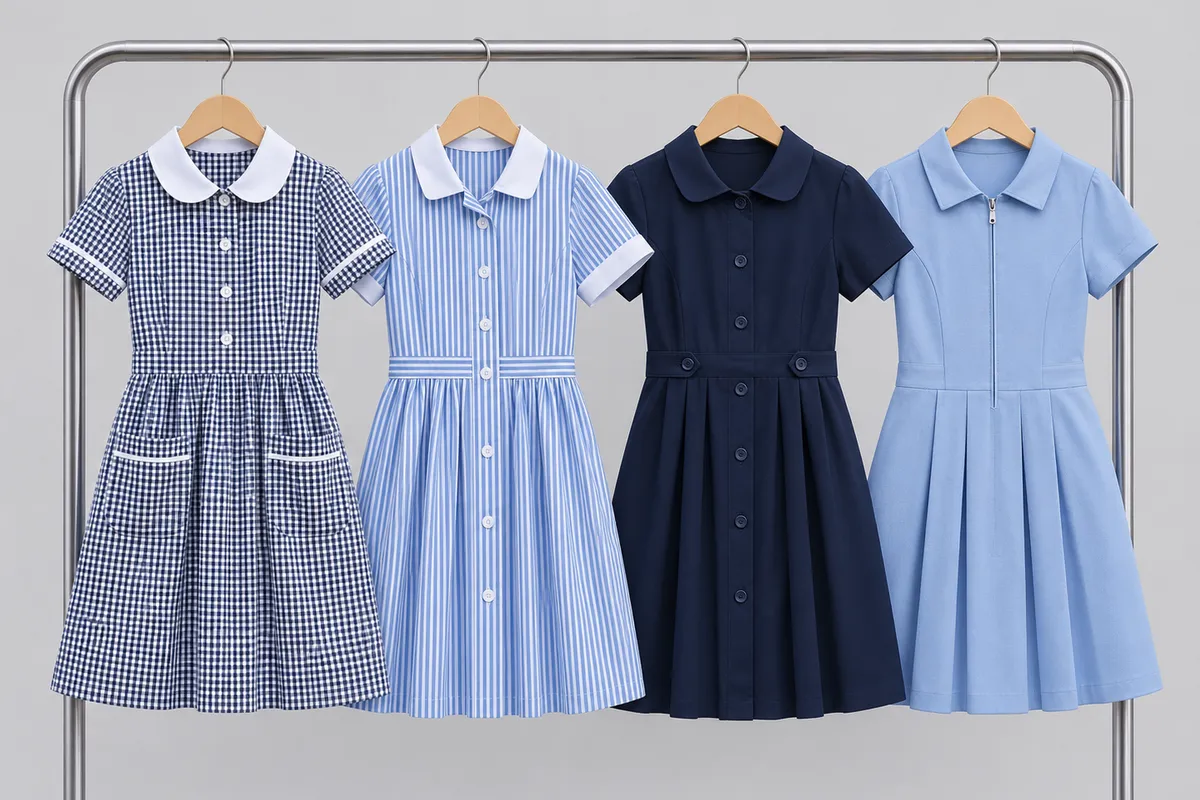
A school dress colour combination is built from three layers: the ground colour of the fabric (usually white), the colour of the check or stripe woven over it, and the trim colours on the collar, buttons, belt and any piping. Getting all three agreed before sampling stops a dress from looking slightly wrong when it arrives in bulk.
Most enquiries describe a dress as “blue gingham” and stop there. This post explains the other decisions hidden inside that phrase, so a supplier or school can specify the whole combination at once.
Layer one: the ground
Nearly every summer dress fabric has a white ground. Some use cream or a very pale tint of the check colour, which softens the look. The ground matters because it fills about half the surface of a gingham and most of a stripe.
A bright white ground gives a crisp, clean look. An off-white or cream ground looks gentler and shows less contrast with older, washed dresses. If you are matching an existing dress, check the ground as carefully as the check colour, because a whiter ground can make a new dress look out of place beside older ones.
Layer two: the check or stripe colour
This is the colour people name. In a classic gingham, the coloured yarn crosses the white to make three tones: solid colour where coloured yarns cross, a mid tone where coloured meets white, and white where white meets white. So a single yarn colour produces a three-tone fabric.
Some schools use two colours in the pattern, such as a navy and red check or a stripe with a fine second line. A two-colour pattern stands apart from neighbouring schools but is harder to match on later orders, because both colours must be right.
Layer three: the trim
Trim is where most combinations go wrong, because it is easy to leave unspecified.
| Trim part | Common choices | What to consider |
|---|---|---|
| Collar | White, dress fabric, or a solid colour | White frames the face; dress fabric looks simpler |
| Cuffs or sleeve bands | Match the collar, or none | Should usually repeat the collar choice |
| Buttons | White, or matched to the check colour | White buttons on a coloured placket stand out |
| Zip | Matched to the check colour, or white | A dark zip on a light dress shows through |
| Belt | Dress fabric or a solid colour | A solid belt adds a third colour to the outfit |
| Piping | None, white, or the check colour | Adds definition at the collar or waist |
| Embroidered logo | Thread colours from the badge | Must read clearly on a busy check |
Combinations that tend to work
These are examples, not a fixed menu. Each assumes a white ground.
- Classic: blue gingham, white collar, white buttons, belt in the dress fabric.
- Simple: green gingham with the collar, belt and buttons all in matching fabric or colour, for a plain, uniform look.
- Defined: red gingham, white collar with red piping, red buttons.
- Two-tone: navy and yellow stripe, navy collar, navy belt, for a secondary-age look.
For a supplier running one dress pattern across several schools, keeping the trim simple and the same for every school makes production steadier. Only the gingham colour changes between schools, and the white collar and buttons stay constant. Our page for schoolwear suppliers and distributors explains how that approach works across a group of schools.
Writing the combination into your enquiry
A clear specification lists each layer separately. Use this as a template:
- Ground: white, off-white or other
- Check or stripe colour, with a reference piece
- Second pattern colour, if any
- Collar colour and fabric
- Cuff or sleeve band colour
- Button or zip colour
- Belt colour and fabric
- Piping, if any
- Logo thread colours, or plain
We match the fabric colours to your reference, send swatches for approval, and then make a sample dress showing the whole combination together. You approve the sample, and that becomes the standard for bulk production and later orders.
Each colour combination is a separate style, with a minimum of 50 pieces and sizes mixed within it. The dress styles we make are shown on our school summer dresses page. Send us your three layers, written out as above, and we will quote per style, by fabric, quantity and branding.
Questions buyers ask
Does a white collar get dirty faster than a gingham one?
A white collar shows marks sooner than one cut from the dress fabric, especially on younger children. It also lifts the look of the dress, so many schools accept the trade-off. A gingham collar is the practical choice if marks are a concern.
Can the buttons be a different colour from the check?
Yes. White buttons are common on coloured gingham, and buttons matched to the check colour give a quieter look. Choose and confirm them on the sample, since buttons are hard to change once a bulk order is sewn.
Should the dress belt match the school jumper colour?
It can, and some schools use a solid belt in the jumper colour to tie the outfit together. Others keep the belt in the dress fabric so the dress looks complete without the jumper. Either works if it is fixed on the sample.