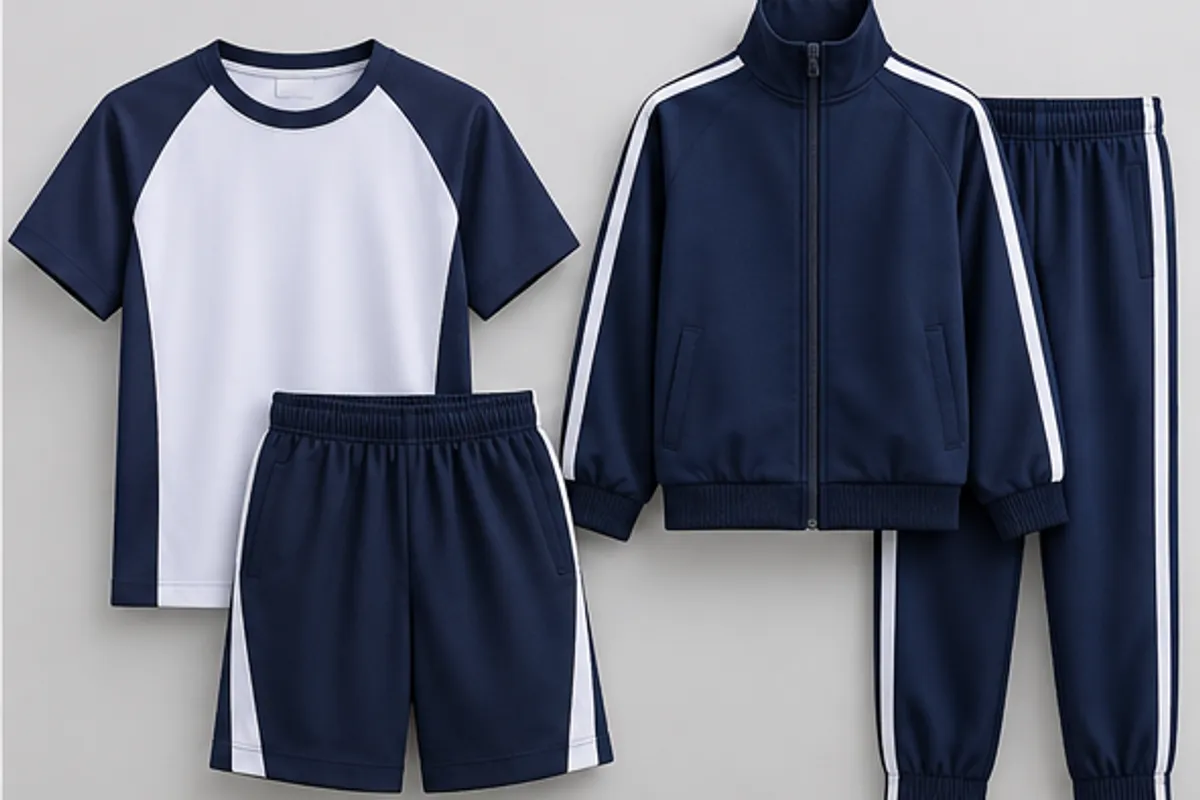
Polyester tricot is the fabric for a tracksuit worn during activity: smooth, light, quick to dry and good at holding bright school colours. Fleece is the fabric for a warm outer layer worn before and after activity, or as a jacket on cold days. A school sportswear list may need one or both, and the choice is less about which fabric is better than about what each garment is for.
We make tracksuit tops and bottoms in polyester tricot and zip-through jackets in fleece. This guide explains how the two fabrics behave, where each fits on a uniform list, and what to check when you combine them.
What polyester tricot is
Tricot is a warp-knitted fabric. In a polyester tricot tracksuit, the face is smooth with a slight sheen, and the back is usually a little softer. Because it is knitted rather than woven, it has some stretch, which suits running, stretching and team sports.
The practical points for a school buyer:
- it dries quickly after washing, which helps families with one set
- it takes strong, saturated colours well, so royal blue, red and bottle green stay bright
- contrast panels and piping can be cut from the same fabric in different colours, which keeps the colour layout crisp
- it is light enough to wear for PE in mild weather, but not a warm layer on its own
Tricot is the usual choice when a school wants a matching top and bottoms for PE, fixtures and trips, especially with two or three school colours in the design.
What fleece is
Fleece is a knitted fabric brushed on one or both sides to raise a soft pile. The pile traps air, which is what makes it warm for its weight. A fleece jacket is worn over a polo or PE top, on the touchline, at break or on a trip.
The practical points:
- it is warm and soft, and comfortable for younger children
- it is bulkier than tricot, so it is a layer rather than an activity garment
- it is usually made in a solid colour; contrast is added through the zip, trims or the logo rather than through many panels
- a fleece in a dark colour will show lint and fluff more than tricot, so care labelling matters
A fleece jacket can sit on a list by itself, as a uniform outer layer, or alongside a tricot tracksuit as part of a sports set.
Side-by-side comparison
| Point to compare | Polyester tricot | Fleece |
|---|---|---|
| Main role | Activity tracksuit, top and bottoms | Warm outer layer, jacket |
| Surface | Smooth, slight sheen | Soft, brushed pile |
| Warmth | Light | Warm for its weight |
| Movement | Some stretch, close fit | Looser, layering fit |
| Colour | Strong, bright colours; multi-panel designs | Mostly solid colours |
| Drying | Quick | Slower than tricot |
| Logo | Embroidery or print, left chest; back print | Embroidery usual on the pile |
| Suits | PE, fixtures, team trips | Break times, outdoor lessons, trips, cold weather |
Read the table as a general guide to the two fabric types. Fabric weight and finish vary, so the exact fabric for your order is confirmed at quotation and on the sample.
Choosing for your list
Ask what the garment has to do. If students will run in it, choose tricot. If they will stand in it, wait in it or travel in it, consider fleece. Some lists use both.
Some combinations work well:
- Tricot top and bottoms only. A full tracksuit for PE and sport. Suits schools in milder climates or those that already have a sweatshirt or jumper for warmth.
- Fleece jacket only. A single outer layer on the main uniform list, often for younger year groups.
- Tricot tracksuit plus fleece jacket. A complete sports set. Match the fleece colour to the tracksuit body and use the same logo position, so the two sit together.
Logo method matters more on fleece than on tricot. A raised pile can swallow fine print, so embroidery is usually clearer on fleece. On tricot, both embroidery and print work, and a printed school name across the back is straightforward. The method, size and position are confirmed with the sample.
Matching colours across two fabrics
When a tricot tracksuit and a fleece jacket share a school colour, they will not look identical. Tricot reflects light; fleece absorbs it, so the same navy can look darker and softer on fleece. We match each fabric to your reference separately and show them together on the sample, so you can judge the pair in daylight before approving. Our page on fabrics and colour matching explains how references are matched.
Both fabrics are knitwear for minimum purposes, so each style starts at 100 pieces. You can see the tracksuit and jacket styles we make on our school tracksuits and jackets page.
Tell us how the tracksuit and jacket will be worn, send your colour references, and we will quote each style per fabric, quantity and branding.
Questions buyers ask
Is a fleece jacket suitable for rain?
Fleece stays fairly warm when damp, but it is not waterproof and will soak through in steady rain. Schools that need rain protection usually source a separate waterproof layer and keep the fleece as the warm layer underneath.
Can tracksuit bottoms be made in fleece?
Our tracksuit bottoms are made in polyester tricot, and fleece is used for the jacket. For a warmer set on cold days, pair tricot bottoms with a fleece jacket over the tracksuit top.
How should tricot tracksuits be washed?
Wash with similar colours at a moderate temperature so bright panels stay clean, and keep high heat away from the smooth face, which can mark under a hot iron. The care label shows the wording you specify.