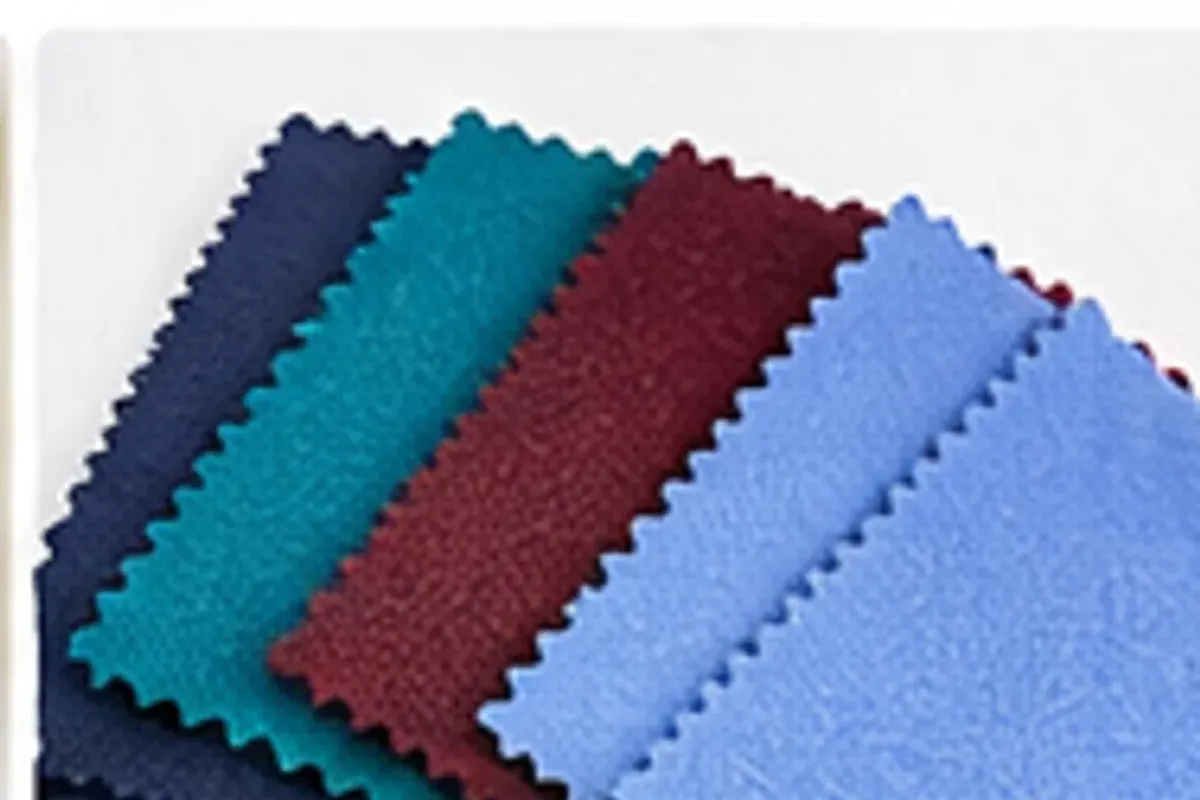
Choose poly-viscose when the trousers should look and feel closer to tailoring, and polyester twill when they must stand up to hard daily wear and frequent washing. Both are standard school trouser fabrics, and the right one depends on the age group, the rest of the uniform and how the trousers will be sold.
We make every trouser and shorts style in either fabric, and the choice is confirmed at quotation. This post explains what changes when you pick one over the other, so you can make that decision with confidence.
What each fabric is
Poly-viscose blends polyester with viscose. The polyester gives strength and shape; the viscose brings a softer handle, a fuller drape and a slightly richer look. It is often woven as a fine twill or a plain suiting cloth.
Polyester twill is woven entirely from polyester in a twill weave, which shows fine diagonal lines on the face. It is firm, holds its shape and dries quickly.
Neither is simply better. They suit different jobs, and both can make a good school trouser when the cloth and construction are right.
Side-by-side comparison
| Point to compare | Poly-viscose | Polyester twill |
|---|---|---|
| Handle | Softer, smoother | Firmer, crisper |
| Drape | Hangs more fluidly | Holds a straighter line |
| Appearance | Closer to suiting; a slight depth of colour | Neat and uniform, with a visible twill line |
| Everyday wear | Comfortable; may show wear sooner at knees and seat with rough use | Stands up well to playground wear |
| Washing and drying | Washes well; dries a little slower | Dries quickly |
| Ironing | Takes a crease well | Holds pressed creases; may need care with heat |
| Match with blazers and skirts | Easy to pair with poly-viscose skirts and blazers | Easy to pair with polyester twill skirts |
| Typical use | Senior trousers, formal uniforms | Primary and junior trousers, shorts, elastic-back styles |
These are general traits. The exact handle depends on the specific cloth, so look at a swatch and the approved sample before you decide.
Matching fabric to age and use
Younger children kneel, sit on floors and play outside. For them, durability and easy care usually come first. Polyester twill suits shorts and elastic-back waist trousers well, because it shrugs off scuffs and is dry by the morning.
Older students sit in classrooms more and often care about how their trousers look. A slim fit in poly-viscose reads as smarter, and pairs neatly with a blazer. Some schools want the senior uniform to feel a step up from the junior one, and a change of fabric is a quiet way to do that.
There are also commercial points to weigh:
- One fabric or two. Using one fabric across all styles keeps the shade consistent on the shelf. Mixing fabrics by age group can make sense, but approve both shades together.
- Matching skirts. Our plain skirts and skorts are made in the same two fabrics. If trousers and skirts must match, specify the same fabric and shade for both.
- Replacing current stock. If families already know a trouser, changing its fabric may draw comments. Send us a pair and we match what you sell now.
Colour matching across fabrics
Grey, black and navy are the usual trouser colours, and grey is where fabric choice shows most. The same grey can look slightly warmer or deeper in poly-viscose than in polyester twill, because the fibres take dye and reflect light differently.
To avoid a mismatch, send a cutting or a garment as your reference. We match the shade and send a swatch for approval before cutting. If you plan to sell trousers in both fabrics, ask to see the two swatches together. Our page on fabrics and colour matching explains how references and approvals work.
How to judge the sample
The fabric decision is only confirmed when you have the sample in hand. Check it as a family would use it:
- Feel the cloth: is it right for the age group?
- Check the shade against your reference in daylight and shop lighting
- Look at the seams at the seat and crotch for even stitching
- Check the waistband, zip and button or elastic for neat finishing
- Confirm the hem allowance if families expect to let down the leg
- Wash it at home and check shape, shade and creases afterwards
- Confirm the waistband label is positioned and printed as agreed
Once you approve the sample, repeat orders are made to it, so the same fabric and shade carry through term after term.
You can see all our trouser and shorts styles on the school trousers and shorts page. Tell us which styles you need and send a pair you sell now if you have one, and we will quote each style by fabric, quantity and branding.
Questions buyers ask
Can we switch fabric at a reorder?
Yes, but treat it as a new specification. A fresh swatch and usually a new sample are needed, and the shade may read slightly differently from the old stock. Approve it against a pair from your current shelf so families see little change.
Is a heavier trouser cloth always more hard-wearing?
Not necessarily. Weave, yarn and construction count as much as weight. A lighter twill with strong seams can outlast a heavier cloth sewn poorly, so judge the sample at the seat, knees and pocket corners.
What care instructions go on the trouser label?
The label shows the care instructions you specify, along with your brand and size. Both fabrics are usually washed at a moderate temperature and ironed on a low to medium setting, and the wording is confirmed before production.