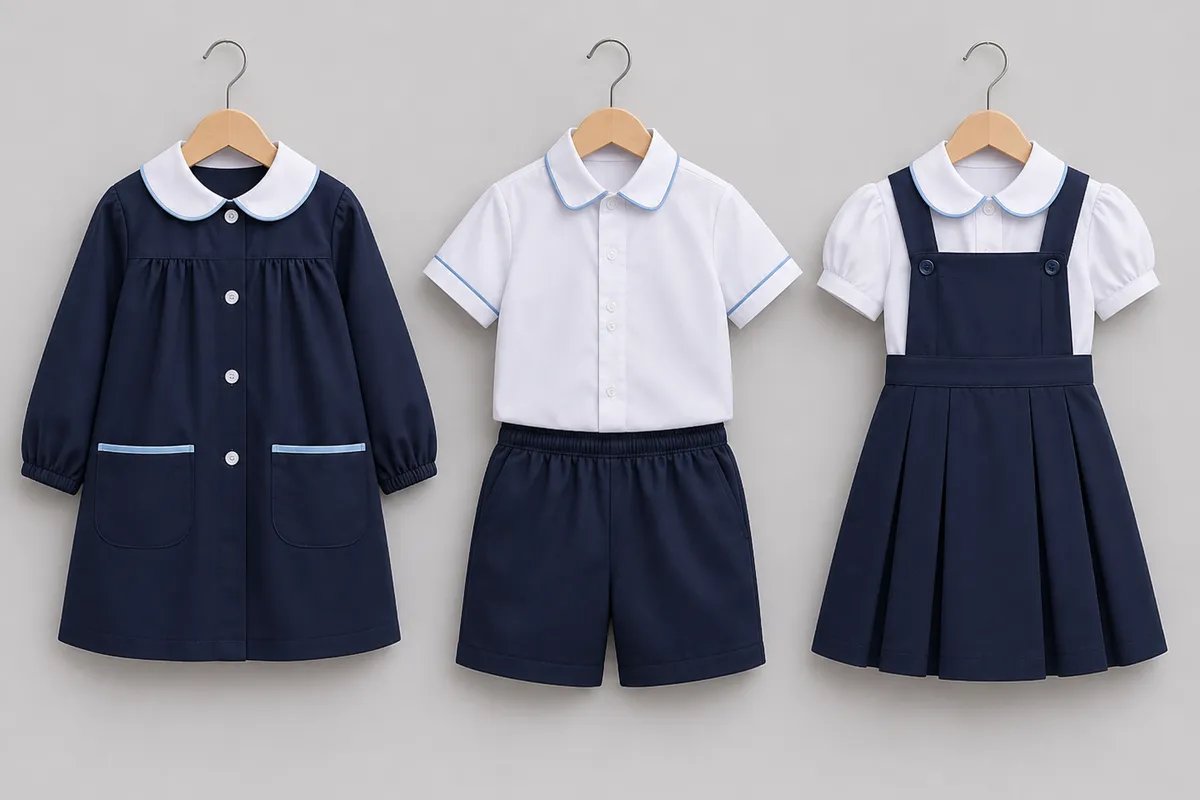
A poly-cotton kindergarten uniform is made from a woven fabric that blends polyester and cotton fibres in one yarn or cloth. Buyers choose it for daily nursery wear because, in general, a blend dries faster after washing, creases less and needs less ironing than pure cotton, while still having some of cotton’s familiar feel. The exact blend and finish are confirmed at quotation and seen on the sample, so the buyer can judge the fabric in their own hands.
What “poly-cotton” means
Polyester is a synthetic fibre; cotton is a natural plant fibre. In a poly-cotton fabric the two are spun or woven together. The proportion of each varies from fabric to fabric, and that proportion affects how the cloth looks and behaves. A blend with more cotton feels closer to cotton; a blend with more polyester tends to be smoother and quicker to dry.
Poly-cotton is one of the two fabrics we list for every nursery style: smocks, shirt-and-shorts sets and pinafore sets.
How the blend behaves in daily nursery use
| Situation | General behaviour of poly-cotton | What it means for a kindergarten |
|---|---|---|
| After washing | Tends to dry relatively quickly | Garments washed in the evening are often ready next morning |
| Creasing | Tends to crease less than pure cotton | Looks tidier after a day of play |
| Ironing | Often needs little or a light press | Less work for families and for shops pressing stock |
| Colour | Holds dyed colour well with normal care | Steady look between washes; follow the care label |
| Feel | Smoother, sometimes slightly crisper than cotton | Judge on the sample |
These are general characteristics of the fibre mix, not ratings or promises for a particular garment. How a garment performs also depends on construction, washing and drying habits.
Things to look at on the sample
The sample is made in the fabric you order. When it arrives, take time to judge the cloth itself, not just the garment:
- Feel the fabric on the inside, where it touches the child
- Hold it up to the light: is it dense enough for the colour and garment?
- Crumple a corner in your hand, release it, and see how it recovers
- Compare the colour with your reference in daylight
- If you can, wash the sample once following the care label and look again
Poly-cotton across the set
If a kindergarten uses two or three garments, keeping them all in poly-cotton helps the colours sit together, because the same blend takes dye in a similar way. Mixing a poly-cotton shirt with cotton shorts is possible, but the colours are then matched separately and may look slightly different side by side.
Shops that stock nursery sets alongside a primary range often choose poly-cotton for both so the shelf looks consistent. The fabric options for every garment we make are listed on our fabrics and colour matching page.
Questions to settle about fabric before quotation
- Poly-cotton for every piece, or cotton for some?
- Will garments be washed at home, at the nursery, or both?
- How much ironing do you expect families or staff to do?
- Is the uniform worn all year, or mainly in warm months?
- Does the nursery feed into a school that already uses poly-cotton?
The answers help us suggest a suitable fabric when we quote. The final choice is confirmed in the quotation and on the sample.
We manufacture poly-cotton nursery garments in India, quoted per style by fabric, quantity and branding. The styles are on our nursery and kindergarten uniforms page. Tell us how the uniform will be worn and washed, and we will quote poly-cotton for your set.
Questions buyers ask
Is poly-cotton suitable for hot weather?
Many schools in warm climates use poly-cotton, often in a lighter weight. Pure cotton is the other option where buyers want a natural fibre. If heat is a key concern, tell us the climate at enquiry and we will discuss both fabrics in the quotation.
Can we see the poly-cotton before ordering?
Yes. The sample is made in the fabric you order, so you handle the actual cloth before bulk production begins. If the feel is not what you expected, say so at sample stage.
Does poly-cotton take embroidered logos well?
Poly-cotton is a common base for embroidered and printed school logos. The method, size and position of the logo are confirmed on the sample, so you see how it sits on the fabric.