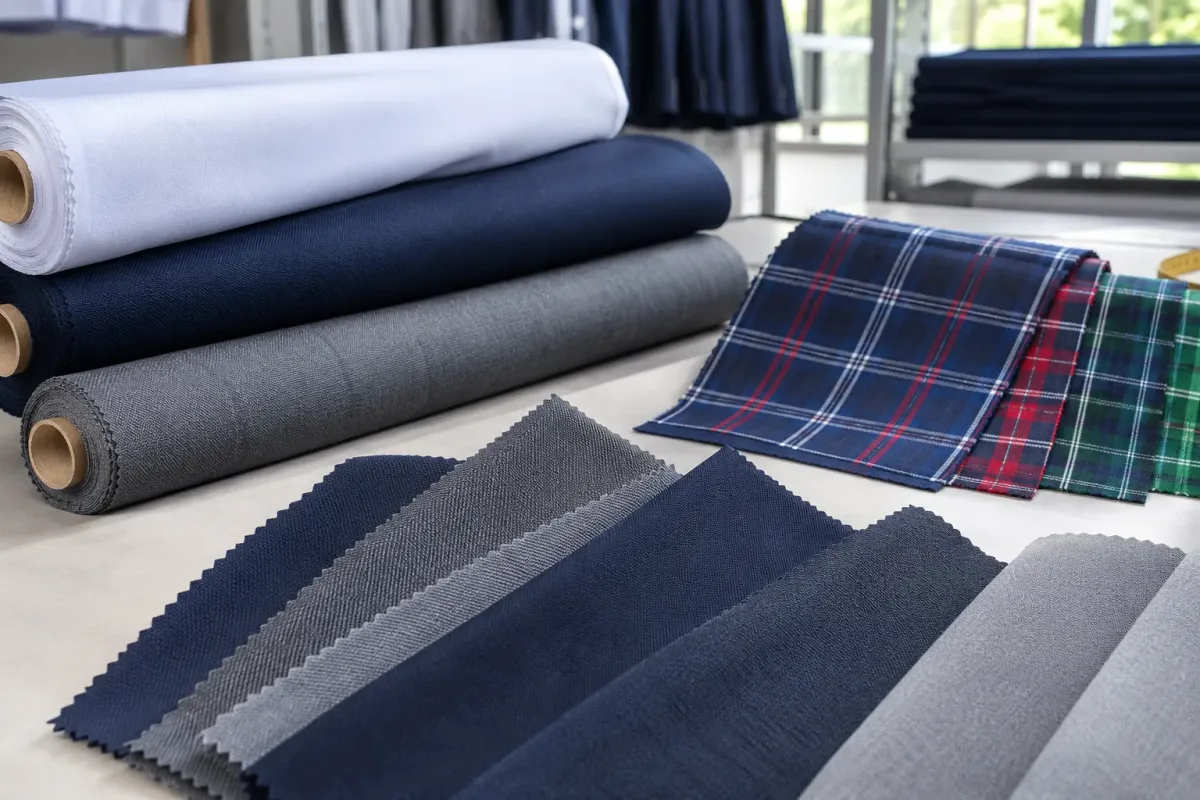
A polo shirt lab dip is a small swatch of fabric dyed to match your colour reference before bulk dyeing begins. For a school polo, it lets you approve the body shade, and the collar trim shade, on the actual fabric rather than on a screen. Approving it carefully is the surest way to get polos that match the rest of the uniform.
Not every order needs a separate lab dip stage; often the colour is approved on the sample. This post explains how to judge the shade either way.
What is a lab dip?
“Lab dip” is a textile term for a test dyeing. A small piece of the chosen fabric is dyed in a laboratory setting, using a recipe intended to match your reference. The swatch is then compared with the reference under controlled light.
For polos, there are usually two pieces to approve:
- Body swatch, in the piqué of your order
- Trim swatch, in the rib used for the collar and cuffs
Because piqué and rib are knitted differently, each takes dye in its own way. They are matched separately and then judged together.
How do you judge a lab dip against your reference?
Judging colour is easier with a method. These steps help:
- Use the physical reference. Lay the swatch next to the garment, fabric or colour card you sent, not a photograph.
- Check in daylight. Stand near a window, away from direct sun.
- Check under indoor light. Shops and classrooms use artificial light, so look again under it.
- Look from a distance. Step back; slight differences that look large close up may disappear at a normal viewing distance.
- Compare body and trim together. On a contrast polo, see whether the two shades sit well side by side.
- Describe what you see. If it is not right, say how: “slightly too green”, “a touch lighter”, “needs more red”.
| Feedback that helps | Feedback that is hard to act on |
|---|---|
| “A little darker, closer to the sweatshirt” | “Not quite right” |
| “Too much blue; the reference is warmer” | “Wrong colour” |
| “Trim matches; body slightly light” | “Both off” |
| “Approve body, adjust trim” | No comment, just a rejection |
Why does a lab dip sometimes differ from the bulk?
A lab dip is a close guide, not an exact copy of every bulk roll. Small variations can come from the dye batch, the fabric lot and the finishing. A sensible approach:
- Approve the shade you want, not a shade that is “near enough” to save time
- Keep one approved swatch as your reference
- Ask for the bulk to be checked against that swatch
- For reorders, refer to the approved swatch or approved sample, not to worn stock
Your physical reference matters more than any colour name. “Royal blue” or “bottle green” covers a range of shades, so a garment or swatch removes the guesswork. Our page on fabrics and colour matching explains how we match an existing uniform and send the colour for approval.
Lab dip or sample approval?
For a polo in white or a standard navy, matching on the sample is usually enough. A separate lab dip stage is most useful when:
- The colour is unusual or very specific to the school
- The polo must match a sweatshirt or jumper closely
- There are two or three colours to match on a contrast or tipped polo
- A previous supplier’s polos varied in colour from order to order
Whichever route is used, you approve the colour before bulk production starts. The process runs enquiry, quotation, sample, advance payment, production, quality check and dispatch.
The polo styles and colours we make are shown on our school polo shirts page. If your school colour is hard to match, send the reference garment early with your enquiry, so colour approval does not hold up the order.
Questions buyers ask
How many colours can be approved on one polo?
A polo body, a collar trim and a tipping stripe can each be matched and approved. Each colour is checked on the correct fabric, piqué for the body and rib for trims, and the full set is seen together on the sample.
Can we approve a lab dip from a photo?
It is not recommended. Screens, cameras and lighting all change how colour looks, so a photo can lead to an approval that disappoints in person. Ask for the physical swatch or the sample and judge it beside your reference.
Why does white need approval too?
Whites vary. Some look bright and slightly blue, others softer and creamier. A white polo next to a white shirt from another source can look mismatched, so approving the white shade on the sample is worthwhile.