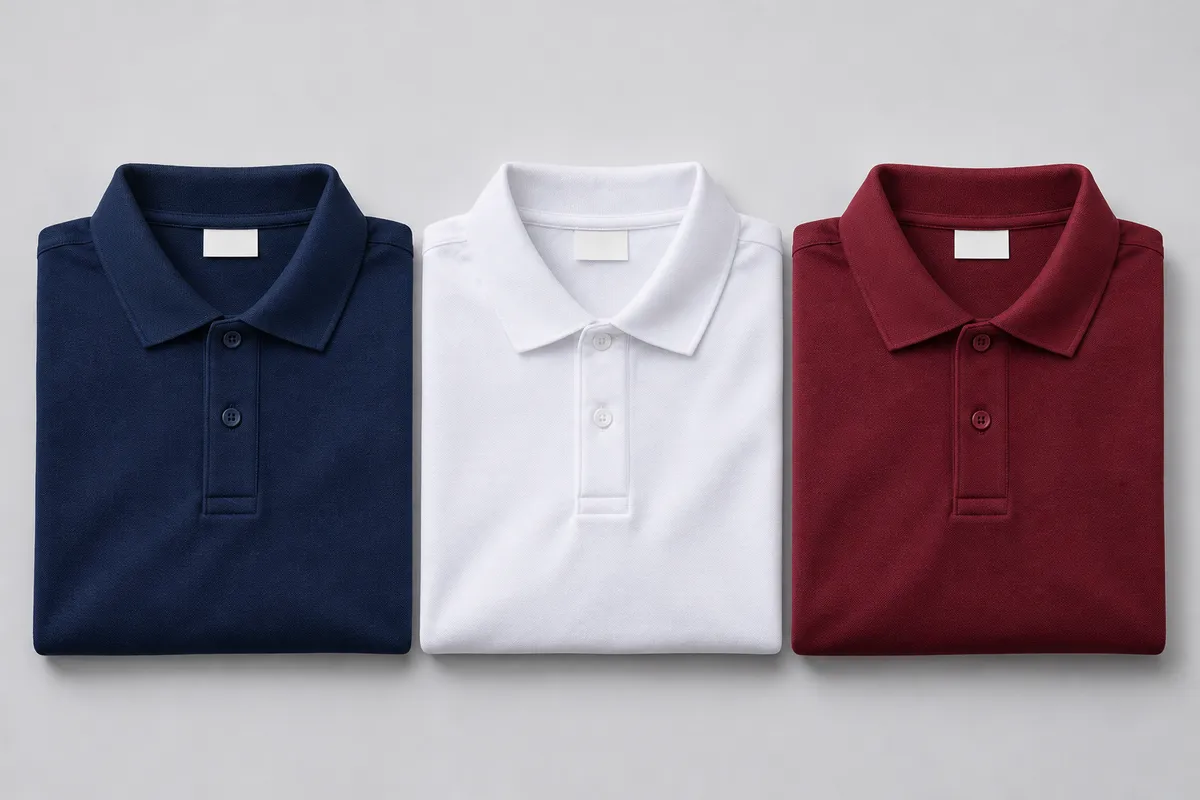
The standard polo shirt logo placement for schools is the left chest, as worn, centred roughly over the heart, with the top of the logo a little below the base of the collar and level with or just below the bottom of the placket. That position is visible above a desk and under an open cardigan, and it stays clear of the placket and the armhole seam.
The exact position is confirmed on the sample. This post explains how it is set, and how it changes from the smallest to the largest polo.
Where exactly does a left chest logo go?
“Left chest” sounds precise, but a few measurements decide where the badge really sits:
| Measurement | What it controls | Common approach |
|---|---|---|
| Down from the shoulder seam | Height of the logo | Set so the logo sits on the chest, not near the collar |
| In from the centre front | Distance from the placket | Enough space that the placket does not crowd the logo |
| Logo width | How much of the chest it covers | In proportion to the polo size |
| Alignment | Level or tilted | Level with the hem, square to the body |
On a polo, the placket is the reference point. A logo too close to it looks squeezed; too far towards the armhole and it disappears under the arm. Most buyers aim for the logo centre to sit roughly halfway between the placket edge and the side of the chest.
How does placement change across sizes?
A polo for a small child is much narrower and shorter than a senior polo. If the logo is placed by the same measurements on every size, it ends up too low on small sizes and too high on large ones.
There are two usual ways to handle this:
- Graded position. The logo position moves with the size, so it looks in the same place on every child.
- Size bands. Two or three logo positions, one for small, middle and large sizes.
The logo size may also step down on the smallest sizes, so it does not cover too much of the chest. If you want the logo the same size on every polo, say so in your specification.
Are other positions used on school polos?
The left chest is by far the most common, but some schools add or choose other positions:
- Right chest for a second logo, such as a trust or house badge
- Sleeve for a small secondary mark
- Back neck for a small school name, below the collar
- Centre chest on some sports polos
Each extra position adds work and may affect the quotation. Any of them can be embroidered or printed, and we agree every position on the sample before production.
How to specify the position
Make the position clear in writing, with a reference where possible:
- Send a polo with the logo already placed as you like it
- Or give distances: down from the shoulder seam and in from the centre front
- State whether the logo size and position change by size band
- Note any second logo and its position
- Ask to see the smallest and largest sizes on the sample, not only a middle size
Shops stocking logo polos for several schools often keep the same position for every school, which makes the range look consistent on the shelf. Our notes for uniform shops and retailers cover ordering for several schools.
The page on logos, embroidery and labels explains how to send artwork. You can see the polo styles on our school polo shirts page.
Send your logo artwork and a reference polo, and we will confirm placement on the sample as part of your quotation.
Questions buyers ask
Is left chest measured as worn or as laid flat?
Left chest means the wearer’s left, so as you face a polo laid flat, the logo appears on the right-hand side. Stating “left chest as worn” in your specification avoids any confusion about which side is meant.
Should the logo line up with a particular button?
Some buyers align the top of the logo with the second button of the placket, which gives a tidy look. It is a useful guide rather than a fixed rule, and the final position is set on the sample across sizes.
Can the logo position change on a long-sleeve polo?
It normally stays the same as on the short-sleeve polo, so the two look alike. Keeping one position across both sleeve lengths also makes the sample check simpler, as you compare like with like.