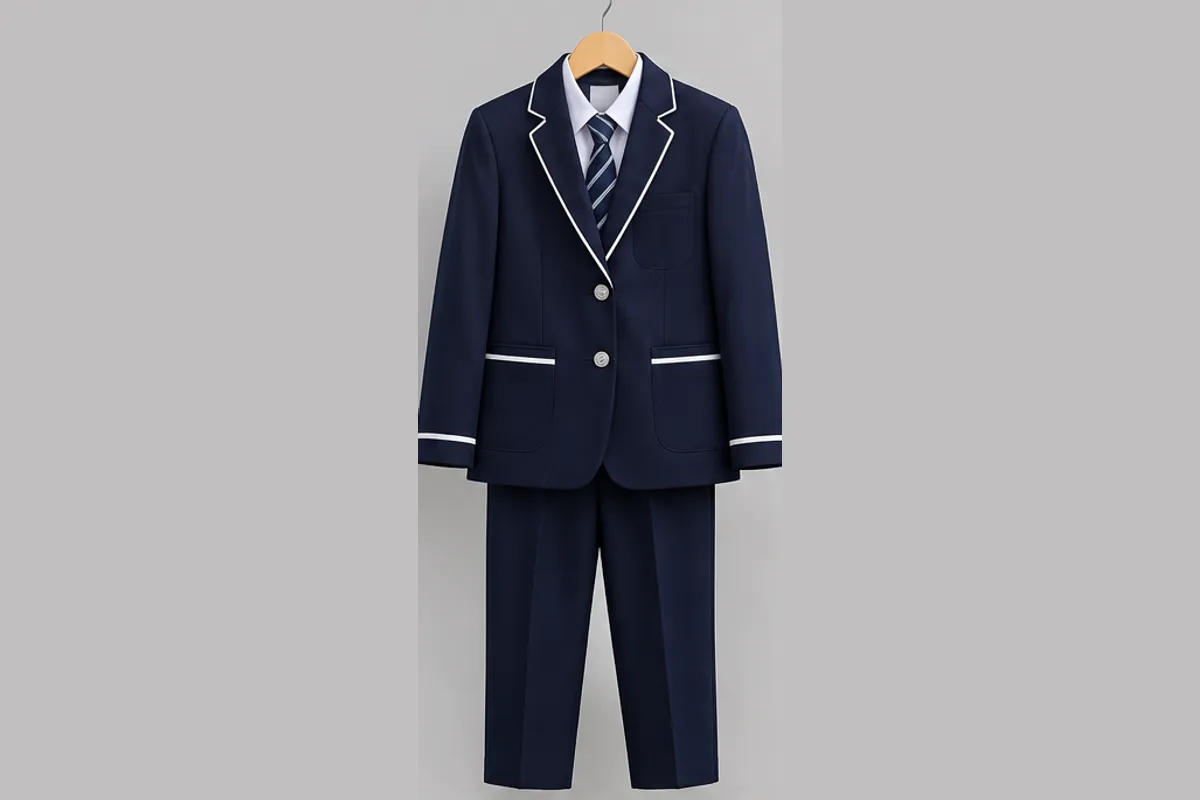
A piped school blazer has a narrow, rounded edging, called piping, set into the seam along the lapels, front edges, cuffs or pocket. Piping gives a fine line of colour that sits flush with the edge, while braid is a flat tape sewn on top. Schools choose piping when they want a quieter, sharper outline than braid, or when the blazer cloth and trim colours are close.
The two are often confused in enquiries, so it helps to define them before going further. The difference changes how the blazer is made and how the trim wears.
Piping and braid defined
Piping is a strip of fabric folded over a fine cord, then stitched into a seam so only a thin rounded bead shows at the edge. Because it sits inside the seam, it has to go in while the blazer is being assembled.
Braid is a woven tape, flat or slightly ridged, sewn onto the surface of the finished edge. It is wider and more visible, and it can follow almost any edge on the blazer.
| Point of comparison | Piping | Braid |
|---|---|---|
| How it looks | A thin raised line | A flat band of colour |
| Where it sits | In the seam, flush with the edge | On top of the edge |
| Visibility at distance | Subtle | Strong |
| Colours | Usually one | One or two woven together |
| When it is added | During assembly | Usually after the edge is finished |
| Suits | Formal, understated uniforms | Traditional, bold uniforms |
Where does piping work on a blazer?
Piping needs a seam to sit in. That makes it a natural fit for:
- the outer edge of the lapels and collar, where the facing meets the front
- the front edges down to the hem
- the top of the breast pocket or the edge of pocket flaps
- the cuff, as a line round the sleeve end
It is less suited to places with no seam, such as the middle of a sleeve, where braid or a separate trim would be used. Piping round a tight curve, such as the lower front corners, needs to be eased in carefully. Look closely at those corners when the sample arrives.
Is piping a good choice for a junior blazer?
Piping keeps its proportions well in small sizes, because a fine line does not overwhelm a short lapel the way wide braid can. That is one reason some schools pipe the junior blazer and braid the senior one. Others use piping throughout and keep braid for a senior or ceremonial style ordered separately.
The practical point for younger years is wear. Piping on a cuff takes knocks at a desk, and the cord inside can show through if the outer fabric wears thin. Choosing a piping fabric close in weight to the blazer cloth helps it age at the same rate.
Specifying piped trim
Write out the piping on your specification in the same way you would for braid:
- positions, listed edge by edge
- colour, with a reference or swatch
- whether all positions use the same colour
- the cuff detail, if any, as a full line or a short section
- whether the badge pocket is piped, plain or braided
Colour is matched to your reference and approved with the cloth on the sample garment. Since the piping goes in during assembly, changing it after bulk cutting is not practical, so the sample stage is the time to adjust.
Uniform suppliers who look after several schools sometimes use one blazer pattern and vary only the piping colour, which makes the same blazer distinctive for each school. Our page for schoolwear suppliers and distributors covers how a shared pattern is ordered by style.
To get a quotation, send your piping positions and colours with your size list. We will price the piped style on our school blazers range by fabric, quantity and branding, and show the trim on a sample for approval.
Questions buyers ask
Can a blazer have piping and braid together?
Yes. A common pairing is piping on the front edges with braid on the cuffs or pocket. Too many trims can look busy, so it is worth seeing both on the sample before deciding on the final layout.
Does piping fade faster than the blazer cloth?
It depends on the materials chosen. Matching piping that suits the same care as the cloth keeps fading similar. Bright colours on a dark blazer will show any change sooner, simply because the contrast draws the eye.
Can existing plain blazers be piped later?
Not easily. Piping sits inside the seams, so it cannot be added to finished blazers without taking them apart. A piped blazer is ordered as a new style, made with the piping from the start.