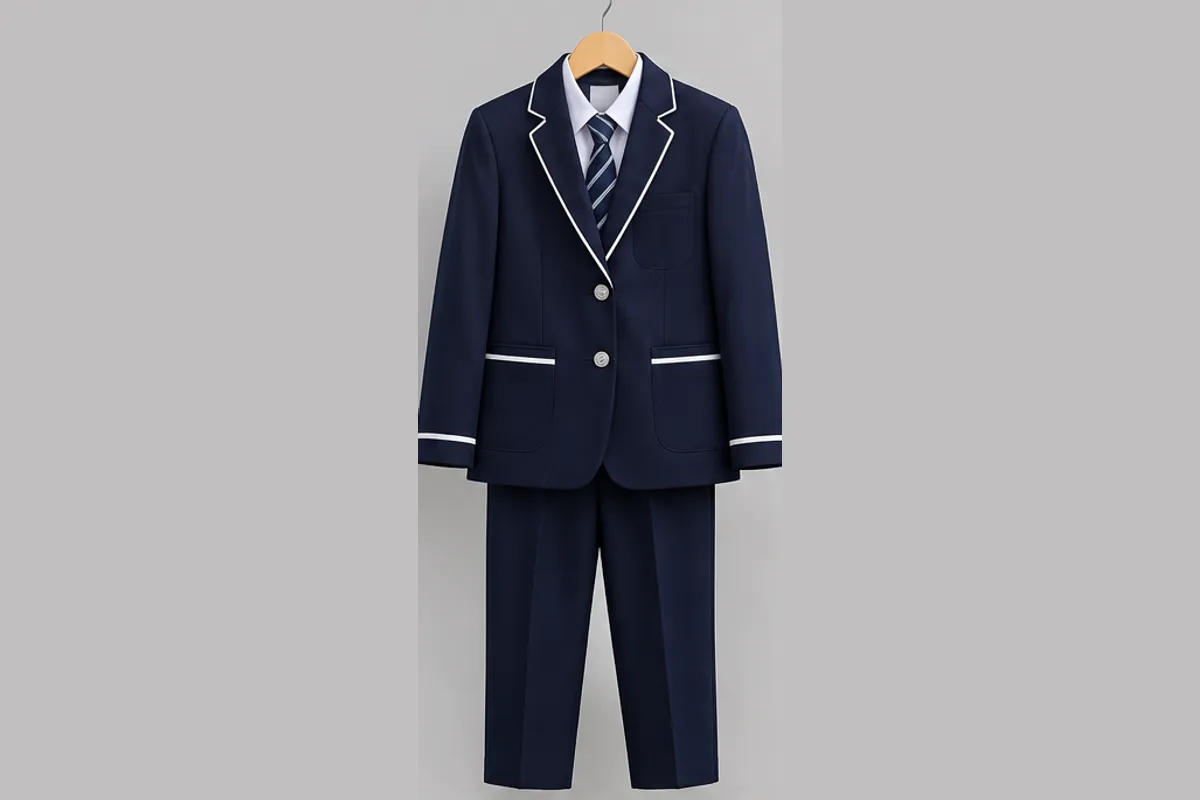
Choose polyester if you want a firm, hard-wearing blazer that keeps its shape and colour with frequent washing. Choose poly-viscose if you want a softer handle and a more matte, tailored look that sits closer to a traditional wool blazer. Both are good choices for school wear; the right one depends on how the blazer is worn, how it is cleaned, and what your current blazer looks like.
This guide explains the difference in plain terms, then covers the parts of a blazer that matter as much as the outer cloth: the lining, the interlining and the braid.
How the two cloths differ
Polyester blazer cloth is made entirely from polyester yarn. It tends to feel firmer and crisper, it resists creasing, and it holds a strong colour well. It is a practical choice for younger students, for schools where blazers are worn every day in all weathers, and for families who wash rather than dry clean.
Poly-viscose blends polyester with viscose. The viscose softens the handle and gives the cloth a duller, more natural surface, so the blazer drapes rather than standing away from the body. Some schools choose it for senior students or for a more formal look. It can show creases a little more readily, and it benefits from careful pressing.
Neither cloth is a single fixed product. Weight, weave and finish vary, so the cloth for your order is confirmed at quotation and on the sample. If you send your current blazer, we match the closest cloth we can and you judge it side by side.
| Point to compare | Polyester | Poly-viscose |
|---|---|---|
| Handle | Firmer, crisper | Softer, more fluid |
| Surface | Can have a slight sheen | More matte |
| Drape | Holds its own shape | Follows the body more |
| Creasing | Resists creases well | Creases a little more readily |
| Look | Practical, everyday | Tailored, more formal |
| Suits | Younger students, daily hard wear | Senior students, formal uniform lists |
| On the sample, check | Colour depth, stiffness at the lapel | Drape, pressing, colour under daylight |
Use this table as a starting point for a conversation with your school or your customers, not as a promise about how a particular cloth will perform. The sample is where you decide.
Lining and interlining
A blazer can be lined or half-lined, as specified. A full lining makes the blazer easier to put on over a jumper and hides the inside seams. A half lining is lighter and cooler, which some schools in warm climates prefer. Tell us which you want and the lining colour, and we show it on the sample.
Inside the front panels and the collar there is usually an interlining, a lighter fabric that gives the blazer its shape. It is what keeps the lapel rolling neatly and stops the front from collapsing after a few weeks of wear. You will not see it, but you will feel it on the sample. Check that the front is firm but not stiff, and that the lapel lies flat when the blazer is buttoned.
The outer cloth and the interlining need to work together. A soft poly-viscose with a heavy interlining can feel boardy; a firm polyester with a light interlining can look limp at the collar. This balance is agreed on the sample before bulk production.
Braid, buttons and colour matching
If your blazer has braided trim, the braid has to suit the cloth as well as the colour. A firm braid on a soft poly-viscose can pucker along the edges; a fine braid on a heavy polyester can look thin. We match braid colours separately from the cloth and show you cloth, lining and braid together on the sample.
Colour matching needs particular care on a blazer order. Navy, bottle green and maroon all have many shades, and the same dye can look different on polyester and on poly-viscose. View the sample in daylight next to your current blazer, not under shop lighting. Our page on fabrics and colour matching explains how we match a colour from a garment or a swatch.
What to check before you approve
Run through this checklist with the sample in your hands:
- The cloth colour matches your reference in daylight
- The handle suits the age group who will wear it
- The lining colour and coverage are as specified
- The lapel rolls cleanly and the front holds its shape
- Braid lies flat along every edge without puckering
- The badge sits flat on the pocket and is the right size
- Buttons are secure and the right colour
- The care label suits how families will clean the blazer
Once you approve the sample, every repeat order is made to it, so blazers bought in different years use the same cloth and match. If you change cloth later, for example moving from polyester to poly-viscose for a new senior blazer, treat it as a new style with its own sample. You can see the styles we make on our school blazers page.
Tell us which cloth you are considering and send a current blazer or swatch, and we will quote it per style, by fabric, quantity and branding.
Questions buyers ask
Can a poly-viscose blazer be washed at home?
That depends on the cloth and the care label you agree. Ask us to confirm care for your chosen cloth at quotation, then wash or clean the sample once the way families will, and check the shape and lapel afterwards.
Does the cloth affect how the badge looks?
It can. Firm polyester supports dense embroidery with little movement, while softer poly-viscose may need a firmer backing behind the badge to stop puckering. Judge the badge on the sample in the cloth you have chosen.
Can boys’ and girls’ blazers use different cloths?
They can, but the two would look different side by side in a class photo. Keeping one cloth and shade for both cuts avoids that, and approving both samples together confirms they match.