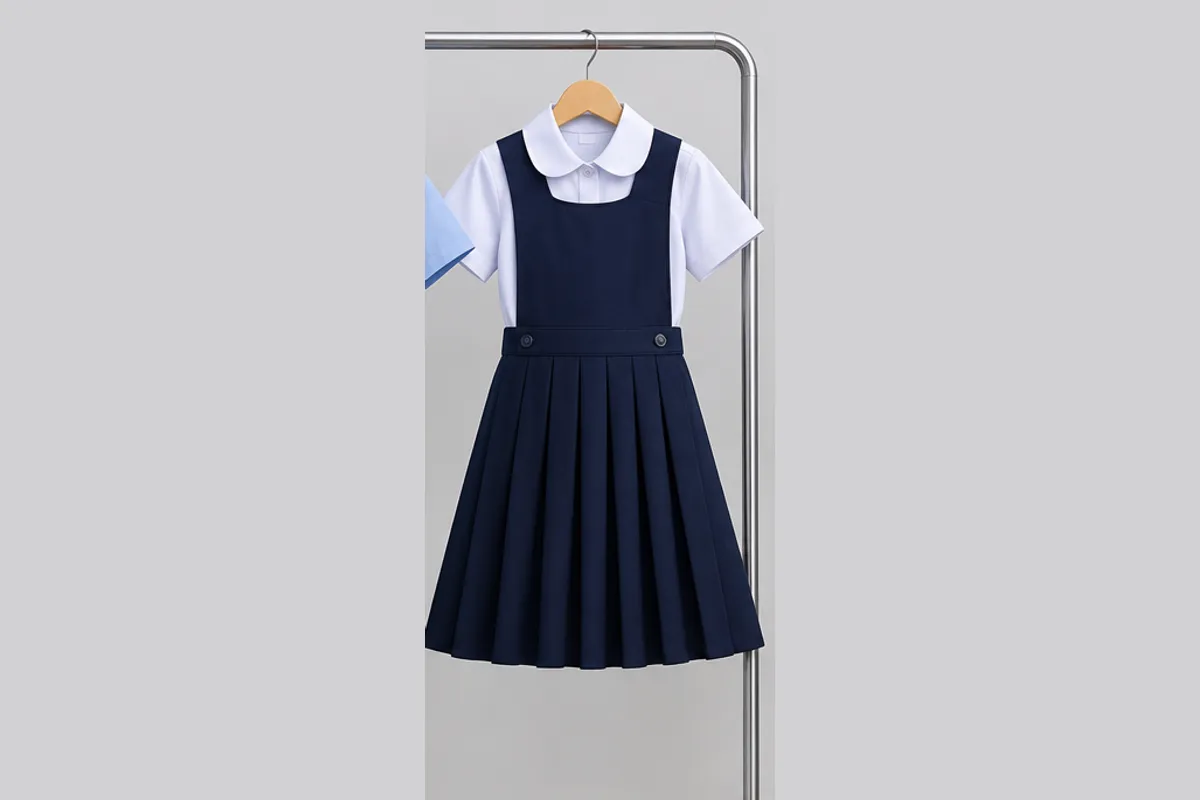
A school pinafore size ratio depends first on which years wear the garment. An infant school that only takes children up to about seven needs a short, steep ratio packed into the smallest bands, while an all-through primary where girls keep the pinafore to the top year needs a longer, flatter spread.
The ratios below are starting examples. Adjust them against your own sales records or the school roll before ordering.
Why one ratio does not fit every school
A size ratio is the share of an order given to each size, written as parts rather than pieces. It lets a buyer scale the same shape to 60, 150 or 600 garments. The trouble is that a ratio borrowed from another school carries that school’s age profile with it.
Three things move a pinafore ratio more than anything else:
- The age span of the wearers. If the list switches girls to a skirt or tunic at eight, the upper bands barely exist.
- The size of each year group. A school with two reception classes and one class higher up has a bottom-heavy roll.
- How generously families buy. Parents of younger children often size up for growth, pulling demand one band higher than the age suggests.
Two starting ratios side by side
Each ratio is written in parts of 20. To build an order, divide your total by 20 and multiply each part by the result, then round to whole pieces.
| Age band | Infant-only school (parts of 20) | All-through primary (parts of 20) |
|---|---|---|
| 3–4 | 4 | 2 |
| 4–5 | 5 | 3 |
| 5–6 | 5 | 3 |
| 6–7 | 4 | 3 |
| 7–8 | 2 | 3 |
| 8–9 | 0 | 2 |
| 9–10 | 0 | 2 |
| 10–11 | 0 | 1 |
| 11–12 | 0 | 1 |
The infant column is concentrated: four bands carry almost everything, and 7–8 is there for tall children and for families sizing up. The all-through column is nearly flat across the first five bands, then thins gently, because girls still need pinafores in the later years even if fewer of them choose it over a skirt.
Scaling a ratio: a worked example
Take an all-through primary ordering 120 pinafores of one style. Divide 120 by 20 to get 6. Multiply each part by 6: 12 pieces of 3–4, 18 each of 4–5, 5–6, 6–7 and 7–8, 12 each of 8–9 and 9–10, and 6 each of 10–11 and 11–12. That totals 120.
For a small order, rounding can leave the top bands with only one or two pieces. That is fine for a first season. Our minimum is 50 pieces per style, and sizes can be mixed freely inside that.
Checking a ratio against real numbers
A ratio is only a start. Before committing, test it against something the school or shop already knows.
- Compare the ratio with the number of girls in each year group, if the school can share it.
- Look at last year’s sales or issue records by size, if you have them for any girls’ garment.
- Ask the school when, if ever, girls move from the pinafore to a skirt or tunic.
- Check whether younger children are commonly bought one size up.
- Hold back a share of the budget for a top-up rather than forecasting every band in full.
If last year’s records show a band selling out early, move one or two parts into it from the slowest band. Small moves over two seasons make a better ratio than large guesses in the first.
Using a ratio with more than one colour
Shops supplying several schools often run the same pinafore pattern in grey, navy and bottle green. Each school’s colour can follow its own ratio. An infant school in maroon and an all-through primary in navy should not share one shape just because the garment is the same. When the colours are quoted together, the colour split is confirmed at quotation.
The size chart behind each band is agreed with you before the sample is cut. Our size charts page explains how that works.
Building your order
Tell us which schools the pinafores are for, the ratio you plan to use and the total per colour. We manufacture in India and quote each style from our school pinafores and tunics range by fabric, quantity and branding.
Questions buyers ask
What is a pinafore size ratio written in parts?
It is the share of each size expressed as small whole numbers, such as 4:5:5:4:2, rather than as pieces. The same parts can be scaled to any total, which makes it easy to compare a first order with a later, larger one.
Should a tunic follow the same ratio as a pinafore?
Usually not. Tunics are often worn by older girls, so their ratio sits further up the age range and the smallest bands carry little. Treat a tunic as its own style with its own ratio and its own minimum.
How often should a ratio be revised?
Review it after each main selling season. Once a shop has a full year of sales by size, the ratio should come from those figures rather than from any starting example.