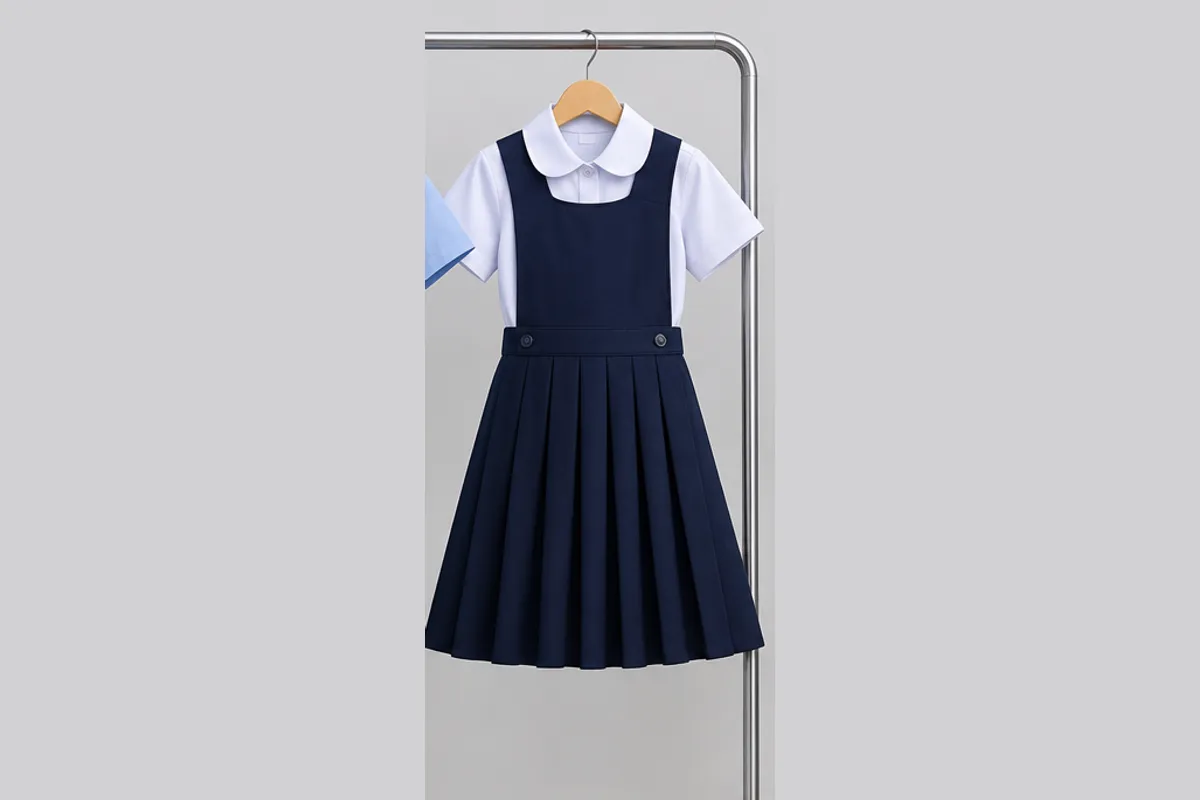
Pinafore pleats are set by three numbers: how many pleats go round the skirt, how deep each fold is, and how far down from the waist seam they are stitched closed. Together these decide how full the skirt looks, how much fabric the garment uses and how easily families can keep it sharp. Agree all three on the sample rather than describing the pleat type alone.
The pleat type, knife, box or inverted, is the starting point. This post is about the numbers that follow once the type is chosen.
Pleat count
More pleats give a finer, more even look. Fewer, wider pleats look bolder and are easier to press.
| Pleat count (for one size) | Appearance | Pressing at home | Fabric use |
|---|---|---|---|
| Many narrow pleats | Fine, traditional, even all round | More folds to press | Highest |
| A moderate number | Balanced, the usual school look | Manageable | Medium to high |
| A few wide pleats | Bold, modern, roomy | Quick | Lower |
| Front pleats only | Pleated front, plain back | Least | Lowest |
Because the skirt grows wider with each size, the pleat count is often kept the same while the pleat width grows. Alternatively, pleats are kept the same width and extra ones are added on larger sizes. Either way, the decision is written into the pattern for each size.
Pleat depth
Depth is how much fabric is folded under each pleat. A deep pleat hides more fabric and gives more swing when the child walks or sits cross-legged. A shallow pleat uses less fabric but can open out and look flat after a few washes.
For young children who sit on the floor, a generous depth stops the skirt riding up. For older girls in a tunic, a deeper pleat keeps the line straight as they move.
How far to stitch them down
Stitching a pleat closed from the waist seam for a short way holds the skirt flat over the hips and tummy, then lets it open below.
- Not stitched: the pleat opens right from the waist. Fullest look, but it can spread outward on a rounder tummy.
- Stitched a short way: the most common choice. Neat at the top, free movement below.
- Stitched further down: a slim line, almost like a straight skirt at the top. Less movement.
- Edge-stitched along the fold to the hem: each fold is stitched close to the edge all the way down. It holds a crease well through many washes, but it is more work and shows on the outside.
Pleats and fabric
Both fabrics we use for pinafores take a pleat. Polyester twill tends to hold a pressed fold crisply. Poly-viscose has a softer drape, and its pleats fall with a little more movement. Fabric options for each garment are set out on our fabrics and colour matching page; the fabric for your pinafore is confirmed at quotation.
The pleats are pressed in during production. How long they stay sharp at home depends on washing and pressing, so a short care note from the shop helps.
Questions to answer in your specification
- Pleat type
- Number of pleats, or “follow the garment we send”
- Pleat depth, or “as our current garment”
- Stitch-down length from the waist
- Whether the folds are edge-stitched
- Whether the pleats should match the school skirt
We manufacture in India and set the pleats on the sample exactly as specified, so you can count and measure before approving. All pleated styles are on our school pinafores and tunics page, and each style starts at 50 pieces. Send your pleat details with your colours and sizes for a quotation per style, by fabric, quantity and branding.
Questions buyers ask
Why do pleats drop out of some pinafores?
Shallow pleats with no stitch-down open easily, and hot tumble drying or careless pressing can flatten folds. A sensible depth, some stitch-down at the top and a clear care note all help pleats last.
Should the pinafore and school skirt have the same number of pleats?
It is not essential, since the garments are different widths, but the same pleat type and similar width look consistent across year groups. Send the skirt and we reflect its pleating on the pinafore.
Can pleats be added only at the front?
Yes. Front pleats with a plain back panel are lighter, simpler to press and use less fabric. They suit pinafores worn under a cardigan, where the back is mostly hidden anyway.